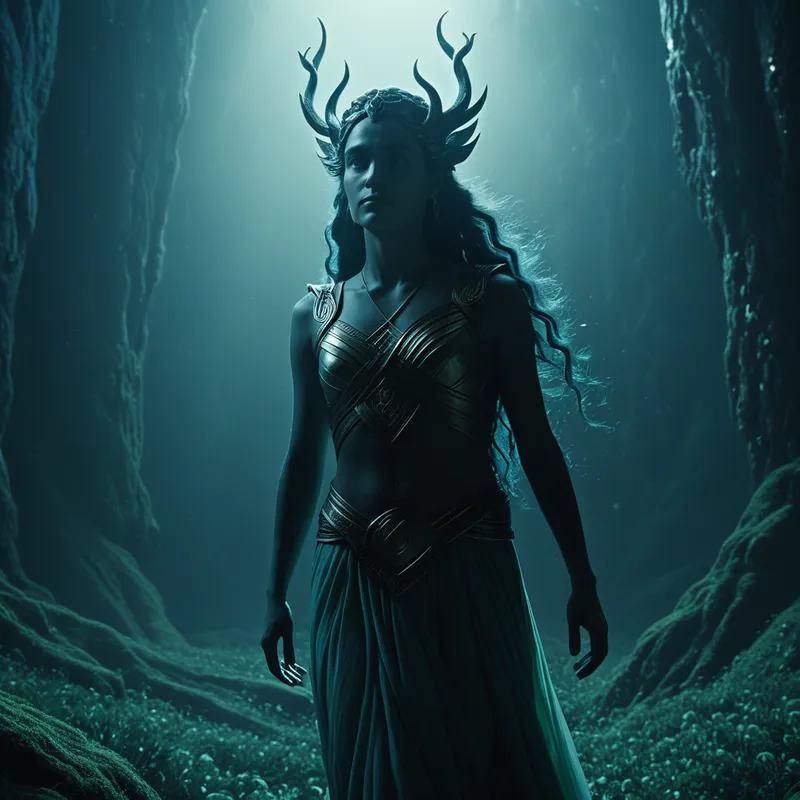
Jimmu First Emperor of Japan
The legendary first emperor of Japan, descended from the sun goddess Amaterasu, whose mythic journey established the imperial line and the nation's divine origins.
The Tale of Jimmu First Emperor of Japan
The tale begins not with a man, but with a divine imperative, a celestial directive carried on the wind of destiny. Jimmu, born Kamu-yamato Iware-biko no Mikoto, was a prince of the heavenly lineage, a great-grandson of the sun goddess Amaterasu. He dwelt in the land of Takachiho in Hyūga, a place bathed in southern sun, yet his spirit was restless. He perceived that his realm, though blessed, was not the true center, not the land destined for the rule of his luminous lineage. “Eastward,” the whispers of the gods seemed to say, “lies the land where the sun’s rays first touch, a fertile land encircled by blue mountains. Go and subdue it, and establish a kingdom that will endure as long as heaven and earth.”
Thus began the Yamato Iware Hiko no Mikoto's Eastern Expedition. With his elder brother, Itsuse no Mikoto, and a host of loyal kin and warriors, Jimmu set sail, his vessels cutting through the waves of the Inland Sea. Their journey was an epic of divine trial and mortal struggle. At every turn, they encountered local chieftains, the kunitsukami or earth-gods, who resisted the arrival of this new celestial order. In a battle at Kusaka, Itsuse was struck by a poisoned arrow and fell. With his dying breath, he counseled Jimmu: “We have fought facing the sun, against its light. We must reverse our path, circle the land, and strike from the west, with the sun at our backs.” This was the first great lesson: to conquer the land, one must first align with its divine rhythm.
Heeding this wisdom, Jimmu led his people on a circuitous voyage around the Kii Peninsula. Exhausted and beset by storms, they finally made landfall at Kumano. Here, the way forward was barred by a dense, forbidding mountain forest, a labyrinth of earthly resistance. As the company faltered, a figure descended from the Takamagahara, the Plain of High Heaven. It was Yatagarasu, the Three-Legged Crow, a sacred messenger of Amaterasu. Glowing like a beacon, the great bird flew before them, its three legs symbolizing heaven, earth, and humanity in harmony. It guided Jimmu’s weary band through the treacherous passes, a living emblem of divine favor lighting the path through chaos.
Emerging from the mountains into the sun-drenched Yamato basin, Jimmu faced his final and most potent adversary: Nagasunehiko, the “Long-Legged Man,” a powerful local ruler. In the ensuing conflict, the heavens themselves intervened. As Jimmu prepared for a decisive battle, a golden kaburaya (whistling arrow) fell from a clear sky, landing before Nagasunehiko’s forces. Seized with a divine terror, the enemy host was thrown into confusion and easily routed. The land, its earthly spirits now pacified and integrated, lay open.
On the first day of the first month, by the River Mimi, Jimmu ascended to the throne. He established his palace at Kashihara and proclaimed the founding principles of his reign: to “govern the universe” and to “harmonize the cosmos.” He did not merely conquer; he married the celestial mandate to the terrestrial realm, becoming the first Tennō, the Heavenly Sovereign, the human axis around which the divine and the mortal worlds would forever turn.
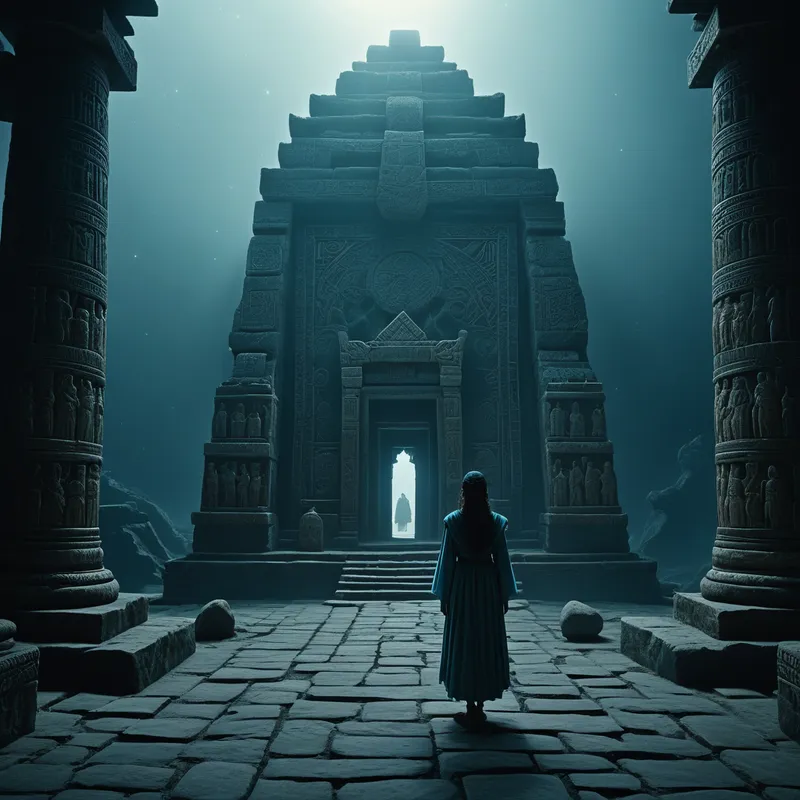
Cultural Origins & Context
The myth of Emperor Jimmu is the cornerstone of the Kojiki (712 CE) and Nihon Shoki (720 CE), texts commissioned by the imperial court to codify a national mythology and legitimize the ruling line. His story is not a folktale but a state-sanctioned foundation narrative, crafted to answer profound questions of origin, authority, and identity. In the context of early Japan’s consolidation of power, Jimmu’s journey from the peripheral south (Hyūga) to the political center (Yamato) mirrors the historical process of state formation, mythologizing the unification of disparate clans under the Yamato sovereignty.
The narrative is deeply embedded in the Shinto worldview, where the natural landscape is alive with kami (spirits). Jimmu’s expedition is as much a spiritual negotiation as a military campaign. The local earth deities (kunitsukami) he subdues are not annihilated but are, through his divine right, incorporated into the new celestial order presided over by Amaterasu’s descendant. This reflects the syncretic, assimilative nature of Shinto and early Japanese polity, where new layers of authority did not erase the old but enshrined them within a larger hierarchy. Jimmu becomes the living bridge between the High Heavenly Plain (Takamagahara) and the Central Land of Reed Plains (Ashihara no Nakatsukuni), his person embodying the sacred contract that grants the Japanese islands and their people a uniquely divine provenance.
Symbolic Architecture
At its core, the myth of Jimmu is a grand allegory for the birth of consciousness and culture from the womb of primal, undifferentiated nature. His journey is the archetypal Hero’s journey, but with a distinct, solar orientation. He moves from the periphery to the center, from a personal, familial identity to a cosmic, kingly one. The death of his brother Itsuse represents the necessary sacrifice of an older, instinctual mode of being (charging headlong, facing the sun) for a more reflective, strategic consciousness (circumnavigating, using the sun as an ally).
The guidance of Yatagarasu, the Three-Legged Crow, is pivotal. It is not a weapon but a guide, a symbol of illuminated intuition that appears when the logical, martial path is blocked. The three legs signify a trinity—perhaps past, present, and future; or heaven, earth, and humanity—coming into balanced movement to lead the nascent self (Jimmu) through the dark forest of confusion and into the clearing of purpose.
The final victory, achieved not by brute force but by a heaven-sent arrow that instills sacred awe (ikazuchi), underscores the myth’s central thesis: legitimate sovereignty is not taken, but received. True leadership is a vessel for a power greater than itself. Jimmu’s ascension is less a coronation and more an assumption of a pre-ordained role as the axis mundi, the human point where divine will manifests in temporal order.
The Dreamer's Resonance
For the individual psyche, the myth of Jimmu resonates as the drama of founding one’s own inner kingdom. It speaks to that moment when we feel a call from a deeper, more authentic self (the solar lineage) to leave the comfortable, familiar “south” of our habits and conditioning, and embark on an arduous expedition toward our true center. The battles along the way are the internal resistances—the “earth-gods” of old wounds, entrenched fears, and limiting beliefs that guard the status quo of the psyche.
The loss of the brother (Itsuse) may mirror the painful but necessary shedding of an old identity or strategy that can no longer serve the journey’s higher goal. The ensuing despair and confusion in the mountain forest is a classic “dark night of the soul,” where the ego’s plans fail utterly. It is precisely here that the Yatagarasu—the symbol of a guiding, transcendent insight from the unconscious—can appear, offering a path not of the ego’s making. To found a stable, harmonious inner realm (the Yamato basin), one must first be guided through the wilderness by this higher wisdom, and then, with its authority, integrate and pacify the warring factions within.

Alchemical Translation
The alchemy of Jimmu’s tale is the transformation of wandering into dwelling, of divine potential into earthly institution. The prima materia is the scattered, divine seed in the peripheral land of Hyūga. Through the ordeal of the journey—the battles (nigredo, blackening), the guidance through darkness, the moments of despair—this seed is purified and tested. The appearance of the golden arrow is the albedo (whitening), a moment of divine illumination that conclusively separates the sovereign principle from the chaotic resistance.
The final act is the rubedo (reddening), the glorious synthesis: the establishment of the palace and the proclamation of the imperial edict. The volatile spirit (the divine mandate) is fixed into a stable, enduring form (the imperial line and the state). Jimmu himself becomes the philosopher’s stone—the perfected entity who transmutes the base metal of raw, contested land into the gold of a “land harmonized by the sun.”
This is not a one-time historical event but an ongoing psychic process. The “Festival of the Founding of the Nation” (Kenkoku Kinen no Hi) can be seen as a collective ritual to re-enact this inner alchemy, to reaffirm the conscious, willed construction of order and identity from the raw materials of existence.
Associated Symbols
Explore related symbols from the CaleaDream lexicon:
- Sun — The celestial source of Jimmu’s lineage and authority, representing divine consciousness, ultimate origin, and the illuminating principle that guides and legitimizes the foundational journey.
- Journey — The epic eastward expedition, symbolizing the transformative passage from a state of potential to one of actualized destiny, fraught with trials, lessons, and necessary sacrifices.
- Mountain — The formidable, labyrinthine peaks of Kumano, representing obstacles, trials of the spirit, and the arduous ascent required to move from one state of being to a higher, more enlightened one.
- Bird — Embodied by Yatagarasu, the Three-Legged Crow, symbolizing divine messenger, guidance from the heavens, and the transcendent insight that appears when the earthly path is lost.
- Leader — Jimmu as the archetypal first sovereign, embodying the transition from personal ambition to a destiny-bound role of unifying, governing, and establishing lasting order.
- Foundation — The literal and metaphysical establishment of the Japanese state and imperial line, representing the act of creating enduring structure, law, and cultural identity from mythic origins.
- Forest — The dense, disorienting woods of Kumano, representing the unconscious, the unknown, and the chaotic, untamed aspects of nature and the self that must be traversed to reach clarity.
- Arrow — The golden kaburaya sent from heaven, symbolizing sudden divine intervention, targeted fate, and the awe-inspiring power that decisively shifts the balance in favor of a sacred mandate.
- River — The River Mimi where Jimmu ascended the throne, representing a boundary crossed into a new era, a place of ritual transition, and the flowing, life-giving sustenance of the newly founded realm.
- Temple — Echoed in the Shinto shrines that later enshrined this mythic history, representing the sacred space where the divine narrative is housed, remembered, and ritually re-engaged by the community.
- Order — The ultimate achievement of Jimmu’s quest: the establishment of cosmic and social harmony (wa), the structuring of chaos into a sustainable, hierarchically integrated system.
- Destiny — The inescapable, heaven-sent imperative that drives Jimmu from his homeland, guiding his every setback and victory toward the fulfillment of a pre-ordained, world-shaping purpose.