Hilal Myth Meaning & Symbolism
The story of the crescent moon, Hilal, marking sacred time, embodying divine witness, and symbolizing the soul's cyclical journey from darkness into revelation.
The Tale of Hilal
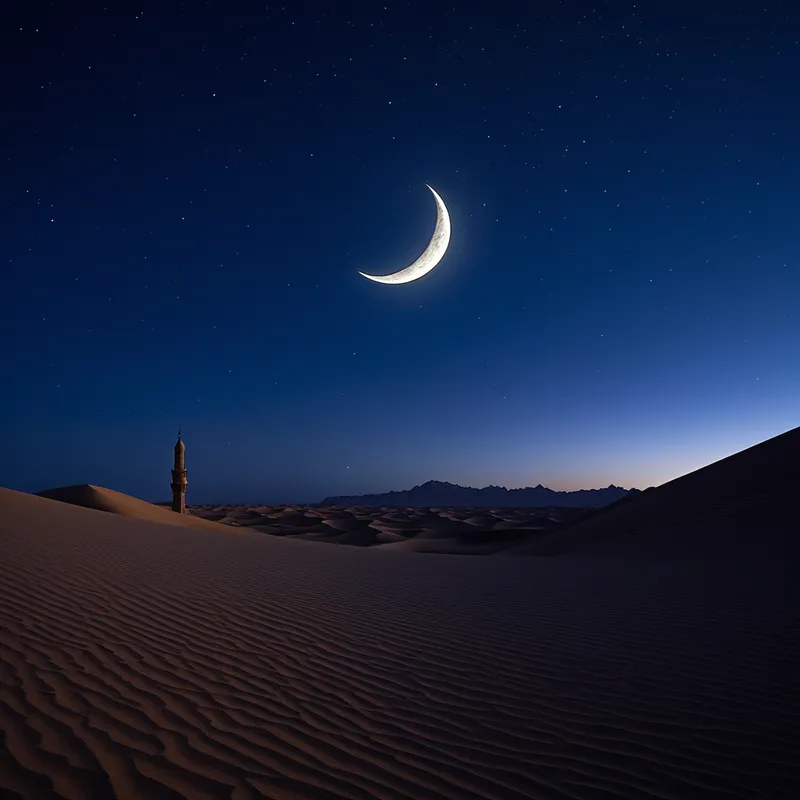
Listen, and let the veil of the commonplace fall away. Before clocks, before calendars, there was the Sky, and the Sky spoke in a language of light and shadow. In the great, silent expanse, where the sun’s departure left a kingdom of indigo and ink, a sliver of hope was born. It was not the full, boastful orb of night, but a shy, curved smile of light—the Hilal.
It begins not with a bang, but with a breath held. The sun, a weary king, sinks below the rim of the world, staining the west in farewell hues. Darkness, deep and absolute, claims the dome. This is the Nights of the Hidden Moon, a time of waiting, of interiority. The earth itself seems to listen.
Then, on the western horizon, where the last memory of the sun lingers like a whisper, a change stirs. Not a light, at first, but a thinning of the dark. A delicate, impossible curve of luminescent pearl etches itself against the deep blue. It is so faint that to blink is to lose it. This is the Ruyat al-Hilal, the moment of witnessing. It is not announced; it is discovered by those who watch with patient, faithful eyes.
The Hilal does not blaze; it hints. It is a cup held sideways, catching not water, but the first, stolen rays of the sun from below the world. It is a bow without an arrow, a promise drawn but not yet released. For three nights it grows, this sliver of certainty, a nail-paring of light that defines the void around it. It marks the birth of sacred time. With its sighting, the fast begins, or the pilgrimage is called, or the month is sanctified. It is the sky’s signature on the contract of faith, a celestial penstroke that initiates the rhythm of worship, community, and return.
It is a silent herald. It says: Begin. It says: The cycle turns. It says: You are seen, and you are timed by a hand greater than your own. And then, having delivered its message, it surrenders to its own destiny, waxing into fullness before waning once more back into the fruitful, necessary dark.
Cultural Origins & Context
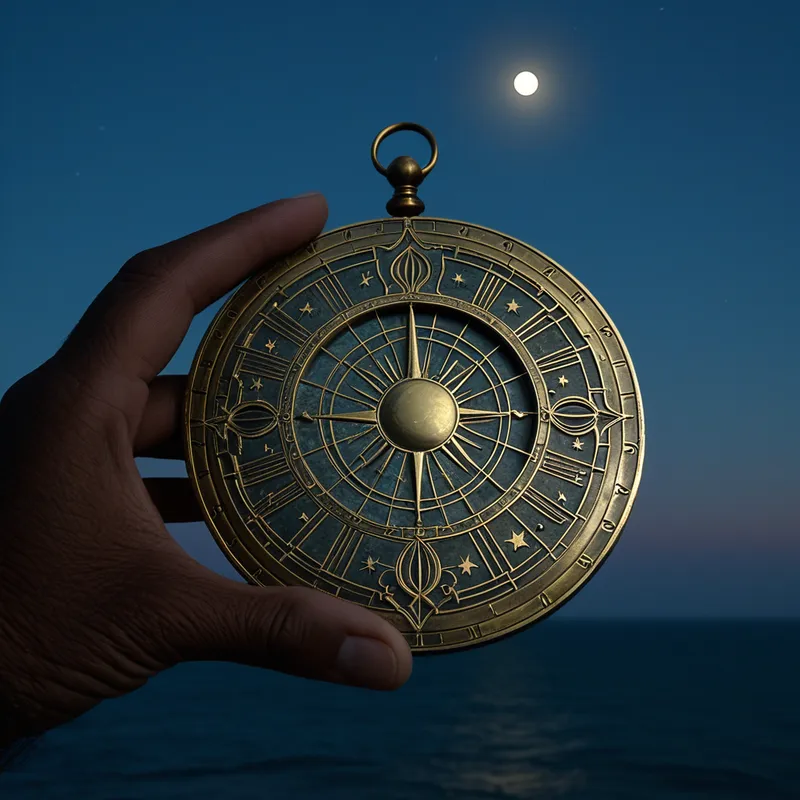
The Hilal is not a myth of personified gods in conflict, but a mythologized celestial event embedded in the very fabric of Islamic practice. Its origins are inextricably linked to the pre-Islamic Arab lunar calendar, which was refined and sacralized within Islam. The Qur’an explicitly ties the measure of time to the moon’s phases: “They ask you about the new moons. Say, ‘They are measurements of time for the people and for the pilgrimage.’” (Qur’an 2:189).
This transformed the Hilal from a mere pastoral marker for nomadic tribes into a central pillar of religious law and community life. Its sighting became a communal act of profound significance, governed by specific legal (fiqh) guidelines. Committees would ascend hills, scan clear horizons, and the testimony of reliable witnesses would be solemnly accepted to declare the start of Ramadan or the feast of Eid al-Adha.
The societal function was multifaceted: it created a unified, lunar-based rhythm distinct from solar or imperial calendars, it demanded communal vigilance and trust (the Ummah looking skyward together), and it instilled a cosmology where human time was harmonized with celestial time. The myth was passed down not in epic poetry, but in ritual repetition, in the annual anticipation of the moon-watchers (muhaqqiqun), and in the shared joy or solemnity its appearance commanded.
Symbolic Architecture
Psychologically, the Hilal is a master symbol of beginnings born from endings, of visibility emerging from invisibility. It represents the first, fragile moment of consciousness after a period of unconscious assimilation—the nascent idea, the dawning feeling, the initial commitment after a time of doubt or darkness.
The crescent is not a full answer, but a perfect question—a curved space that holds both what is revealed and what is yet concealed.
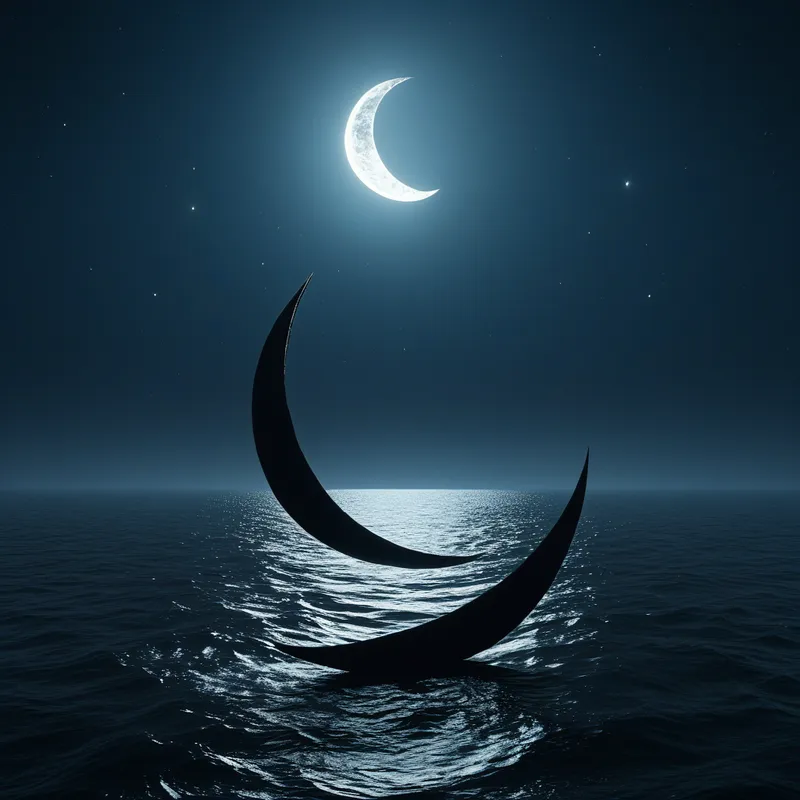
It symbolizes divine guidance that is subtle, requiring attentive seeking (istinbat), not overwhelming. The light of the Hilal is reflected light; it does not generate its own, teaching that our initial illumination often comes from a Source beyond our current position, reflected into our darkness. Furthermore, its shape—a bow, a cup, a boat—suggests a vessel. It is the container that initiates the journey, the receptivity that must exist before any filling (of knowledge, spirit, grace) can occur.
The Nights of the Hidden Moon are equally critical. They represent the nigredo of the soul, the necessary period of germination, dissolution, and return to the primal state. Without this fertile void, the new crescent has no contrast, no meaning. The Hilal thus eternally dances with its own absence, teaching the law of cycles: revelation requires retreat, form demands formlessness.
The Dreamer's Resonance
When the pattern of the Hilal appears in modern dreams, it often signals a psychological process of delicate emergence. The dreamer may be in a “dark moon” phase of their life—a period of depression, transition, creative block, or unknowing. The appearance of the slender crescent is the first somatic hint of a shift.
This is not the dream of the blazing sun (conscious triumph) or the full moon (emotional culmination). It is the dream of the first step, the quiet intuition, the faint but undeniable sense that a new phase is possible. One might dream of spotting a thin sliver of light in a vast darkness, of finding a crescent-shaped object, or of anxiously scanning a twilight sky with others. The somatic feeling is one of anticipation mixed with fragility—a hope so new it feels vulnerable to dismissal.
Psychologically, this dream motif asks the dreamer: What is seeking to be born in you? What ending have you recently endured that is now making space for a new beginning? Are you patient enough to witness the first, faint signs, or do you demand immediate, full-blown clarity? It calls for trust in cyclical processes and attentiveness to subtle inner movements.
Alchemical Translation
The myth of Hilal models the alchemical process of psychic transmutation, or individuation, with elegant precision. The entire lunar cycle is the Opus Magnum, but the moment of the Hilal is the critical transition from nigredo (blackening, dissolution) to albedo (whitening, purification).
The modern individual’s “dark moon” is a period of crisis, loss of identity, or deep introversion—a necessary descent where old structures are broken down. To rush from this darkness is to bypass the work. The Hilal phase is the first, conscious acceptance of the new pattern that wants to emerge from this dissolution. It is the act of “sighting”—of bringing a nascent, fragile aspect of the Self into the light of awareness.
Individuation does not begin with grand declarations, but with the silent, personal ruyah—the witnessing of one’s own emerging form.
This requires the “moon-watcher” within: the patient, observant ego that does not force growth but creates the conditions (stillness, attention, a clear horizon) for it to be seen. To honor the Hilal is to commit to the nascent Self, to begin the practices (the “fast,” the “pilgrimage”) that will nurture this new consciousness to fullness. It teaches that renewal is not a singular event but a rhythmic law of the soul. Each ending contains the sliver of the next beginning, and each act of faithful witnessing aligns our personal time with the timeless rhythm of becoming.
Associated Symbols
Explore related symbols from the CaleaDream lexicon: