
Herald Myth Meaning & Symbolism
The mythic Herald is the divine messenger, the voice of the gods that shatters the mundane, demanding attention and announcing irrevocable change.
The Tale of the Herald
Hear now, and let your soul grow still. For I speak of the moment the world cracks open.
It begins not with a war, nor a quest, but in the unbearable stillness of the ordinary. A king pores over scrolls in a sunlit hall, the dust motes dancing in predictable paths. A shepherd leans on his staff, watching his flock crop grass on a slope that has known a thousand such afternoons. A woman draws water from a well, the bucket’s splash a familiar percussion. This is the world of men, a world of cause and effect, of plowed fields and predictable seasons.
Then—a shiver in the air. Not a wind, but a listening. The birds fall silent mid-song. The very light seems to thicken, to gather itself. It is a pressure in the ears before the sound arrives.
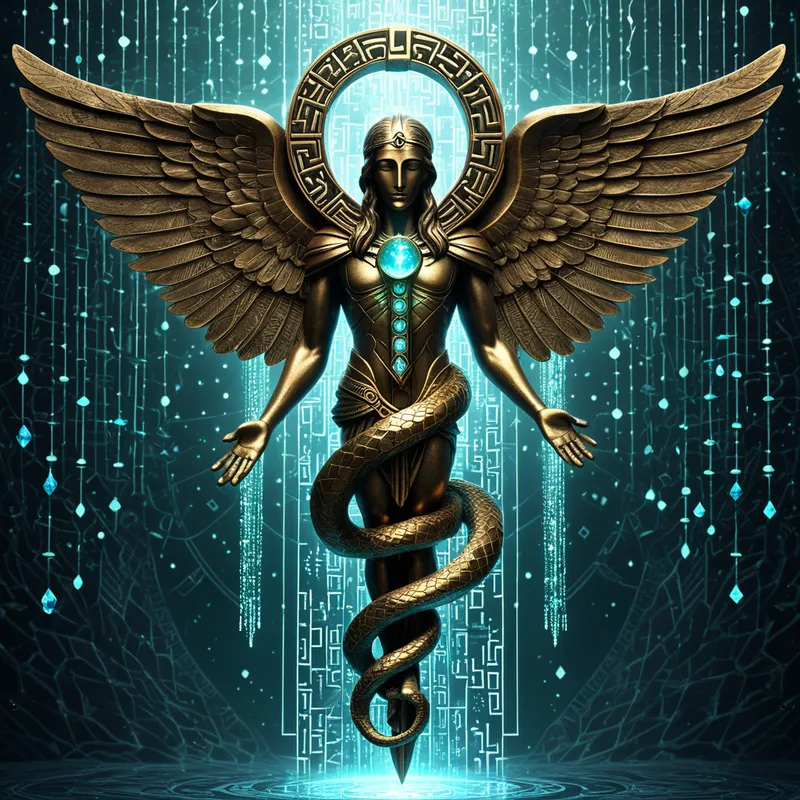
And then, He is there. Or She is there. You do not see an approach; there is only a sudden, absolute presence. It might be Hermes, his winged sandals barely touching the earth, his face a mask of beautiful, impersonal urgency, the twin serpents of his caduceus coiling in restless energy. It might be Iris, a being of prismatic light and rushing air, her form dissolving and re-forming like a storm-cloud shot through with sun.
The air hums with a frequency that vibrates in the marrow. The herald does not greet. There is no time. The message is not a letter to be read; it is a force to be endured. The voice that issues forth is not quite a sound—it is clarity itself given vibration. It bypasses the mind and lodges directly in the spirit.
"King of Mycenae," it thunders, or whispers with the same finality, "the thousand ships are yours. Make ready." "Shepherd of Ida," it murmurs, "the goddesses await your judgment. Choose." "Daughter of Acrisius," it breathes into the dark of a bronze tower, "the golden rain will come."
The words are irrevocable. They are not an invitation; they are an announcement of a new reality. In their wake, the old world—the world of the scroll, the flock, the solitary vessel—is revealed to be a dream. The herald is the awakening. As swiftly as they came, the presence dissolves. The light returns to normal. The birds resume their chatter.
But nothing is the same. The king’s hands tremble above his maps. The shepherd’s heart pounds with a terror and a glory he cannot name. The woman feels a divine seed quicken within her. The message has been delivered. The story, the terrible, glorious story, has now begun. And the one who heard it is forever changed, standing on the threshold between the person they were and the destiny they must now become.

Cultural Origins & Context
In the oral tapestry of ancient Greece, the herald was not a minor functionary but a vital nerve of the cosmic and social order. This mythic pattern is woven into the very fabric of the epics, from the Iliad and Odyssey to the myriad hymns and tragic plays. The herald was the embodied interface between the realms: between the gods (theoi) and mortals (brotói), between the human world and the underworld, and between rival city-states in times of war or truce.
Heralds like Talthybius or Eurybates were sacred and inviolable in human affairs, their persons protected by divine law (themis). This earthly protocol mirrored the divine principle. To hear a divine herald was to receive a piece of Moira itself. These stories were told by bards at feasts and in royal courts, serving a crucial societal function: they modeled how to recognize and respond to a moment of radical, often disruptive, truth. The myth trained the psyche to understand that the greatest shifts in personal and collective life are often announced, not negotiated.
Symbolic Architecture
The Herald is the archetypal personification of the Call. It represents the irreducible moment of intrusion from a deeper order of reality into the conscious, managed world of the ego.
The Herald does not argue; it announces. It is the psychic event that ends deliberation and initiates destiny.
Symbolically, the Herald is Threshold Incarnate. Its sudden appearance marks the end of one chapter of life and the absolute, non-negotiable beginning of another. The winged feet of Hermes symbolize the speed with which such calls can arrive—and the impossibility of outrunning them once issued. The rainbow form of Iris represents the bridge (synaphe) between states of being, a fleeting, beautiful, and utterly transformative connection between heaven and earth.
Psychologically, the Herald is the autonomous complex that erupts from the unconscious. It is the dream figure who delivers a stunningly clear message, the sudden intuition that reorganizes your understanding, the external event (a diagnosis, a lost job, a chance meeting) that acts with the force of a divine decree, shattering your previous plans. It is the voice of the Self, the total psyche, addressing the smaller, conscious self.
The Dreamer's Resonance
When the Herald archetype activates in the modern dreamscape, the dreamer is in a state of psychic readiness—often a readiness they are consciously resisting. The dream herald may take many forms: a ringing phone with a voice of absolute authority, a stranger at the door delivering a sealed scroll, an animal that speaks a single, lucid sentence, or a booming public address announcement in a silent, empty train station.
The somatic experience in such dreams is key: a feeling of electrified air, a weight of significance, a paralysis of awe or dread. This is the body registering the shock of the unconscious breaking through. The dreamer is often a passive recipient, frozen, listening. This mirrors the psychological process underway: the conscious ego is being confronted with information or a demand it did not generate and cannot control. The dream is staging an intervention. To dream of a herald is to experience your own psyche insisting, "You must attend to this. Your current path is obsolete. A new reality is already in motion."

Alchemical Translation
The alchemical journey begins with the nigredo, the blackening, the dissolution of the old. The myth of the Herald is the precise moment this process is initiated from beyond the ego's control. In the work of individuation, we do not choose our deepest call; it chooses us. The Herald represents that fateful, often uncomfortable, election.
The alchemical gold is not found by refining what you already are, but by obeying the call to become what you are meant to be, as announced by the inner Herald.
The modern individual's "alchemical translation" of this myth involves several stages. First, Recognition: learning to distinguish the trivial noise of anxiety from the profound, resonant signal of the true Call—which always carries a sense of numinous authority and existential weight. Second, Reception: overcoming the ego's instinct to cover its ears, to rationalize away the message, to return to the "flock on the hillside." This requires a courageous submission to a truth larger than one's current identity.
Finally, Integration and Departure: The message, once fully received, becomes an internal compass. The herald vanishes, but the caduceus remains, now an inner symbol. The individual must leave the familiar "kingdom" or "hillside" of their former life. They may not know the full road to Troy, or what the "golden rain" will create, but they know the first step must be taken. The Herald’s announcement transmutes confusion into destiny, paralysis into purpose. The long journey of the soul—with all its trials, monsters, and potential triumphs—begins with the willingness to listen, truly listen, to that first, clear, terrifying, and glorious word.
Associated Symbols
Explore related symbols from the CaleaDream lexicon: