
Hera's Milk Myth Meaning & Symbolism
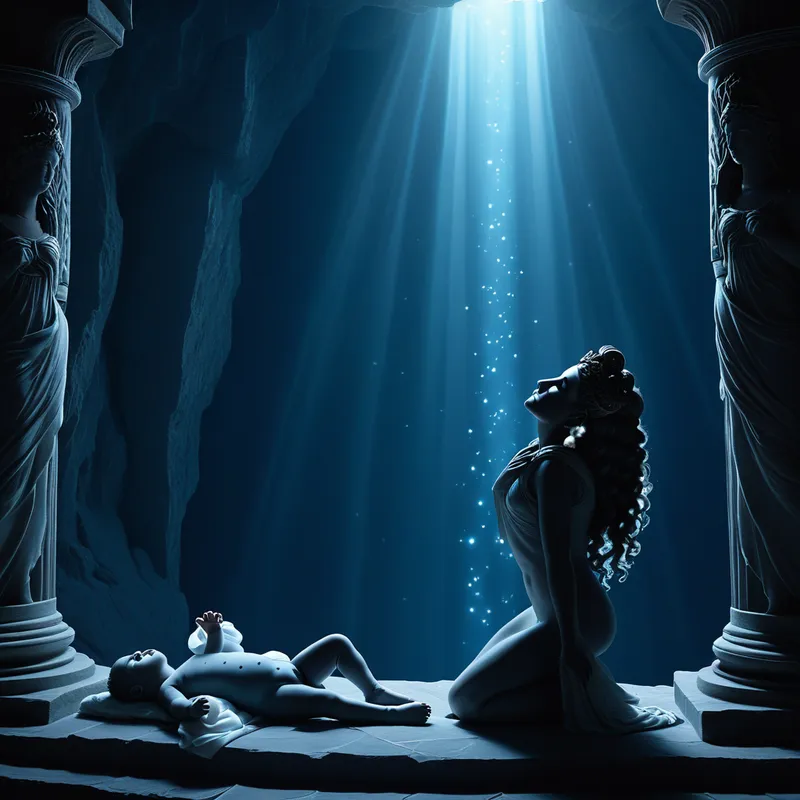
The infant Herakles, seeking immortality, drinks from the sleeping goddess Hera, whose spilled milk becomes the starry river in the night sky.
The Tale of Hera's Milk
The night on Mount Olympus was not like the nights of men. It was a silence woven from the breath of deities, a deep, velvet dark pricked only by the cold fire of eternal stars. In a chamber fragrant with ambrosia and the scent of sacred cypress, the Queen of Heaven slept. Hera, wife of Zeus, her form the very model of sovereignty and matronly power, was adrift in dreams of order and dominion.
But into that sacred stillness crept a desperate hunger. It was not a thief of shadows, but a babe, placed at her side by a trick of fate and a scheming god. This was the infant Herakles, son of Zeus and the mortal Alcmene, a child marked for greatness and for the burning hatred of the goddess who now slumbered beside him. He was an orphan of divine design, thrust into the heart of the very power that wished him erased.
Driven by an instinct deeper than fear, a need for the strength to survive the wrath his existence provoked, the child sought not just sustenance, but divinity itself. His small mouth sought the breast of the goddess. The touch was an electric shock in the tranquil night. Hera’s eyes flew open—not with the slow wakefulness of mortals, but with the instantaneous, terrible clarity of a deity betrayed. The intimate sanctity of her body, the very source of life for her own divine children, had been violated by her husband’s bastard son, the living emblem of his infidelity.
A surge of revulsion, rage, and cosmic shock convulsed through her. She recoiled, thrusting the infant away. And in that violent, reflexive motion, a stream of her immortal milk—liquid starlight, the essence of divine nourishment—arced from her. It did not simply drip. It flew. It spilled out into the boundless void beyond the marble terraces of Olympus.
Where it fell, a miracle of anger and accident was born. Those drops of sacred milk did not vanish into darkness. They caught fire with their own innate luminosity. They scattered, coalescing into a shimmering, milky-white path across the black dome of the sky. A river of spilled potential, a scar of maternal fury and unintended grace, was forever etched upon the heavens. The child, having taken but a sip, gained not the full immortality he sought, but a measure of his legendary, unconquerable strength. And the cosmos itself gained a new story written in light: the Galaxias Kyklos, the Milky Circle.
Cultural Origins & Context
This etiological myth, explaining the origin of the Milky Way, is not found in the grand epics of Homer but in the later, more scholarly tradition of mythography. It is most famously recorded by the pseudo-Eratosthenes in his Catasterismi, a work detailing the mythical origins of constellations. This places the tale in a context of Hellenistic learning, where myths were cataloged and systematized, their narratives pressed into service to explain the natural world.
Its societal function was layered. Primarily, it was a mythos of origin, answering the profound human question written nightly in the sky: "What is that luminous path?" The answer rooted the cosmos in the domestic and psychological dramas of the gods, making the universe intimately familiar. Furthermore, it served as a foundational episode in the saga of Herakles, explaining the source of his superhuman might as literally divine, siphoned from his greatest enemy. It reinforced Hera’s role as the perpetual, wronged antagonist, her very body becoming a site of cosmic conflict. The myth was passed down not by bards to warriors, but by scholars and poets to citizens and philosophers, a story that blended astronomy, theology, and deep family drama into a single, unforgettable image.
Symbolic Architecture
At its core, the myth is a profound allegory of unintended consequence and paradoxical nourishment. Hera’s milk symbolizes the ultimate source: the nourishing, life-giving, and sovereign power of the feminine divine, the Magna Mater. It is not offered, but taken; not given in love, but spilled in revulsion.
The deepest nourishment often comes not from sanctioned grace, but from the chaotic spillage of a broken contract.
Herakles represents the orphan archetype par excellence. He is cast out from his rightful place, seeking sustenance from a source that actively wishes him dead. His act is one of profound audacity and survival instinct. The milk itself is ambivalent—it is both poison and elixir, the substance of the enemy that becomes the foundation of the hero’s strength. The resulting Milky Way is the eternal symbol of this transformation: a betrayal fossilized into beauty, a personal trauma magnified to a cosmic scale. It represents the creative potential that can erupt from rupture, the eternal monument to something beautiful born from an act of rejection.

The Dreamer's Resonance
When this myth stirs in the modern unconscious, it rarely appears as literal goddesses and star-fields. It manifests as dreams of illicit nourishment. One might dream of drinking from a forbidden well that tastes of light and sorrow, or of stealing a key ingredient from a powerful, sleeping figure. There is a somatic quality of both thrilling transgression and deep anxiety—the heart pounds with the fear of being caught in the act of taking what one desperately needs.
Psychologically, this dream pattern signals a process of seeking strength or wholeness from a source perceived as hostile or withholding. This could be an internalized critical parent, a societal structure, or a part of one’s own psyche (like the inner critic or the anima/animus) that feels antagonistic. The dreamer is the orphaned Herakles, engaged in the necessary, terrifying work of "drinking the milk" anyway—of internalizing a capacity or strength from the very archetype that seems to reject them. The spilled milk in the dream might appear as a lost opportunity that transforms into an unexpected path, a "mess" that somehow becomes a guiding light.
Alchemical Translation
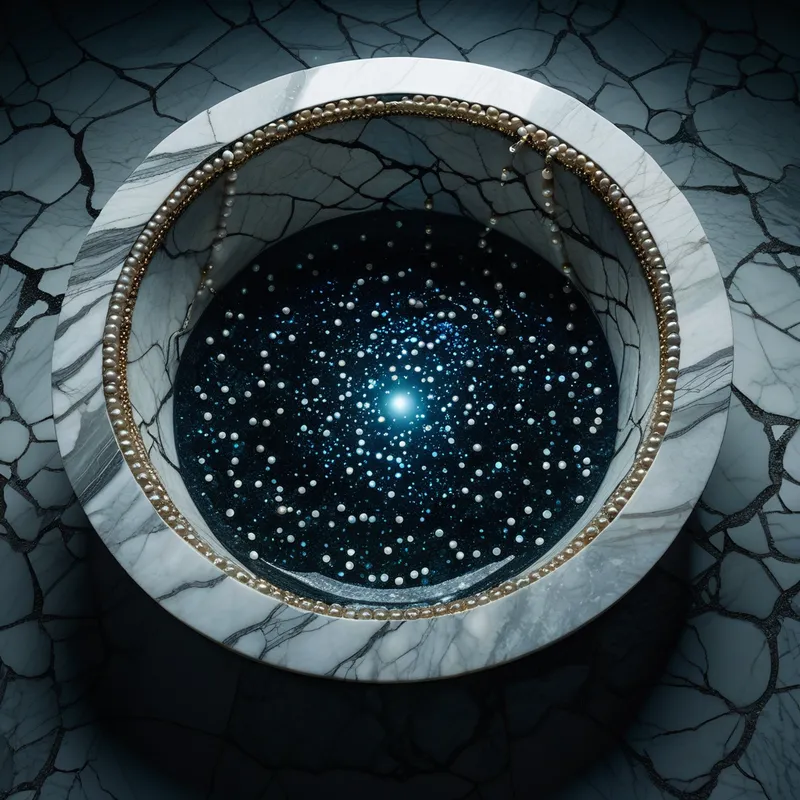
The alchemical journey modeled here is the transmutation of rejection into essence. The prima materia is the orphaned state, the feeling of being an illegitimate outsider craving a legitimacy that is denied. The forced, traumatic "feeding" from Hera is the nigredo, the blackening—a dark, confusing, and painful confrontation with the source of one’s deepest lack.
Individuation requires the courage to be nourished by the shadow, to find the elixir in the very substance of our rejection.
Herakles does not reconcile with Hera; he incorporates a part of her power against her will. This is the separatio and coniunctio in one violent act. The spilling of the milk is the critical moment of albedo, the whitening. The raw, personal pain (the milk) is projected out, not to be lost, but to be seen in a new, cosmic context (the Milky Way). The individual trauma is sublimated into a universal symbol.
For the modern individual, this translates to the process of taking what was meant to weaken or destroy you—criticism, abandonment, betrayal—and, through the fierce alchemy of the psyche, spinning it into a core component of your strength and your unique path. You do not win the love of the inner critic (Hera); you take its fierce standards and transform them into self-discipline. The Milky Way that results is your own life’s work, your unique trajectory across the dark, a luminous path created not from sanctioned blessing, but from the audacious, necessary act of self-creation against the odds. The cosmos itself bears the mark of the orphan’s hunger.
Associated Symbols
Explore related symbols from the CaleaDream lexicon: