Hasht Behesht Pavilion Myth Meaning & Symbolism
A celestial pavilion of eight paradises, built for a king's soul, becomes a myth of architectural perfection, divine favor, and the ephemeral nature of earthly glory.
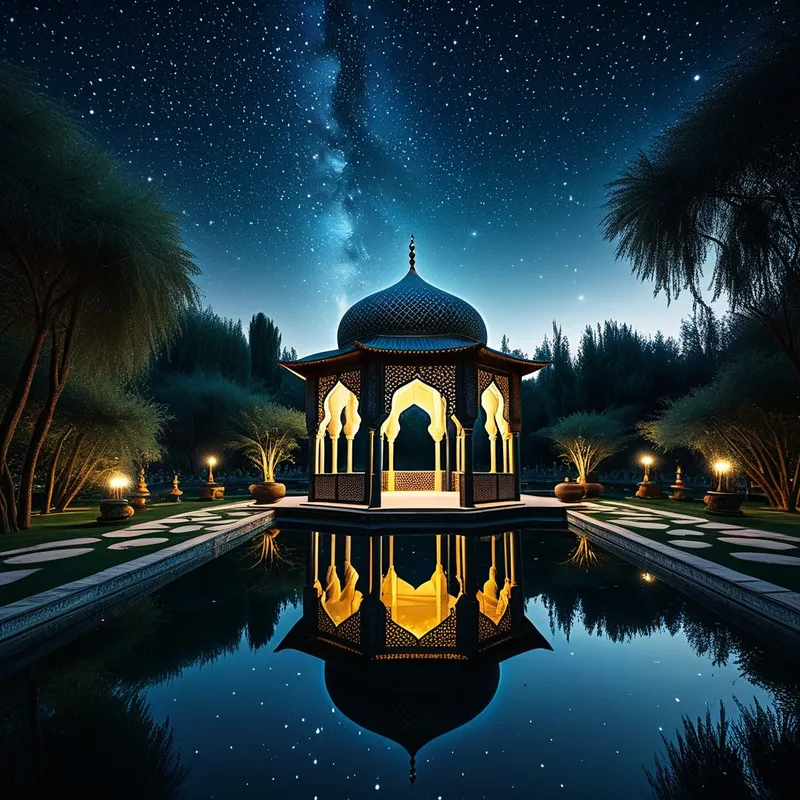
The Tale of Hasht Behesht Pavilion
Listen, and let the scent of night-blooming jasmine and the murmur of qanat waters carry you to an age when the earth was closer to the sky. There was a king, not merely a ruler of lands and armies, but a sovereign of the soul, whose heart was a vast, empty chamber echoing with both divine inspiration and a terrible, human loneliness. His palaces were many, his gardens famed, yet in the quiet hours, a chill would settle in his bones—a whisper that all he built was dust, and his name would be forgotten.
One evening, as the last violet bled from the sky over Isfahan, a vision descended upon him not in a dream, but in the waking stillness. It was the form of a pavilion, but such a pavilion! It was not of stone and mortar, but of light and geometry, a perfect echo of the celestial order. It had eight sides, for the eight levels of Paradise, and eight vaulted portals, each opening onto a different garden of eternal spring. At its heart, a pool would hold not water, but the inverted sky, and from its center, a fountain would rise like a silver prayer. This was to be the Hasht Behesht, a dwelling place for his weary spirit, a bridge between his earthly reign and the divine realm.
With a fervor that shook the court, he summoned his greatest mi'mar, his most gifted calligrapher, his most visionary tile-maker. "Build this," he commanded, his voice trembling with a hope he dared not name. "Build it so perfectly that the angels will mistake it for a piece of their own home, fallen gently to earth." For years, the site hummed with sacred labor. The mi'mar calculated the proportions of the universe into its pillars. The calligrapher inlaid verses from the Quran so finely they seemed to float on the walls. The tile-maker fired blues so deep they held the memory of twilight, and golds that captured the first touch of dawn.
The day of completion arrived. The king walked through each of the eight iwans, each framing a perfected world: a garden of red roses, one of white lilies, an orchard of pomegranates, a grove of cypress trees pointing heavenward. The air was cool and sweet. The sound of water was a constant, gentle hymn. He stood at the central pool, saw his reflection crowned by the intricate, honeycombed muqarnas of the dome—a fractal universe in stucco—and for a moment, his loneliness vanished. He felt whole. He felt seen, not by his subjects, but by the cosmos itself. The pavilion was complete, and in its completion, it was perfect.
And so, the story is told, on the first night the king slept within its marble embrace, a profound silence fell over the gardens. The nightingales ceased their song. The waters stilled. In the morning, the king was found not in his chamber, but standing once more at the pool. A serene, unearthly peace was upon his face, but in his eyes, there was a new knowledge. The pavilion was perfect, yes. But he, the king, was not. The bridge was built, but he could not cross it; he could only behold it. The Hasht Behesht stood not as his eternal home, but as a sublime mirror, showing him the beauty of the paradise he could conceptualize but not yet inhabit. It was his masterpiece, and his most poignant lesson.
Cultural Origins & Context
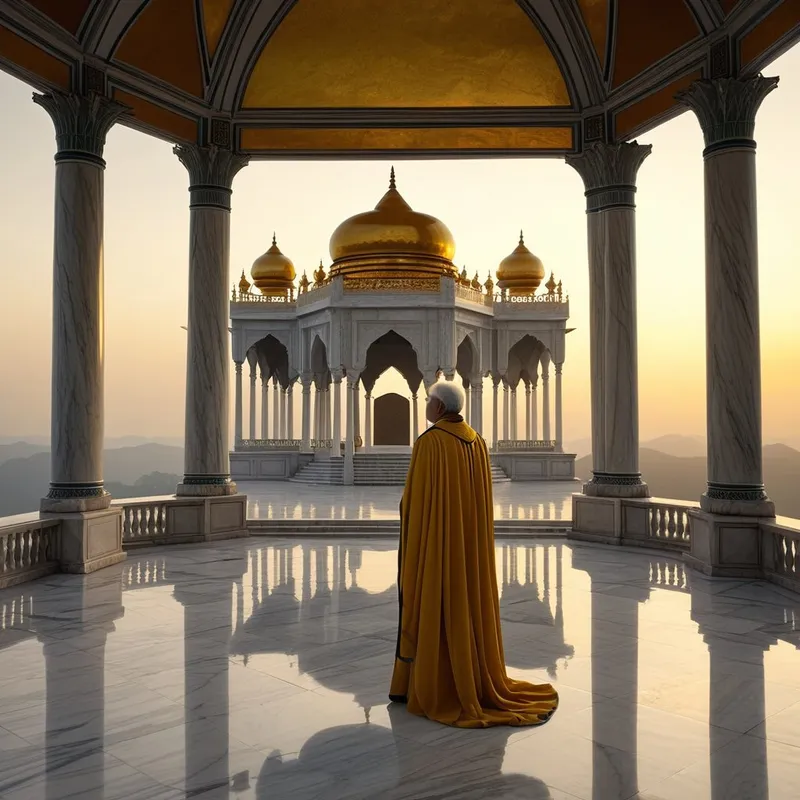
The mythos of the Hasht Behesht is not a single, codified epic from antiquity, but a potent narrative essence that crystallized around actual architectural marvels, most famously the 17th-century pavilion in Isfahan built during the Safavid dynasty. The story is a folktale, a philosophical parable passed down by storytellers in coffee houses and court poets alike. It functions as a cultural dream about creation itself.
In the Persian imagination, architecture was never merely functional. It was the highest art, a direct dialogue with the divine mathematics governing the universe. The chahār bāgh (four-part garden) was a recreation of the Quranic paradise. The dome represented the vault of heaven. Therefore, a pavilion named "Eight Paradises" was the ultimate earthly attempt to materialize a spiritual blueprint. The myth served a dual societal function: it glorified the patron-king's piety and vision, while simultaneously, in its melancholic resolution, delivering a core tenet of Sufi thought: the futility of clinging to worldly forms, no matter how exquisite. The tale warns that even the most perfect creation is a sāyah—a shadow—of the true, uncreated divine reality.
Symbolic Architecture
The pavilion's symbolism is a precise psychic geometry. The number eight is paramount. In Islamic cosmology, it signifies the eight angels carrying the divine throne, the eight gates of paradise, and the seven heavens plus the divine realm. Psychologically, it represents totality, regeneration, and the point of transition between the earthly (the square, the four directions) and the celestial (the circle, the dome).
The Hasht Behesht is not a building, but a three-dimensional mandala of the Self—a map of psychic wholeness that the conscious ego can walk through but cannot permanently possess.
Each of the eight portals symbolizes a different aspect of the soul's potential perfection—love, wisdom, courage, serenity—framed and cultivated, yet always leading back to the central void, the pool. The king is the ego-consciousness, the part of us that seeks to build a permanent, perfect identity ("my legacy," "my enlightenment"). The pavilion is the archetype of the Self, a transcendent structure of the total personality. The myth's core conflict is the ego's heartbreaking, necessary realization that it can witness the Self, can even labor to create a vessel for it, but cannot become it through an act of will or possession. The perfection achieved is outside of him.
The Dreamer's Resonance
When this myth stirs in the modern unconscious, it rarely appears as a literal Persian pavilion. Instead, one dreams of finding a perfectly designed, empty house with many rooms. Of discovering a breathtaking, complex machine that operates flawlessly but for which one has no manual. Of finally completing a monumental personal project—a book, a business, a work of art—only to feel a strange, hollow detachment upon its finish.
The somatic experience is key: a feeling of awe mixed with a profound, quiet loneliness. The dreamer is the king at the pool. The psychic process is the confrontation with the opus, the great work of one's life phase, and the subsequent, often painful, differentiation between the ego and the Self. The dream signals that a structure of meaning has been built within the psyche. The conflict is the ego's temptation to move in, to claim this structure as its own identity ("I am my successful career," "I am my enlightened persona"). The myth-dream warns that this identification leads to spiritual stagnation. The pavilion must remain a sacred, somewhat separate space—a symbol of wholeness to orient toward, not a trophy to inhabit.
Alchemical Translation
The alchemical journey mirrored here is the opus contra naturam—the work against one's own natural tendency to identify with one's creations. The king's initial state is one of lack, the prima materia of longing. His vision is the informatio, the divine inpouring of the archetypal image. The years of construction are the stages of albedo and citrinitas—purification and illumination—where skills are honed, materials are refined, and consciousness is applied.
The completion of the pavilion is the coveted rubedo, the reddening, the achievement of the philosopher's stone. But here lies the myth's genius and its critical lesson for individuation:
True alchemical gold is not the perfect creation, but the transformation in the creator who learns he does not own the gold he has made.
The king's moment of peace and subsequent melancholy is the separatio, the final and most difficult stage. He must psychologically separate from his own masterpiece. He must realize that the wholeness he senses resides in the symbolic structure between the eight portals, in the relationship of the parts, not in himself as a solitary part. This is the transmutation: from a king who builds to claim immortality, to a soul who builds to understand his own mortal, participatory role in a beauty far greater than himself. The pavilion stands. He walks away, changed. The structure remains as an eternal inner reference point—a Hasht Behesht within the psyche—now truly fulfilling its function: not as a dwelling, but as a compass.
Associated Symbols
Explore related symbols from the CaleaDream lexicon: