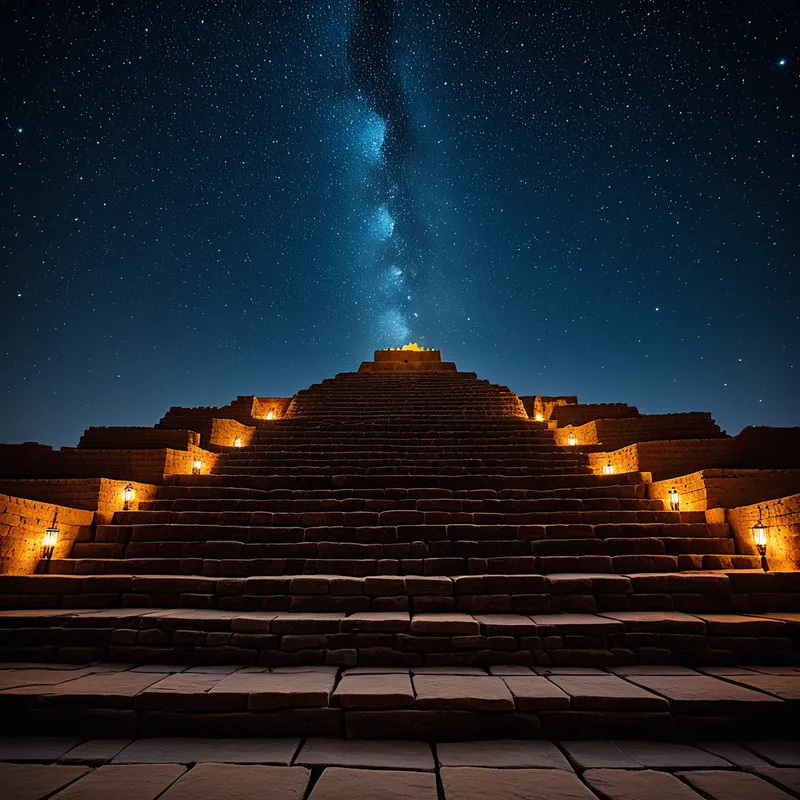
The Blueprint of the Self: Architecture in Dreams
The Somatic Echo
Before you see the spire or feel the floor, you sense it. It is a pressure in the sternum, a density in the bones. It is the weight of stone and the hollowness of a grand hall, felt in the marrow. This is the somatic echo of architectural dreams—a visceral knowing of structure, of load-bearing walls within the psyche. You may wake with a clenched jaw, as if holding up a lintel, or with a strange lightness, as if a wall you didn’t know was there has simply vanished. The body registers the blueprint long before the mind can read it. It is the feeling of foundation: solid, cracked, shifting, or perilously absent.
The Dreamer's Log (Case Vignette)
I am in a forgotten control room, deep within a monolithic structure. Dust coats every surface. A single terminal screen is alive, flickering with lines of indecipherable, glowing code. I know this place holds the master plan for the entire citadel, but I cannot read the language. The silence is absolute, and the weight of all the unseen floors above me presses down.
Alchemical Interpretation: The dreamer stands at the threshold of their own unconscious operating system, confronted by the foundational code of their psyche, which is currently archaic and illegible to the conscious self.

The False Lead
This theme is not about literal career aspirations to be an architect, nor is it a simple metaphor for "building a life." To reduce it to planning or mere life structure is to mistake the cathedral for its scaffolding. A dream of crumbling walls is not a prophecy of "bad luck" ahead; it is a somatic report on a foundational belief that can no longer bear the weight of your current consciousness. The architecture of the soul is not about external achievement, but the internal arrangement of space—where you allow light, where you store memory, where you have built secret rooms to hide your grief.
Psychological Architecture
Here, in the silent halls of the dream, you meet the hidden contractors of your soul. This is deep Shadow work, the survey of the inner estate. You may discover a beautifully appointed reception room (the persona) leading to a dank, forgotten cellar (the repressed). A sealed door whispers of a trauma walled up alive. A missing staircase reveals where you have denied yourself ascent. Individuation is not just exploring these rooms; it is the terrifying, glorious act of becoming the architect. It is taking the dusty blueprint from the control room and deciding: This load-bearing wall of old resentment must go. This corridor of perpetual anxiety needs a window. I will build a sanctuary here, where there was only storage. You reconcile the internal family system—the orphaned child weeping in the basement, the tyrannical ruler in the high tower, the nurturing caregiver in the kitchen—by redesigning the house so all parts have dignified space. You give the exiled ones a voice in the renovation.
Mythic Resonance
Consider the Labyrinth of Crete. It was not merely a prison for the Minotaur; it was a masterwork of deceptive architecture, designed by the artificer Daedalus to contain a monstrous truth at its center. We each have such a labyrinth—a complex, defensive structure built to hide our own inner beast, our unintegrated shadow. The hero Theseus needed Ariadne’s thread, a slender line of consciousness, to navigate the confusing passages and return to the light. The myth tells us that the path to our center is convoluted by design, and that the only way out is through, guided by the fragile, persistent thread of self-awareness. The architecture is both the problem and the puzzle; to solve it is to slay the monster and reclaim your sovereignty.
Symbolic Nodes
- Foundations: The core beliefs and early imprints upon which the self is built.
- Rooms: Specific aspects of the psyche or compartments of lived experience.
- Doors & Thresholds: Opportunities, transitions, or barriers between states of being.
- Staircases: Conscious ascension or descent into deeper levels of the self.
- Windows: Perception, awareness, and the relationship between inner and outer worlds.
- Cracks & Collapse: The failure of old structures, creating necessary space for change.
- Blueprints & Control Rooms: The hidden, directive intelligence of the unconscious.
Archetypal Resonance
The energy at the core of the architectural dream is that of The Creator Archetype. This is not the shadow creator, obsessed with novelty for its own sake, but the essential Architect of the Self. Its somatic echo is the feeling of potential tension—the hand poised to draw the line, the mind holding a vision of form within the void. Its alchemical potential lies in its drive to impose meaningful order on chaos, to take the raw materials of experience, memory, and emotion and synthesize them into a coherent, inhabitable structure. In the dream of architecture, the Creator is actively, often silently, assessing the integrity of the current design and imagining the next necessary renovation. It is the archetype that whispers, "This can be remade."
The Alchemical Process
The transmutation here is one of conscious reconstruction. The prima materia is the existing psychic structure, with all its flaws, anachronisms, and beautiful, outdated halls. The heat and pressure are applied by life itself—events that stress the foundation, relationships that demand new rooms, inner truths that can no longer be contained in old cells. This is the nigredo, the darkening: the feeling of being lost in your own labyrinth, the dust in the control room, the terror of the crack spreading up the wall.
The alchemical fire is the sustained, courageous attention you bring to these fault lines. It is the willingness to read the flickering, illegible code of your own origins. As you hold this heat, the structure begins to soften. Rigid beliefs dissolve (albedo). From this dissolution, you consciously choose new principles, design new supports, and integrate sealed-off wings (rubedo). The gold you produce is not a perfect, static palace, but a dynamic, resilient, and self-aware sovereignty—a structure that knows it is both the building and the builder, forever capable of thoughtful adaptation.

The Integration Protocol
Question 1: In the architecture of your psyche, which room feels most like "home," and what does that tell you about the core self that resides there?
Question 2: Where is there a door you have been afraid to open, and what do you suspect—or hope—is on the other side?
Question 3: If your current inner structure had a foundational motto etched into its cornerstone, what would it be? What motto would you choose to replace it?
Action 1 (Somatic Blueprint): Stand barefoot, feeling your feet on the ground. Close your eyes and sense the vertical axis of your spine. For five minutes, simply feel yourself as a structure. Where do you feel solid? Where feels empty, strained, or dense? Do not analyze, just receive the somatic report.
Action 2 (Unstructured Cartography): With a large piece of paper and pencils or paints, let your hand draw the map of your inner landscape. Do not draw a house. Let it be abstract: a labyrinth, a circuit board, a geological cross-section, a constellation of rooms. Let the lines, shapes, and colors emerge from the feeling, not the thought. Where does the line thicken? Where does the color go dark? This is a dialogue with the blueprint.
Action 3 (Threshold Ritual): Physically enact a small renovation. It could be cleaning out a literal closet (making space), repainting a corner of a room (changing the atmosphere), or deliberately using a door in your home you usually ignore (crossing a threshold). As you perform this, hold the intention that you are authorizing a congruent shift in your internal architecture.
Final Validation
To dream of architecture is to be entrusted with a profound and often daunting responsibility: the stewardship of your own soul's dwelling. It is natural to feel overwhelmed by the scale of the renovation, to fear the dust and disruption of tearing down what no longer serves. That fear is a sign of your integrity, recognizing the weight of the task. But remember, you are not starting from an empty plot. You are the inheritor, the current resident, and now, the conscious architect. The power that built the labyrinth also holds the thread. You contain the blueprint, the rubble, and the vision for the sanctuary to come. Breathe into the somatic echo, and begin.