
Griot Tradition Myth Meaning & Symbolism
The myth of the first Griot, a being born of silence and story, who carries the living memory of a people in their voice.
The Tale of the Griot Tradition
In the beginning, there was the Word. But before the Word, there was the Silence. A deep, listening silence that cradled the world in its palm. In this time, people lived and died, and their deeds were like footprints in the sand, washed away by the next tide of days. Kings rose and fell, and no one remembered their true names. Heroes fought, and their courage evaporated like morning dew. The people felt a great emptiness, a hollow in the chest of the world, for they were a people without a past, adrift on a sea of forgetting.
Then came a time of great drought. The earth cracked like an old pot, and the sun was a merciless eye. In a village where the elders could no longer recall the songs for rain, a child was born. He was not like other children. He did not cry; he listened. His eyes were pools that reflected not just the world, but the echo of the world. They called him Kouma.
As Kouma grew, the drought deepened. Desperation hung in the air, thick as dust. One evening, as the elders sat in defeated silence, Kouma, now a young man, walked to the center of the village. He opened his mouth, but no ordinary sound emerged. From his lips flowed a low, resonant hum that was the sound of the parched earth itself. Then, it shifted—the crackle of dry grass, the whisper of a long-dead wind. The people stopped and stared.
And then, he began to speak. But it was not his voice alone. It was layered, a chorus. He spoke the name of the founding ancestor, Djigui, describing the exact bend in the river where he had decided to settle. He recounted the treaty made with the spirit of the forest, word for word, a pact everyone had forgotten. He sang the forgotten rain-calling hymn, each syllable a drop of memory hitting the dust. As he sang, his voice weaving the past into the present, a great cloud, remembering its own name, gathered overhead.
The first heavy drop fell on his forehead. Then the deluge. The village erupted in joy, dancing in the resurrected rain. But they saw Kouma was changed. His eyes held the weight of centuries. His voice was no longer just his own; it was a vessel. The chief placed a hand on his shoulder and said, “You are no longer Kouma. You are Jeli. You are the one who guards the fire of memory so our people do not live in the cold. Your tongue is the needle that sews the generations together.”
From that day, the Griot was born. He sang the genealogies so precisely that the ancestors sat up in their graves and nodded in recognition. He held the mirror of history to kings, praising their glory or whispering the warnings of their predecessors’ follies. He carried the soul of the people, not in a book, but in the living breath of his song, a breath that could summon rain from memory and give a nation its spine of story.
Cultural Origins & Context
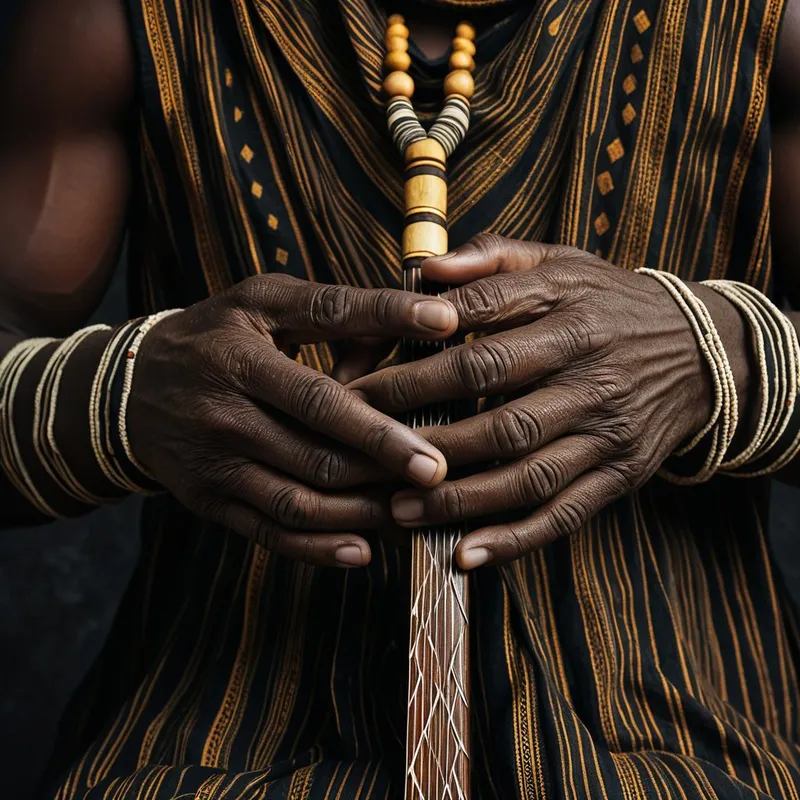
The Griot tradition is not a single, frozen myth but a living, breathing institution central to the Mande and many other West African peoples, including the Mandinka, Fulani, Wolof, and Soninke. The Griot—or Jeli (plural Jeliw) in Manding languages—occupies a specific, vital, and often complex social caste. They are the historians, genealogists, storytellers, musicians, and praise-singers.
This “myth” of origin is not a tale told in one sitting but is embedded in the very function of the Griot. It is passed down through rigorous apprenticeship, often within Griot families, where the young Jeli learns not just the technical mastery of instruments like the kora or the ngoni, but the vast oral libraries of history, law, and philosophy. Their societal function was multifaceted: they were the adhesive of social order, validating lineage and authority; the ethical compass, reminding rulers of their duties through parable and past precedent; and the communal soul, transforming collective experience into art during weddings, naming ceremonies, and festivals. They were the living database and the moral auditor, their voice the thread in the cultural loom.
Symbolic Architecture
At its core, the Griot myth is a profound allegory for consciousness itself. The Griot is the archetypal vessel of Living Memory. He represents the human capacity to internalize the past, not as dead fact, but as animating narrative.
The Griot does not merely recall events; he resurrects them in the present tense, making the ancestral breath the very air the living now breathe.
The drought in the tale symbolizes spiritual and cultural aridity—the crisis that occurs when a society loses connection with its foundational myths and identity. Kouma’s transformation into Jeli is the awakening of the archetypal Sage within the collective psyche. His voice, which becomes a chorus, symbolizes the ego’s surrender to a larger, transpersonal voice—the voice of the lineage, the daimon of history. The rain that follows is the psychic nourishment that flows when the conscious mind re-establishes its dialogue with the deep, guiding waters of the unconscious and tradition. The Griot’s mandated role to speak truth to power symbolizes the necessary, often uncomfortable, function of consciousness to critique the ruling attitudes (the King) of the psyche, preventing inflation and moral decay.
The Dreamer's Resonance
When this myth pattern stirs in the modern dreamer, it signals a profound process of psychic integration and the search for authentic voice. To dream of finding an ancient, forgotten songbook and being compelled to sing from it, or of discovering one’s voice can physically alter the environment (causing growth or storms), points to the emergence of the inner Griot.
Somatically, this may manifest as a tightening or opening in the throat chakra, a sudden urge to speak a long-held truth, or a deep, resonant feeling in the chest when contemplating one’s personal or familial history. Psychologically, the dreamer is navigating the tension between personal amnesia (the drought) and the daunting responsibility of claiming their inheritance (the chorus of voices). They may feel the weight of unlived lives—parental expectations, cultural baggage, ancestral trauma—pressing to be voiced and transformed. The dream is an invitation to stop running from this weight and to learn to carry it, to become the conscious curator of one’s own soul’s history.

Alchemical Translation
The individuation journey modeled by the Griot myth is the alchemy of turning ancestral lead into spiritual gold. It is the process of moving from being a passive subject of history (personal and collective) to becoming its active, articulate witness and shaper.
The modern Griot’s work is to descend into the silent archive of the personal and collective unconscious, to listen to its discordant and harmonious voices, and to return singing a song that integrates them into a coherent, life-affirming narrative.
First, we must endure our own “drought”—the feeling of meaninglessness, rootlessness, or a voice that feels small and personal. This is the nigredo, the dark night. Then, we must cultivate “Kouma’s listening”—deep, receptive introspection, journaling, therapy, or ancestral research. This is the albedo, the whitening, where contents of the unconscious begin to surface.
The critical alchemical stage is the “transformation of the voice.” This is the citrinitas, the yellowing. It is the terrifying, empowering moment when we speak or create from a place that feels bigger than our solitary ego. We write a poem and realize it channels a grandparent’s sorrow. We make a decision that honors a forgotten family strength. Our personal story expands to include the joys and sufferings of our line.
Finally, the “summoning of the rain” is the rubedo, the reddening, the culmination. This is the embodied result: a life lived with deeper purpose, resilience drawn from connection to a transpersonal stream, and the capacity to “water” others with wisdom that is both intimately personal and universally human. We become, in our own sphere, the keeper of the sacred fire, ensuring that the lessons of our journey are not lost but become part of the healing song for generations to come.
Associated Symbols
Explore related symbols from the CaleaDream lexicon: