Faerie Feast Myth Meaning & Symbolism
A mortal is lured into a timeless faerie feast, risking everything for a taste of the Otherworld's magic and the perilous wisdom it offers.
The Tale of the Faerie Feast
Listen, and let the veil thin. The world you know is but one skin stretched over another, deeper world. In the time when the hills were not yet silent, when the mist that clung to the moor at dusk was the very breath of the Sídhe, there lived a man. He was not a king, nor a warrior of great renown, but a man of the earth, perhaps a hunter or a poet, with a soul that heard the music in the wind and saw faces in the ancient, gnarled trees.
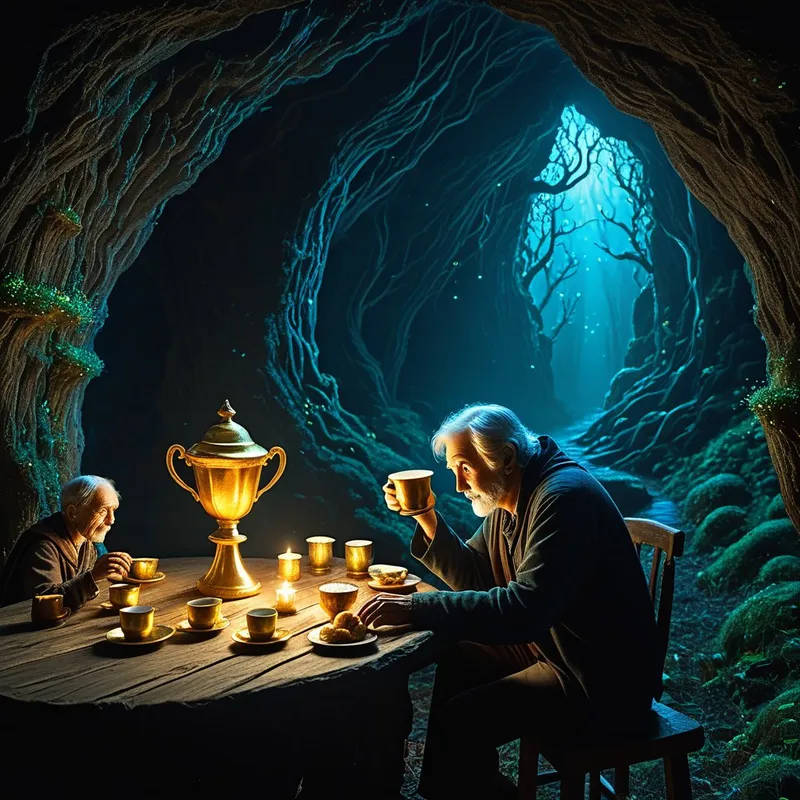
One evening, as the sun drowned itself in the western sea and the world hung in the balance between day and night—the betwixt and between—he found himself lost. Not lost in the woods, but lost in the feeling of the world. A strange, sweet music coiled through the air, a melody that bypassed the ears and spoke directly to the longing in his bones. It led him to a hillside, one he knew, yet did not know. A door of living root and stone stood open where there had been only turf, and from within spilled a light that was neither torch nor star, but the cold, beautiful luminescence of captured moonlight and foxfire.
Drawn by a hunger he could not name, he crossed the threshold. The air inside was thick with the scent of roasting meats he could not identify, of honeyed mead and eternal summer blossoms. Before him stretched a hall of impossible grandeur, its pillars the trunks of great silver trees, its roof a tapestry of living ivy and crystal. And there, at a table that seemed to stretch into infinity, sat the Sídhe. They were devastatingly beautiful, their faces pale and perfect as carved alabaster, their eyes holding the depth of forgotten lakes. They smiled, and their smiles held no warmth, only a captivating, terrible allure.
They beckoned him to sit. A place was made. Before him was set a chalice of gold, filled with a liquid that shimmered with its own internal light. A feast was laid out: fruits that glowed with inner fire, bread that steamed with the scent of otherworldly grains. "Eat," their silence seemed to say. "Drink. Be one with us." The music swelled, a symphony of eternal joy that promised to erase every care, every memory of mud, and toil, and mortal time. His hand trembled over the cup. The promise was absolute. The temptation, total.
Cultural Origins & Context
The motif of the Faerie Feast, or the invitation to the Sídhe’s hall, is a cornerstone of Celtic folk belief, preserved in late medieval Irish and Welsh manuscripts like the Book of Invasions (Lebor Gabála Érenn) and woven through countless folktales collected in the 19th century. These were not mere bedtime stories but maps of a cosmological reality. The Celts perceived the world as layered; our mortal realm (Midgard in a Celtic sense) existed alongside the Otherworld (Tír na nÓg, Annwn), accessible through liminal spaces: burial mounds (sídhe), mist-covered lakes, and certain times like Samhain.
The tales were told by bards and seanchaí (storytellers) not just for entertainment, but as cautionary wisdom and cosmological instruction. They served a critical societal function: defining the proper relationship between humans and the powerful, capricious forces of the unseen world. The feast myth explicitly codified the dangers of overstepping boundaries, of mortal greed for the divine, and the absolute law of the Otherworld: to partake of its substance is to be bound by its rules, forever.
Symbolic Architecture
At its heart, the Faerie Feast is a supreme metaphor for the encounter with the numinous—the overwhelming, awe-inspiring aspect of the psyche that feels utterly "other." The Sídhe represent the archetypal inhabitants of the collective unconscious: beautiful, timeless, amoral, and possessing a wholeness (and a danger) that the conscious ego lacks.
The feast is the temptation of psychic inflation, the siren call to abandon the difficult, imperfect human project for a state of imagined perfection.
The golden cup and glowing food symbolize the intoxicating allure of unconscious contents—raw creativity, spiritual insight, instinctual energy—in their untamed, undigested form. To consume them is to be consumed by them. The hero’s hesitation is the fragile ego’s recognition that this integration cannot happen through simple possession or surrender; it requires a conscious relationship. The timeless hall represents the stasis of the unconscious, where there is no growth, no conflict, and therefore no true life. The myth warns that a direct, unmediated merger with the archetypal world results in the dissolution of the individual self—a psychological death, symbolized in many variants by the mortal turning to dust upon returning home, having eaten "fairy food."
The Dreamer's Resonance
When this myth stirs in the modern dreamer, it often manifests not as a literal feast with fairies, but as a profound encounter with forbidden or overwhelming allure. It may be a dream of wandering into a breathtakingly beautiful but eerily silent party where you feel both welcomed and profoundly alien. It could be the offer of a perfect job, a transcendent relationship, or a spiritual revelation that promises to solve all your problems, yet carries an uncanny sense of dread.
Somatically, the dreamer might awake with a feeling of hollow euphoria or deep anxiety, a literal taste in their mouth, or a sense of having been "somewhere else." Psychologically, this signals a critical juncture. The unconscious is presenting a potent content—perhaps a dormant talent, a shadow aspect, or a spiritual yearning—with such force that it threatens to overwhelm the conscious personality. The dream is the psyche’s dramatic staging of the choice: to naively ingest the content and risk possession (inflation, obsession, dissociation), or to find a way to relate to it without being swallowed by it. The feast is always a test of boundaries.
Alchemical Translation
The journey of the Faerie Feast models the alchemical nigredo, the blackening, where the conscious mind is dissolved in the face of the unconscious. The mortal at the threshold is the ego in its ordinary state, lured by the promise of golden wholeness (the lapis). The critical alchemical operation, however, is not consumption, but relation.
The triumph is not in eating the food, but in surviving the invitation with one's mortal will intact, thereby earning the right to later engage the Sídhe on new terms.
The true psychic transmutation begins if the hero, in later tales, learns to visit the Otherworld without partaking, or brings back a symbolic token—a branch of silver apples, a strain of music—that can be integrated into the human world. This is the albedo. The feast’s temptation must be consciously resisted so that its essence can be later transformed, through the work of consciousness, into something that nourishes rather than annihilates the self. For the modern individual, this translates to the hard work of acknowledging our deepest, most alluring fantasies and potentials—the "fairy food" of perfect love, absolute success, or spiritual bliss—without allowing them to seduce us away from the gritty, transformative process of living a real, imperfect, and individual life. We must learn to sit at the table, feel the full force of the allure, and yet choose to return, hungry but ourselves, to the world of time.
Associated Symbols
Explore related symbols from the CaleaDream lexicon: