Exodus Myth Meaning & Symbolism
A people enslaved in Egypt are led by a reluctant prophet through a parted sea and a desert wilderness toward a promised land and a covenant with their God.
The Tale of Exodus
Hear now the tale of the great Unbinding, a story written in the dust of the desert and the salt of a sea-road.
In the black mud-brick cities of Mitzrayim, a people groaned. They were the children of Yaakov, bound not by memory but by the whip, their spirits crushed under the sun-dried bricks of Pharaoh's monuments. Their cry ascended from the kilns and the quarries, a sound that pierced the veil of heaven.
The answer came not with an army, but with a whisper from a burning bush that was not consumed. It found a fugitive prince, Moshe, a man split between two worlds and belonging to none. The voice declared itself: YHWH, the God of his fathers. "I have seen the affliction of my people. I have heard their cry. I will send you to Pharaoh to bring my people out."
Armed only with a shepherd's staff and his stammering tongue, Moshe returned to the gilded prison of the palace. "Let my people go," was the demand, simple and impossible. Pharaoh's heart, a stone heavier than any pyramid block, refused. Then came the plagues—the Nile running with blood, the skies dark with locusts, the land trembling with frogs and boils and pestilence. Each was a crack in the world-order of Egypt, a challenge to its gods of the river, the sun, and the earth. Still, the stone heart did not break.
Until the final, terrible night. The angel of death passed over the houses marked with the blood of a lamb, but in every Egyptian home, the firstborn died. A wail rose over Egypt that had no bottom. In the crushing silence of that grief, Pharaoh relented. "Go."
They went, a ragged multitude flowing into the wilderness like a river suddenly undammed. But regret is swift. Pharaoh's chariots, bronze flashing in the dawn, thundered after them, pinning the people against the shores of the Sea of Reeds. Terror seized them. They cried out to Moshe, "Were there no graves in Egypt, that you have brought us to die in the wilderness?"
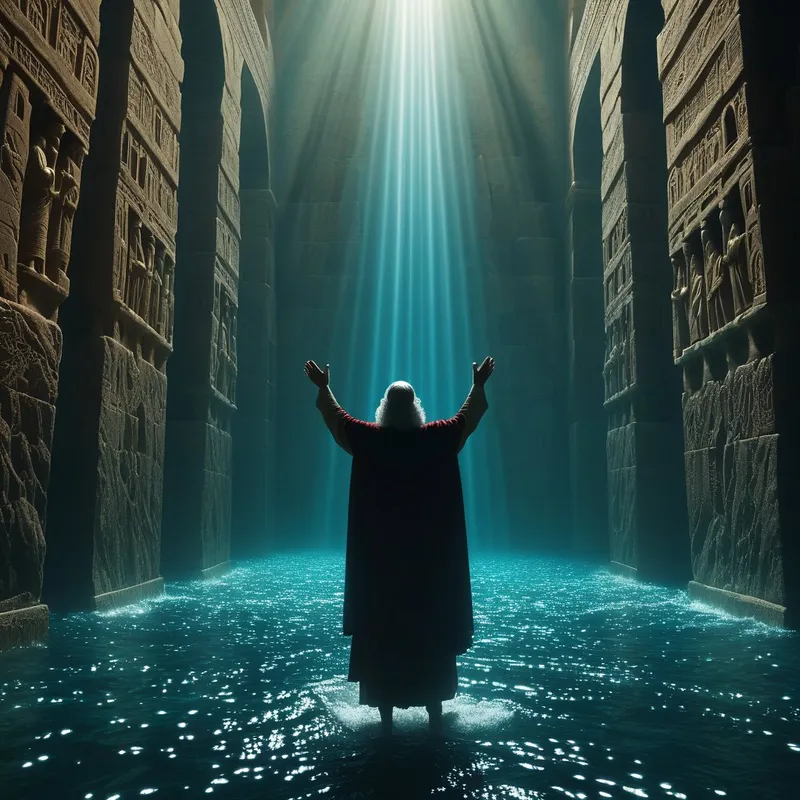
Then Moshe raised his staff over the waters. A wind from the east, a wind of Ruach Elohim, roared all night. It clawed at the sea, heaping the waters into walls, leaving a path of wet sand through the deep. The people crossed on dry ground, between towers of water that glimmered with trapped light. When the last soul reached the far shore, Moshe lowered his arm. The walls collapsed. The chariots and their drivers were swallowed by the returning sea.
Now began the true journey. In the vast, sun-scorched womb of the desert, Midbar, they wandered. Hunger gnawed. Thirst parched. From the sky fell bread like frost, Manna. From a rock struck by Moshe's staff, water gushed. At the foot of a trembling, smoke-wreathed mountain, Har Sinai, the voice spoke again, not to one man but to the whole people, in thunder and trumpet blast, giving the Law—the Ten Words carved by divine fire on stone. A covenant was forged: "You shall be my people, and I shall be your God."
For forty years, a generation died in the wilderness, their slave-minds buried in the sand. They built a portable sanctuary, the Mishkan, and carried it before them. They learned to walk as a free people, bound not to a Pharaoh, but to a promise. Moshe, the liberator who could not enter the land of promise, climbed Mount Nebo, looked across the Jordan, and died. His work was done. The people, born in the crucible of the desert, stood on the threshold, ready to cross over.
Cultural Origins & Context
The Exodus story is the foundational national epic of ancient Israel, the narrative heart of the Torah. Its origins are layered, likely woven from older tribal memories of escape from Egyptian hegemony, possibly during the late Bronze Age, combined with liturgical and legal traditions developed over centuries. It was not a history book but a theological and identity-forming document, recited during Passover (Pesach) and other festivals to answer the core question: "Who are we?" The answer was always: "We were slaves in Egypt, and YHWH brought us out with a mighty hand."
It functioned as a social charter, justifying the unique covenantal relationship with YHWH, the structure of Mosaic law, and the claim to the land of Canaan. The story was told by priests and prophets to remind the people of their origin in liberation, their obligation to justice (for they knew the heart of the stranger), and the consequences of breaking faith. It transformed a probable series of migrations and conflicts into a sacred, archetypal drama of divine election and human response.
Symbolic Architecture
At its core, Exodus is the psyche's drama of differentiation from the collective. Egypt symbolizes the unconscious, undifferentiated state—a place of comfort, predictability, and profound bondage. It is the "fleshpots of Egypt," the known suffering preferred to the terrifying freedom of the unknown. Pharaoh represents the tyrannical, inflating complex of the ego that seeks to keep the nascent Self enslaved, building monuments to its own glory.
The call to Exodus is the eruption of the Self, the burning bush that illuminates but does not destroy the vessel of consciousness.
The Ten Plagues are the necessary deconstruction of the old psychic order, the systematic humiliation of the "gods" of the familiar world (stability, security, power) so that liberation becomes possible. The Parting of the Sea is the critical, irreversible threshold. It is the baptism into a new mode of being, where the very elements of chaos (the watery deep, Tehom) are split to provide a path. To turn back is annihilation.
The forty years in the Midbar is the essential liminal space of transformation. The slave mentality, the internalized Pharaoh, must die off. Here, in the emptiness, the new identity is forged not through ease, but through dependence on the "daily bread" of the Self (Manna) and the living water from the struck rock (the unexpected grace that flows from confronting one's own hardness). Har Sinai represents the terrifying and awe-ful moment of direct encounter with the numinous, resulting not in bliss, but in Law—the necessary structure and boundaries (the Aseret HaDibrot) that make a coherent, ethical life possible outside of Egypt.
The Dreamer's Resonance
When this myth stirs in modern dreams, it signals a profound process of psychic liberation underway. Dreaming of being trapped in a vast, oppressive system (a corporate labyrinth, a endless school) points to the "Egypt" complex. Dreams of a guiding but distant voice, a pillar of fire or cloud, or a sudden, impossible pathway opening in an insurmountable obstacle (a wall of water, a cliff) reflect the emergent Self providing direction.
Dreams of wandering in a beautiful but barren desert, feeling both lost and strangely purposeful, mirror the "wilderness" phase. The somatic experience is often one of anxiety mixed with a deep, quiet certainty—the "manna" feeling of receiving just enough sustenance for the day's journey. To dream of receiving tablets of stone, a scroll with immutable rules, or of building a sacred, intricate inner space (the Mishkan) indicates the psyche is consolidating a new, more authentic value system and inner structure to replace the collapsed order of "Egypt."

Alchemical Translation
The alchemy of Exodus is the opus contra naturam—the work against the ingrained nature of the slave. It models the individuation process perfectly. First, there is the nigredo, the blackening: the recognition of one's bondage in the "Egypt" of personal history, familial complexes, or cultural conditioning. This is the painful, plague-ridden confrontation with what enslaves us.
The promised land is not a place of completion, but the capacity to engage in the struggle for meaning on ground of one's own choosing.
The parting of the sea is the separatio, the decisive, often crisis-driven break that feels miraculous and terrifying. The long wilderness wanderings represent the albedo, the whitening and purification. Here, the inflated ego (the generation of slaves) dies, and the individual learns to rely on the guidance of the Self, internalizing the law not as external imposition, but as the innate moral architecture of the mature psyche. The covenant at Sinai is the rubedo, the reddening or integration—a sacred marriage between conscious identity and the divine ground of being.
Finally, crossing the Jordan into the promised land is not a final rest, but the beginning of a new kind of work: the application of the liberated, covenanted Self to the realities of life. Moshe's inability to enter signifies that the archetype of the liberator must recede; the individual alone must step into their own future, carrying the law within, forever remembering they were once a slave, and are now free.
Associated Symbols
Explore related symbols from the CaleaDream lexicon: