Erlik Khan Siberian Myth Meaning & Symbolism
A myth of the first shaman's descent to the underworld to bargain with Erlik Khan for the souls of the sick and the secret of life's balance.
The Tale of Erlik Khan
In the time before time, when the world was still soft from the dreaming of Tengri, there was a separation. From the pure, bright clay of the upper world, the first humans were shaped. But the act of creation leaves a residue, a necessary counterpart. From the darker, colder clay of the abyss, another was formed: Erlik Khan.
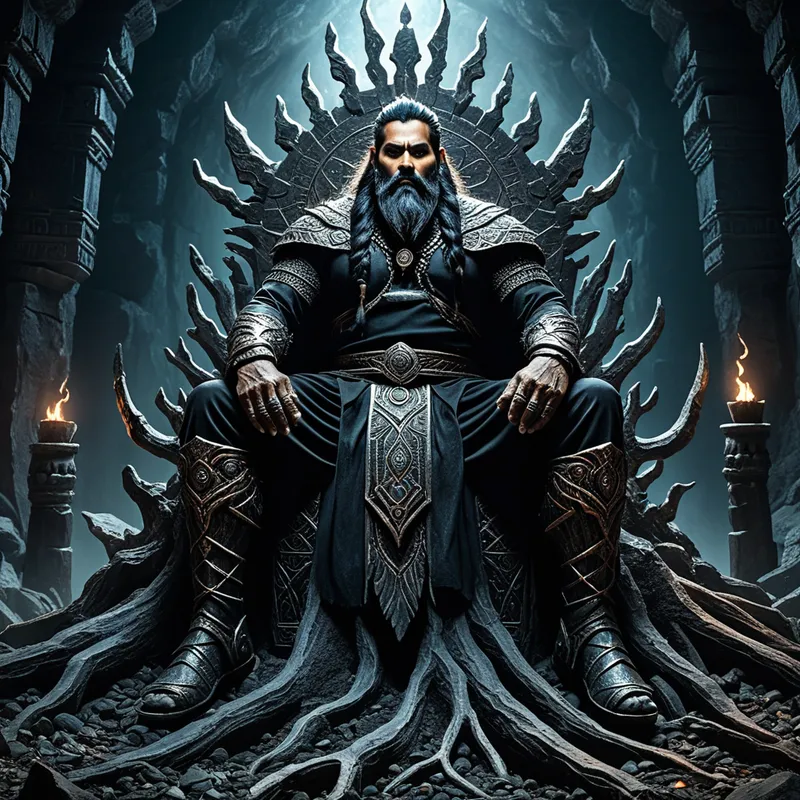
He was cast down, not into nothingness, but into a realm of his own—a vast, echoing kingdom beneath the roots of the World Tree. Here, in the chill and the silence, he built his palace of black iron and petrified wood. He became the master of all that falls away: the decaying leaf, the fading breath, the departing soul. His beard was of black copper, his teeth of iron, and his eyes held the cold glow of embers in a long-dead fire.
Above, in the world of light, life flourished but was incomplete. Sickness came. Death came not as a gentle sleep, but as a theft. Souls were drawn down to Erlik’s realm and did not return. The people wailed to the heavens. Tengri, in his distant majesty, heard them. He called upon the first of the shamans.
“You must go down,” came the command, a thought like thunder in the shaman’s mind. “You must face the Lord of the Below and bargain for the return of the stolen souls. You must secure a covenant for life.”
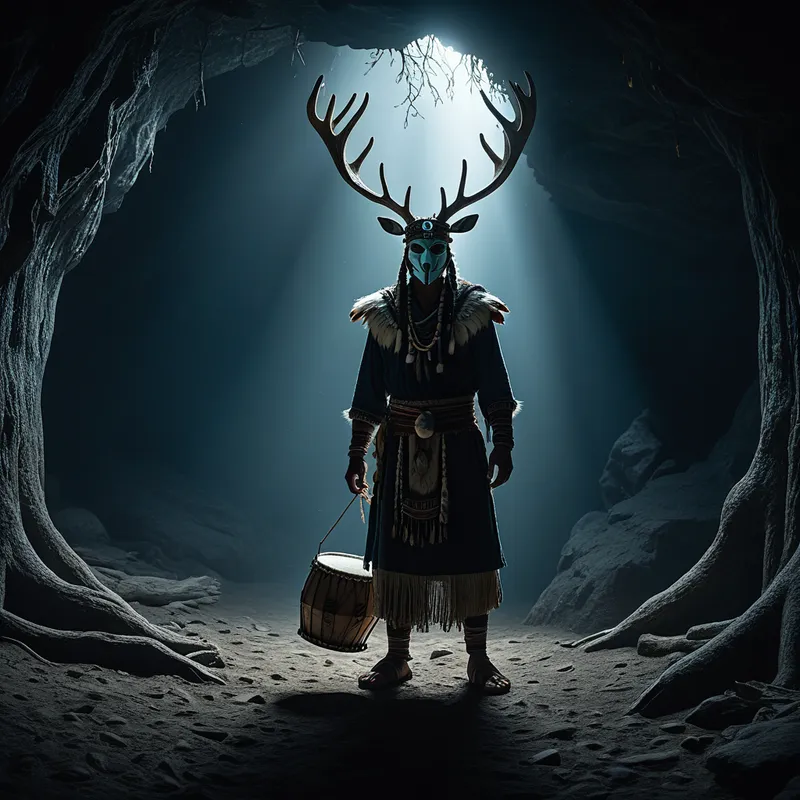
The shaman’s heart drummed a rhythm of terror. He put on his coat of power, hung with iron jingles to scare away malevolent spirits. He took his drum, the very hide of his helping spirit, and began the beat—a heartbeat for the journey out of the body. He descended. Not with steps, but with will. Through the tangled, suffocating roots of the World Tree, into the thickening dark where the air tasted of metal and old soil.
The kingdom of Erlik was a negative mirror of the world above: rivers flowed backwards, trees grew with roots towards a black sky. Finally, before the great, grim palace, the shaman stood. Erlik Khan sat upon his throne, surrounded by the pale, shimmering forms of the dead. His voice was the grind of stone on stone.
“Little insect of the upper world,” Erlik boomed. “You dare enter my domain uninvited? Your soul will join my collection.”
The shaman, trembling, raised his drum. “Great Erlik Khan, I come not for myself, but sent by Tengri. The people suffer. You take souls before their time. I have come to bargain for their return.”
A laugh, dry as falling bones, echoed through the hall. “Bargain? What has the bright world that I could possibly desire? I have the souls. I have the silence. I have the final word.”
The shaman felt despair coil in his gut. But then he remembered his purpose. “You have power,” the shaman said, his voice gaining strength. “But you have no honor in the world above. No songs are sung for you. No smoke of offering reaches your nostrils. Grant me the souls of the sick, and let death come only in its season. In return… the people will remember you. They will give you your due.”
Silence fell, deeper than before. Erlik’s ember-eyes narrowed. The offer hung in the stagnant air—not for material things, but for recognition. For a place in the order of things. To be more than mere refuse; to be a counterpart, a necessary lord.
“A clever insect,” Erlik murmured at last. “Very well. The souls of the sick you may take back. And death shall have its season. But for this… there is a price. Not for them. For you. To seal this pact, you will take something of my realm back with you. You will carry the knowledge of me. You will feel the chill of my kingdom in your bones. And you will be my voice in the world of light, reminding them that all things come to me in the end.”
The shaman bowed his head, accepting the terms. It was a victory, but one that changed the victor forever. He gathered the luminous souls like a net of mist and began the arduous ascent, the new weight of the underworld’s truth heavy upon him. He emerged into the sun, a bridge between worlds, forever marked by the darkness he had faced and the bargain that made life possible.
Cultural Origins & Context
The myth of Erlik Khan is a cornerstone of the spiritual worldview of many Indigenous peoples of Siberia, particularly among Turkic-speaking groups like the Altai, Khakas, and Shor, as well as influencing Mongolian cosmology. This is not a mere “story” but a living narrative framework transmitted orally through generations of shamans. It was performed, not just told, during rituals of healing, funeral rites, and seasonal ceremonies.
The shaman, acting as psychopomp and healer, would ritually re-enact this descent during healing séances. Drumming, chanting, and donning specific regalia, they would journey to Erlik’s realm to retrieve a patient’s stolen or strayed soul, or to escort the dead to their proper rest. The myth thus functioned as a sacred map, a procedural guide for navigating the most profound crises of life and death. It reinforced a cosmic order where balance was not a given, but a hard-won and continuously negotiated treaty between the forces of life (Tengri, the Upper World) and the forces of death and transformation (Erlik, the Lower World). Society depended on the shaman to maintain this precarious balance.
Symbolic Architecture
Erlik Khan is not a simple devil or villain. He is the archetypal Shadow made sovereign. Created from the same primordial substance as life itself, he represents the necessary, repressed counterpart to celestial order—the entropy, decay, and mortality without which life has no definition, no urgency, and no end point.
The underworld is not hell, but the unconscious itself; Erlik is the king we must acknowledge to rule our own inner realm.
The shaman’s descent is the classic katabasis, the hero’s journey inward and downward. The drum is the vehicle of ecstatic travel, the disciplined focus that allows one to navigate chaos. The critical moment is the bargain. The shaman does not slay Erlik; he negotiates with him. He offers the Shadow what it truly craves: recognition, integration, and a dignified role in the whole. The price—carrying the knowledge of the dark—symbolizes the burden of consciousness. To be whole, one must bear the weight of knowing one’s own capacity for darkness and the inevitability of one’s end.
The Dreamer's Resonance
When this mythic pattern stirs in the modern dreamer, it often manifests as dreams of descending into basements, caves, or subway tunnels, of encountering a powerful, intimidating, yet strangely compelling authority figure in a low or confined place. There is a sense of a necessary confrontation or negotiation.
Somatically, this may correlate with feelings of heaviness, coldness in the limbs, or a tightening in the gut—the body registering the “descent” into repressed material or unaddressed grief, illness, or shame. Psychologically, this is the process of engaging with the personal Shadow: the aspects of oneself deemed unacceptable, weak, or destructive. The dream-Erlik might be a fierce boss, a stern father, a criminal, or a dark version of the self. The dream is signaling that these energies can no longer be exiled; they demand audience and a treaty. The anxiety in the dream is the fear of being consumed by this darkness, but the myth assures that the outcome is not annihilation, but a difficult, transformative dialogue.
Alchemical Translation
The alchemy here is not of turning lead to gold, but of turning exile into treaty, and denial into acknowledged law. The individuation process modeled is one of sovereign integration.
First, the separatio: The conscious ego (the upper world people) recognizes something is amiss—sickness, stagnation, a repeating pattern. It feels robbed of vitality (soul loss).
Second, the nigredo: The ego, guided by the Self (Tengri), must consciously descend (the shaman’s journey). This is the dark night, the confrontation with the raw, unintegrated Shadow (Erlik in his full, terrifying sovereignty).
Third, the coniunctio: This is not a merging, but a sacred pact. The ego does not become the Shadow, nor does it destroy it. It negotiates. It offers the Shadow a place in the psychic economy—recognizing its power, its necessity in the cycle of death-and-rebirth, its role in defining limits. In return, the Shadow releases its compulsive, “thieving” hold on energy and agrees to operate within a conscious framework.
The crown of wholeness is forged in the underworld, not found in the sky.
The shaman returns “marked,” carrying the chill. This is the transformed individual. They are no longer innocent of life’s darkness. They bear the scar of the negotiation, which becomes a source of wisdom, depth, and the ability to heal others because they have faced the lord of illness itself. They hold the tension of the opposites, becoming a living World Tree, rooted in darkness and reaching for the light.
Associated Symbols
Explore related symbols from the CaleaDream lexicon:
- Cave — The entrance to the underworld and the unconscious; the place of descent where one confronts the foundational, often dark, aspects of existence.
- Descent — The essential movement of the myth, representing the voluntary journey into the depths of the psyche to retrieve lost vitality or knowledge.
- Drum — The shaman's vehicle and heartbeat of the journey; symbolizes the focused rhythm that maintains consciousness during the dissolution of ordinary reality.
- Shadow — The direct psychological correlate of Erlik Khan; the totality of the repressed, inferior aspects of the personality that hold great power.
- Bargain — The core action of the myth, representing the negotiation with the Shadow for integration, rather than its destruction or submission.
- Soul — That which is stolen and must be retrieved; represents vital energy, identity, and wholeness that is lost to unconscious complexes.
- Tree — The World Tree connecting all realms; the axis of the psyche along which the journey of integration travels.
- Throne — The sovereignty of the Shadow; the established, authoritative power of the repressed contents that must be formally acknowledged.
- Bridge — The function of the shaman and the integrated Self; that which connects the conscious world with the underworld, enabling dialogue and exchange.
- Ritual — The structured enactment of the myth; the conscious, respectful framework that makes the dangerous journey of descent and negotiation possible.