Echidna Myth Meaning & Symbolism
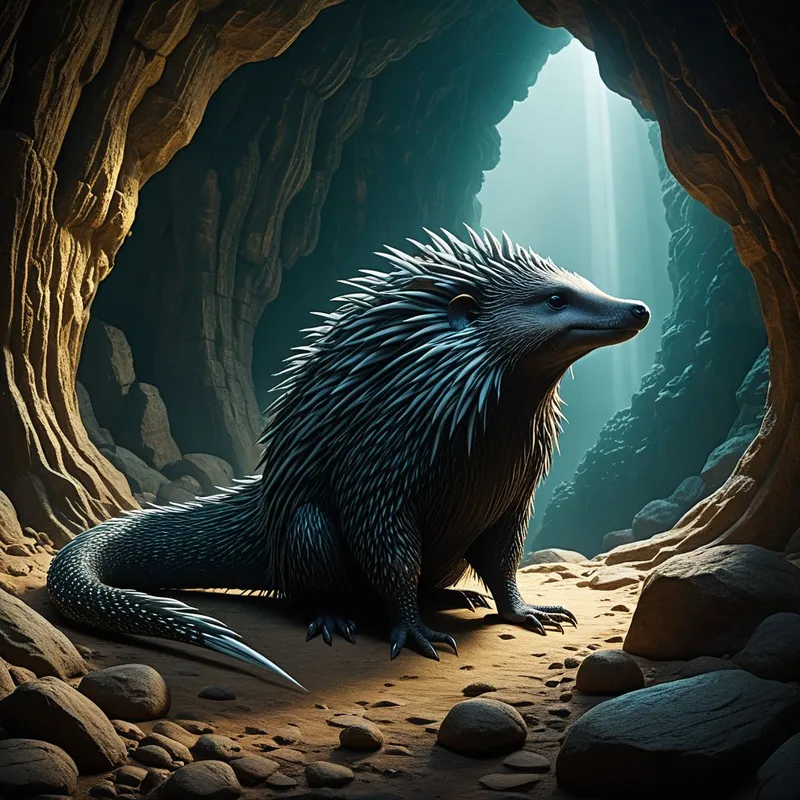
The primordial half-woman, half-serpent, mother of all monsters, dwelling in a cave at the edge of the world, embodying the raw, untamed genesis of chaos.
The Tale of Echidna
Before the gods of Olympus claimed their thrones, when the world was still raw from the forge of creation, the earth itself gave birth to terrors. In the deepest, most forgotten chasms, where the sun’s reach failed and the bones of the world groaned, she waited. Her name was whispered on the winds that howled through mountain passes—Echidna.
She was a child of the primordial titans, Phorcys and Ceto, born of the fathomless sea and the hungry dark. Her form was a paradox that froze the blood: the face and torso of a nymph, hauntingly beautiful, with eyes that held the depth of starless nights. But from the waist down, she was a monstrous serpent, a coil of immense, scaled power that whispered against the stone. This was her domain: the sunless cave of Arima, a place spoken of only in dread, where the earth cracked open near the Cimmerian mist.
To this cavern of shadows came another exile, a being of fire and storm—Typhon, the deadliest creature ever to challenge the sky. He was a hurricane given flesh, with a hundred serpent heads that hissed with the voices of beasts and gods. In that pit of genesis, monster recognized monster. In a union of cataclysm, Echidna and Typhon coupled, and from their dread embrace sprang the pantheon of nightmares that would haunt the heroic age.
Her children were the crucible of heroes. There was Cerberus, the three-headed guardian of the dead, and the Lernaean Hydra, whose many heads sprouted anew when struck. Chimera, lion-headed, goat-bodied, serpent-tailed, breathed chaos. The Caucasian Eagle and the Orthrus were her brood. The Sphinx with her riddles, and the Colchian Dragon that never slept—all were born of her serpentine womb. She was the womb of every trial, the mother of every monstrous obstacle the shining order of Olympus would ever face.
And so she dwelt, the eternal mother in her dark nursery, until the wheels of fate turned even for her. Some say she was slain in her sleep by the hundred-eyed giant Argus Panoptes, a servant of the new order. Others whisper she was left alive, an eternal, contained source, for as long as the world knows fear and challenge, the Mother of Monsters must have a place to be. Her cave remains, a silent, gaping mouth at the world’s edge, the dark cradle from which all terrors first crawled.
Cultural Origins & Context
The figure of Echidna is woven into the earliest layers of Greek cosmogony, appearing in the foundational texts of Hesiod’s Theogony and later in the fragments of epic cycles. She is not a goddess of the polished Olympian pantheon but a relic of the chthonic, pre-Olympian world—a being born directly from the Earth (Gaia) and the Sea (Pontus). Her storytellers were poets like Hesiod, who used such genealogies to map the universe’s moral and physical architecture, explaining the origin of evil, hardship, and the monstrous challenges that define a heroic culture.
Her myth served a crucial societal function: to give a source to chaos. By personifying the origin of monsters in a single, maternal figure dwelling in a specific, albeit remote, location, the Greeks contained the terrifying randomness of the unknown. It created a genealogy of fear. Every beast slain by a hero was not a random accident but a sibling from a known lineage. This narrative containment made the world comprehensible and, by extension, conquerable. Echidna’s cave is the symbolic birthplace of all that must be faced and overcome for civilization (represented by Olympus) to establish and maintain its order.
Symbolic Architecture
Echidna is the archetype of the primal creative matrix, but one that births forms of terror and challenge. She is not evil in a moral sense, but a necessary, foundational aspect of reality—the chaotic, fertile ground from which all defined things must emerge and against which they must define themselves.
She is the womb of the world, but a womb that labors with dragons. Her beauty speaks to the allure of the unconscious, its profound depth and potential; her serpent-body reveals its instinctual, amoral, and potentially overwhelming nature.
Her hybrid form is the ultimate symbol of the liminal. The woman—representing fertility, nurture, and perhaps even a tragic consciousness—is forever fused with the serpent—ancient emblem of the earth, rebirth, cunning, and the untamed life-force. She exists at the threshold between the human and the utterly alien, between creative potential and destructive force. Her cave, Arima, is not just a physical location but a psychological one: the deep, hidden chamber of the psyche where our most primal and unformed potentials—our fears, rages, and wild instincts—are gestated.
Her union with Typhon, the personification of cataclysmic upheaval, symbolizes what happens when the raw, formative power of the deep psyche (Echidna) meets active, volcanic chaos (Typhon). Their offspring are the specificized forms of inner and outer conflict: the Hydra of multiplying problems, the Cerberus that guards our personal thresholds of transformation, the Sphinx that challenges our intellect with existential riddles.
The Dreamer's Resonance
When the pattern of Echidna stirs in modern dreams, it signals a profound engagement with the foundational layers of the Self. This is not about encountering a single monster, but about confronting the source from which all one’s personal "monsters" are born.
To dream of a beautiful figure whose lower half is a serpent, or of a deep, nurturing yet terrifying cave, points to a somatic and psychological process of confronting the primal matrix of one’s own psyche. The dreamer may be feeling overwhelmed by the genesis of too many challenges at once—a "litter" of problems in career, relationships, and health all seeming to arise from the same deep, shadowy place within. The body may respond with feelings of deep anxiety, a sinking in the gut (the serpent region), or a sense of being "poisoned" at the source.
This dream motif asks the dreamer: What is gestating in your deepest cave? What unformed, powerful, and terrifying potentials are you nurturing in the dark? The sorrow in Echidna’s beautiful face may reflect the dreamer’s own grief or fear over the powerful, chaotic forces they feel within—forces that seem alien yet intimately part of them. The dream is an invitation to acknowledge this inner "mother of monsters," not to slay her, but to understand her as the necessary ground of one’s being.
Alchemical Translation
In the alchemical journey of individuation, Echidna represents the prima materia—the chaotic, base, and monstrous starting material of the great work. The process is not about killing her, but about integrating her creative-destructive power. She is the shadow of the Creator archetype, the part of us that creates not order, but the raw material upon which order is built.
The heroic ego’s task is not to destroy the cave, but to descend into it, acknowledge the mother, and claim her children as its own challenges to be metabolized.
The first alchemical step is containment (the cave itself). One must learn to hold the chaotic, generative energy without being flooded by it. This is the "vessel" of the work. The second is recognition: seeing the beauty and the terror as two aspects of the same profound source. The sorrow of Echidna is the psyche’s lament over its own split state.
The final translation is transmutation through relationship. Each monster she births—each Hydra of resentment, Cerberus of defense, or Sphinx of intellectual pride—must be engaged with consciously. By facing these "offspring," the individual does not erase Echidna but changes their relationship to her. She transforms from a feared source of external persecution into the acknowledged, deep wellspring of one’s resilience, strength, and creative potency. The energy that once created autonomous monsters is harnessed to fuel the conscious creation of the Self. The cave remains, but the hero who has visited it is no longer its victim; they understand they are, in part, its child.
Associated Symbols
Explore related symbols from the CaleaDream lexicon: