Dilmun Myth Meaning & Symbolism
The myth of Dilmun tells of a silent, sterile paradise made fertile by the divine union of water and earth, a blueprint for psychic creation.
The Tale of Dilmun
In the beginning of time, before the clamor of cities and the weight of history, there was a place. It was not a place of struggle or sorrow, but of a profound and aching stillness. The gods themselves knew of it, a secret held in the breath between creation and chaos. They called it Dilmun.
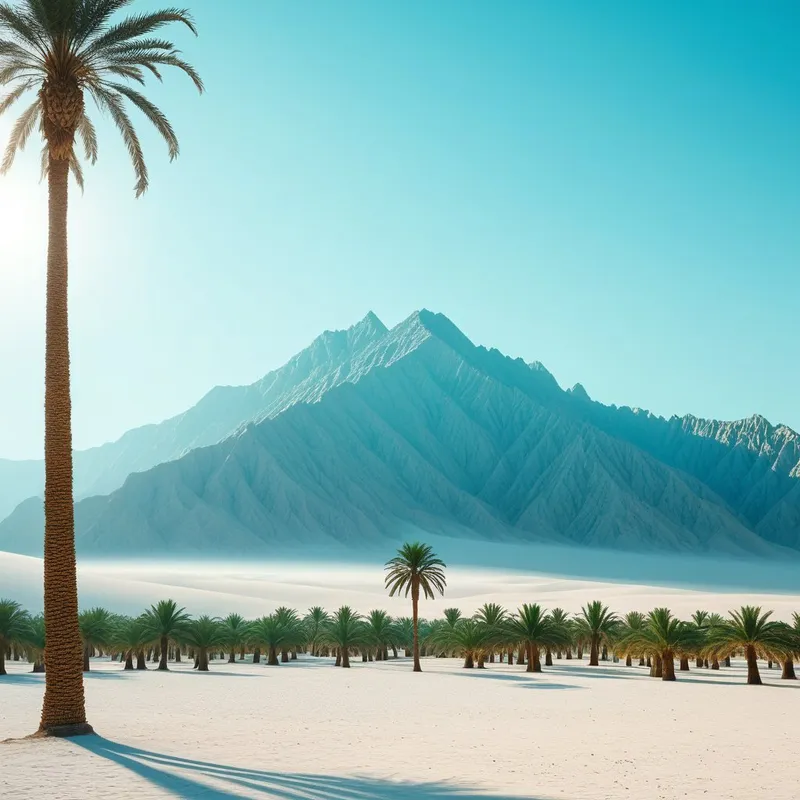
Dilmun was pure. Its earth was white as bleached bone, its waters clear as the first thought. Date palms stood in silent rows, but they bore no fruit. The marshes held no reeds, the fields no grain. There was no sickness, no old age, no weeping—but also no laughter, no growth, no life. It was a paradise of absence, a perfect, sterile jewel. It was a land that had forgotten the taste of rain.
In this silent realm dwelt the goddess Ninhursag, the great mother of the wild things. Yet here, even her power was held in suspension. She looked upon the clean, barren earth and felt a longing deeper than the abyss. She turned her gaze to Enki, the cunning lord of the sweet waters, the one who fills the rivers and knows the secrets in the deep.
Their meeting was not a clash, but a convergence. Ninhursag, the solid, waiting earth. Enki, the fluid, seeking water. She spoke of the silence. He heard the thirst. From the great abyss, the Apsu, Enki called forth his essence. He did not send a storm, but a gift. He commanded the sun-god Utu to bring fresh water up from the depths of the world, to let it rise not as a flood, but as a gentle, pervasive emergence.
And so it happened. Water, sweet and life-giving, began to seep into the white soil of Dilmun. It did not roar; it whispered. It filled the dry riverbeds with a quiet murmur. It kissed the roots of the barren date palms. The earth, touched by Enki’s gift, shuddered—a deep, tectonic sigh of release.
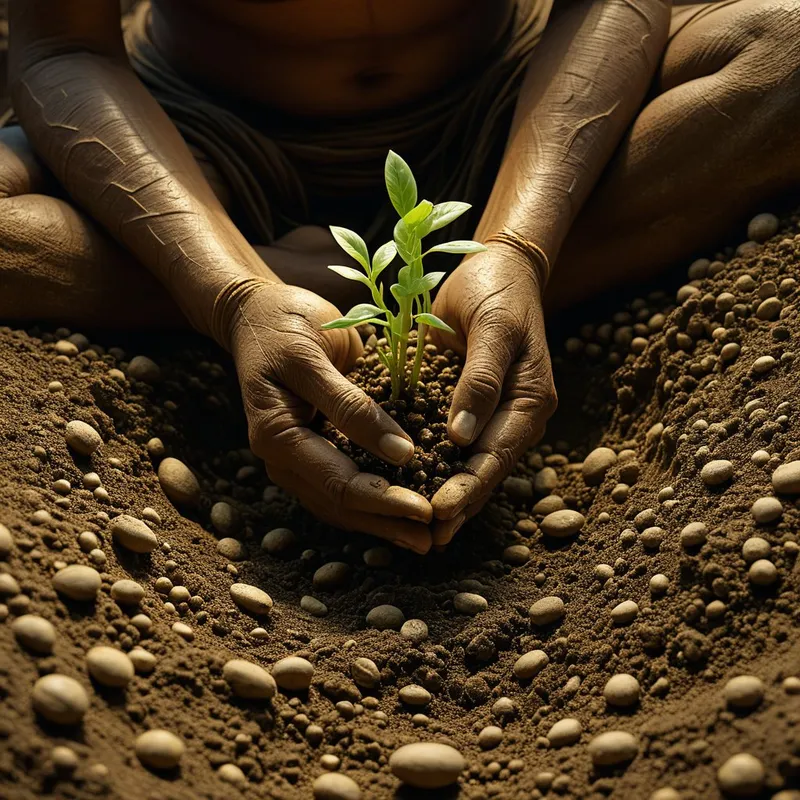
Where the water met the earth, where Enki’s fluidity merged with Ninhursag’s solidity, life happened. It was not made; it was unlocked. The date palms groaned and swelled, their branches heavy with golden fruit. Barley sprouted from the fields in a green wave. Lush gardens of cucumbers and apples unfolded like tapestries. The marshes sang with reeds, and the air, once silent, hummed with the drone of bees and the rustle of leaves. Dilmun was no longer sterile. It was fertile. It was complete. The divine marriage was consummated in the sprouting of a single seed, and paradise awoke from its dream of purity into the messy, glorious reality of creation.
Cultural Origins & Context
The myth of Dilmun is preserved in the Sumerian epic "Enki and Ninhursag," a composition dating back to the late third millennium BCE. It was not a popular folktale but a sacred narrative, likely recited by temple scribes and priests during rituals that affirmed the cosmic order. For the people of Mesopotamia, living in a land dependent on the precarious gifts of the Tigris and Euphrates rivers, the myth explained the fundamental principle of their existence: fertility is not a given; it is a divine collaboration.
Dilmun also held a geographical mystique. Scholars believe it referred to the region of Bahrain, a trading partner known for its fresh-water springs and date palms in the midst of the salty sea. Thus, the myth also functioned as a kind of sacred geography, transforming a known trade destination into an archetypal realm of origin and purity. It served as a societal anchor, reminding the city-state that their civilization—their agriculture, their laws, their very lives—was a miraculous intervention in a world that could easily revert to barren silence.
Symbolic Architecture
At its core, Dilmun is not merely a place, but a state of being. It represents the primordial condition of the psyche before the engagement of consciousness. It is perfect, conflict-free, and utterly inert.
The sterile paradise is the greatest prison, for it offers everything except the one thing that matters: the friction required for creation.
The white earth symbolizes the tabula rasa, the pure but potential-less self. The clear waters are consciousness in its most undifferentiated, dormant state. The deities are not external beings but archetypal forces within the human soul: Ninhursag as the grounding, maternal principle of form and containment (the Great Mother), and Enki as the fluid, penetrating principle of insight, energy, and life-giving spirit (the Spirit). The conflict is not one of battle, but of need. Form yearns for animation; spirit seeks a vessel.
The rising of the sweet water is the critical moment of psychic activation. It is the influx of libido (life energy), the first stirring of emotion, the dawning of a creative idea that irrigates the dry fields of the mind. The resulting fertility is the birth of the living personality—no longer a static ideal, but a dynamic, growing, and fruitful entity.
The Dreamer's Resonance
When this myth stirs in the modern unconscious, it often manifests in dreams of profound stillness that is both peaceful and unsettling. One may dream of a beautiful, empty house; a pristine, snow-covered landscape with no footprints; or a crystal-clear pool in which nothing swims. The somatic feeling is one of suspension, of breath held. There is no pain, but a deep, quiet ache of incompletion.
This dream pattern signals a psyche in a state of potential, poised on the brink of a creative or emotional awakening. The sterility reflects a period of latency, recovery, or perhaps a defensive withdrawal into a "perfect" but lifeless inner world. The dream is the soul's diagnosis: you are safe, but you are not alive. The longing felt in the dream—for movement, for sound, for growth—is the psychic equivalent of Ninhursag's gaze toward Enki. It is the Self calling for the necessary, life-giving "water" to break the spell of sterile perfection and initiate the messy, fruitful process of becoming.

Alchemical Translation
The journey from silent Dilmun to fertile Dilmun is a perfect model for the alchemical process of individuation—the psychological transmutation of the base, unconscious self into the realized, whole Self. The first stage, nigredo, is often associated with darkness and decay, but Dilmun presents a different beginning: the albedo, the whitening. This is the stage of purification, of achieving a stark, simplified clarity. Yet, as the myth warns, to remain in the albedo is to remain in a state of spiritual arrest.
The goal is not purity, but wholeness; the fusion of spirit and matter within the soul's own vessel.
The intervention of Enki's water represents the citrinitas, the yellowing or dawning of the solar light of consciousness into this white void. It is the moment of inspiration, the therapeutic insight, the courageous feeling that floods the isolated psyche. This is not a violent rupture, but a sacred marriage (hieros gamos) of the deep, structuring feminine (earth/body/unconscious) and the active, fertilizing masculine (water/spirit/consciousness).
The resulting fertility—the lush gardens, the fruiting trees—symbolizes the final stage, the rubedo, the reddening. This is the embodied, passionate, and fully lived life. The individual is no longer a blank slate or a repository of potential, but a creator in their own right, bearing the unique fruits of their experience. The myth teaches that our deepest awakenings are not explosions, but irrigations. Wholeness is achieved not by fleeing to a painless paradise, but by allowing the living waters of the spirit to penetrate the waiting earth of our being, thereby transforming a silent ideal into a singing, tangible reality.
Associated Symbols
Explore related symbols from the CaleaDream lexicon: