Demeter's Seeds Myth Meaning & Symbolism
A goddess's grief for her stolen daughter brings eternal winter, until a compromise seeds the cycle of life, death, and seasonal rebirth.
The Tale of Demeter's Seeds
Hear now the story that cracks the earth open, the tale that explains why we shiver in the dark and hunger for the sun. It begins not with a hero, but with a mother’s love, a love as deep and fertile as the black soil itself.
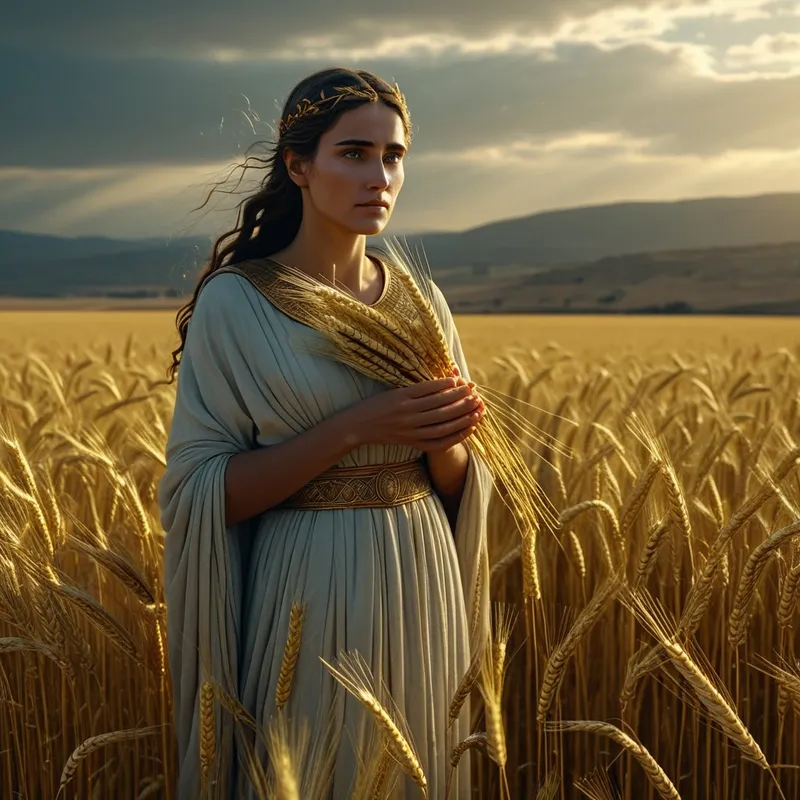
In the golden age when the world was young and untamed, Demeter walked the earth. Where her feet touched, life erupted. Barley grew tall, vines grew heavy, and flowers turned their faces to her like children. Her joy was her daughter, Persephone, whose laughter was the sound of budding leaves and whose beauty was the first blush on a ripening fruit. They wandered together in the Nysian plain, a place of eternal spring, weaving garlands of violet and crocus.
But beneath the world, in sunless halls of polished stone and echoing silence, a loneliness festered. Hades, lord of the departed, watched from the deep. He saw Persephone’s light and desired it for his own, a single flower for his barren kingdom. With the silent consent of her father, Zeus, he acted.
The earth split with a sound like a thousand trees falling. From the chasm, a chariot of obsidian drawn by immortal, smoke-dark horses erupted. Hades, in his terrible majesty, seized Persephone. Her cry was swallowed by the closing earth. Only her torn garland and the fading scent of lilies remained on the torn grass.
Demeter’s scream was a scythe that cut across the world. She heard the echo of that cry in the sudden silence of the birds. For nine days and nine nights, she roamed the earth, a torch in each hand, her divine form cloaked in mortal grief. She asked the sun, who had seen all; she asked the rivers, who had heard all. But the world had gone mute with fear. The green world began to wither at the edges, a blight following in her footsteps.
In her despair, disguised as an old woman, she came to Eleusis. There, in the king’s house, she nursed an infant prince, seeking to make him immortal, to fill the void with a new, undying child. But the ritual was interrupted, and in her fury, she revealed her divinity, commanding a temple be built. There she sat, in the stone silence of her shrine. And the great Hunger began.
The earth turned to iron. Seeds shriveled in the furrow. Plows broke on the frozen ground. Cattle lowed and died. Mankind faced extinction, and the gods received no sweet smoke from their altars. The cosmos was unraveling from the core.
The truth was finally whispered by the spring-nymph Arethusa, who had seen the ghost of a girl weeping in the land of the dead. Hecate, torch-bearing, led the raging Demeter to the throne of Zeus. The king of gods, faced with the annihilation of his creation, commanded Hades to return the girl.
In the underworld, Persephone had eaten nothing, a prisoner of her longing. But as Hades set her in his chariot for the ascent, he offered her a final gift—a few ruby seeds from a pomegranate. Parched and distracted, she accepted, consuming its sweet-tart flesh. Those few seeds were a chain, a contract written in the juice of the dead.
She emerged into the light, and mother and daughter flew into each other’s arms. The ice cracked. A sigh went through the world. But the law of the Moirai was absolute: whoever consumes the food of the dead must return to them. For each seed eaten, a month must be spent below.
Thus, a compromise was struck, seeded in grief and necessity. For two-thirds of the year, Persephone walks with her mother, and the earth blooms with Demeter’s joy. But for one-third, she descends to her dark throne, and Demeter’s grief brings the fallow time. The seed must go into the dark earth to break open. The daughter must become queen. The mother must learn to let go. And so, the wheel of the seasons was born from a broken heart.

Cultural Origins & Context
This myth, central to what we call the Homeric Hymn to Demeter, was far more than a simple etiology for the seasons. It was the sacred, beating heart of the Eleusinian Mysteries, the most revered initiatory cult of the ancient Greek world for nearly two millennia. The hymn itself, likely composed in the 7th century BCE, served as a liturgical text, recounting the foundation myth of these rites.
At Eleusis, initiates (mystai) underwent a profound ritual process, the details of which were guarded by a vow of secrecy so potent that we still do not know their full content. We do know it involved a sacred drama re-enacting Demeter’s search, her grief, and Persephone’s return. The myth was not merely told; it was experienced. Its function was societal and deeply personal: to alleviate the primal fear of death by promising a better lot in the afterlife, a hope directly linked to Persephone’s dual citizenship in the worlds of light and dark. It transformed the agricultural cycle—the literal life and death of the seed—into a map for the human soul, offering a vision of cyclical renewal that transcended the finality of the grave.
Symbolic Architecture
The myth’s power lies in its flawless symbolic architecture, where every element is a facet of a profound psychological truth.
Demeter is the archetype of the Great Mother in her full spectrum: the giver of life and abundance, and, when wounded, the withholder who brings sterility and winter. Her grief is not petty; it is the creative force of the universe turned inward, demonstrating that life itself withdraws when its deepest bonds are violated.
Persephone represents the innocent, nascent consciousness—the kore (maiden)—who is compelled into a necessary initiation. Her abduction is a brutal metaphor for the inevitable descent of the psyche into the unconscious (the Underworld). She does not choose it, yet she must integrate it to become whole. Her return is not a full rescue, but a transformation. She is no longer just Demeter’s daughter; she is Queen of the Dead, a holder of profound, shadowed wisdom.
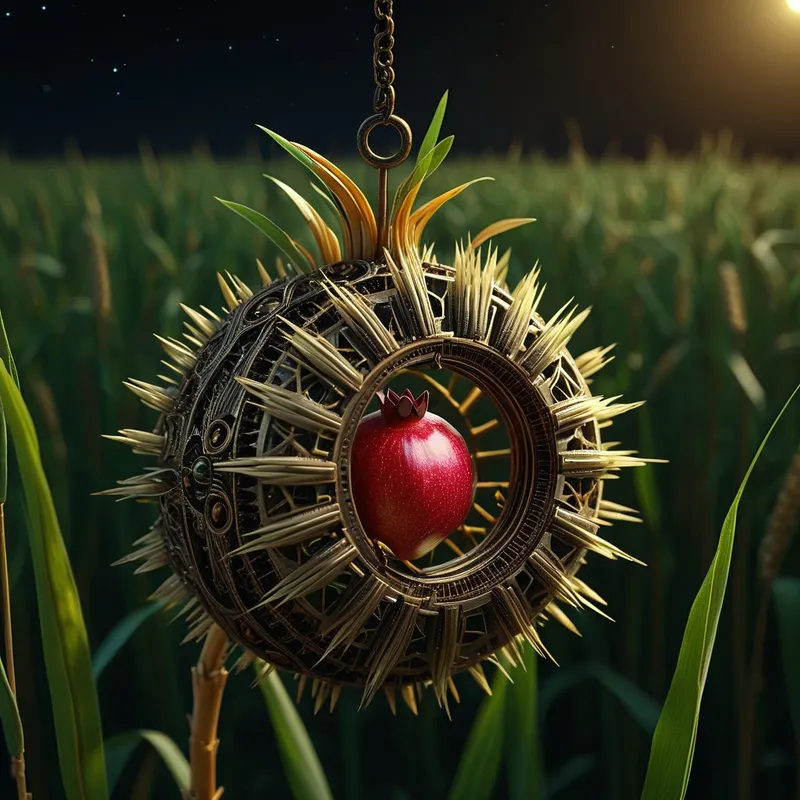
The Pomegranate Seeds are the crux of the alchemy. They are not a trick, but a fateful choice that seals a transformation.
To eat the food of the underworld is to internalize its reality. The seeds are the compact between the conscious self and the unconscious depths—a binding agreement that once you have known the dark, you can never wholly live in the light again, nor should you.
Hades is not merely a villain, but the necessary principle of containment, depth, and the invisible. He is the catalyst for the entire cycle of death and rebirth. Without his claim, Persephone remains eternally a child, and Demeter’s creation remains static, without rhythm or depth.
The cycle itself—descent, sojourn, return—models the fundamental pattern of psychological life: wholeness is achieved not by avoiding the darkness, but by establishing a conscious rhythm between our surface identities and our hidden depths.
The Dreamer's Resonance
When this myth stirs in the modern dreamer, it rarely appears as a classical tableau. Instead, it manifests as the feeling of the pattern. One may dream of a cherished garden suddenly freezing over, symbolizing a creative or emotional life that has gone fallow due to a profound, often unacknowledged loss. The dream-ego might search frantically for a lost child, a lost idea, or a lost version of the self in a labyrinthine landscape.
The figure of Persephone appears as the part of the self that feels “stolen” or forced into a situation—a career, a relationship, a depression—that feels like a living death. The pomegranate seeds might appear as a forbidden but tempting contract, a secret kept, or a small, consequential choice that seems to bind one to a difficult path. The somatic experience is key: the heavy, sinking feeling of abduction; the hollow, gnawing ache of Demeter’s search; the ambiguous relief mixed with dread upon the return, knowing a part of you remains below.
Such dreams signal that a major initiation is underway. The conscious personality (Demeter) is in mourning for an old state of innocence that has been irrevocably lost to the depths of the unconscious (Hades’ realm). The psyche is working to negotiate a new relationship between these poles, seeking the lawful compromise that will allow life to continue, but in a more complex, seasoned form.

Alchemical Translation
For the individual, the myth of Demeter’s Seeds is a master guide for the alchemical process of individuation. It maps the transformation of the personality from a state of naive unity, through catastrophic rupture, into a higher, cyclical integrity.
The first stage is the Abduction (Nigredo). This is the unavoidable crisis: the loss of a loved one, the failure of a life-structure, the eruption of depression or illness. Like Persephone, the ego is plunged into the dark, against its will. All seems lost.
The second is the Grief-Stricken Search (the Mortificatio). This is Demeter’s winter. The conscious mind, robbed of its beloved object (a relationship, a talent, a meaning), withdraws its energy from the world. Life feels barren. This is not a pathology, but a necessary period of incubation and protest. The psyche refuses business as usual.
The third is the Consumption of the Seeds (the Coniunctio). This is the critical, transformative moment in the dark. It is the decision, however forced, to engage with the underworld. In psychological terms, it is when we stop merely suffering our depression, grief, or shadow, and begin to consciously relate to it. We “eat” its reality. We learn its rules. We find, like Persephone, a form of sovereignty in the place of our captivity.
The alchemical gold is not the return to the previous state, but the establishment of the cycle itself. The triumph is in becoming a creature who can dwell in two worlds, whose roots are in the darkness and whose flower opens to the light.
The final stage is the Cyclical Return (the Circulatio). This is the established rhythm. The individual no longer seeks a permanent, static happiness in the “upper world.” They understand that wisdom, creativity, and depth require periodic descents into the interior. The mother (the nurturing, social self) learns to release the daughter (the soul) to its necessary depths, trusting in the return. The person becomes like the earth itself: capable of abundant expression and necessary fallowness, of joy and profound grief, each giving meaning to the other. They have internalized the law of the seed: that to bear fruit, one must first consent to be buried.
Associated Symbols
Explore related symbols from the CaleaDream lexicon: