Coya Raymi Moon Festival Myth Meaning & Symbolism
A sacred Incan festival honoring the Moon, weaving myth, ritual, and the deep psychological reconciliation of light and shadow, order and chaos.
The Tale of Coya Raymi Moon Festival
Listen. The world holds its breath in the high, thin air of Tawantinsuyu. The sun, Inti, has long since plunged behind the jagged teeth of the Andes, leaving a sky of deepening indigo. But this is not a night of darkness. It is the night of Coya Raymi, when the true sovereign of the shadows ascends her throne.
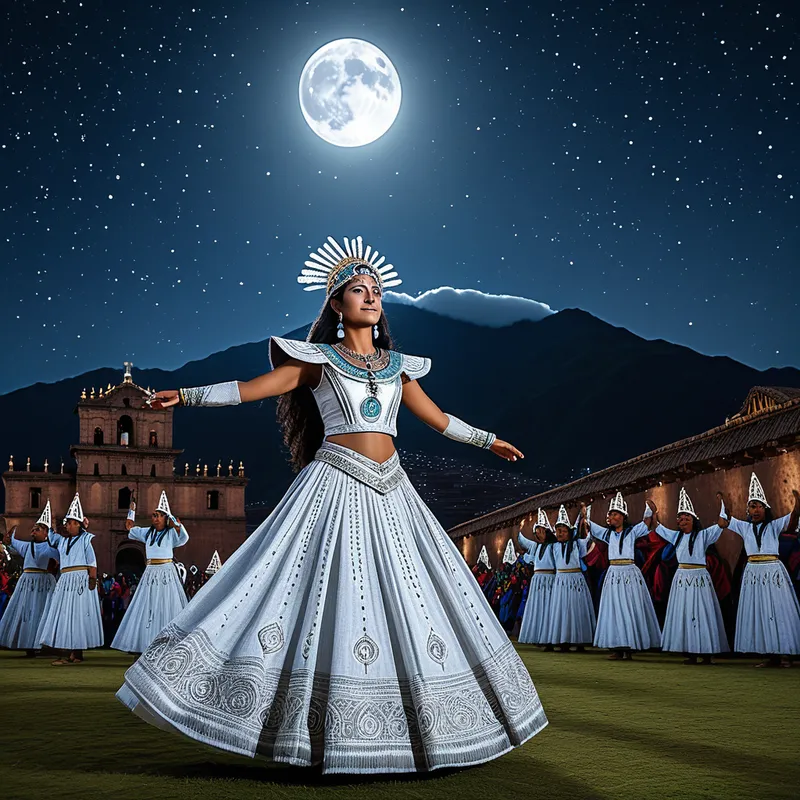
From the sacred precinct of Coricancha, a procession begins, not with drums and shouts, but with a profound, silver silence. It is led by the Sapa Inca and the acllas, the daughters of the moon, cloaked in fabrics that seem woven from moonlight itself. They carry no torches. They need none. For above, Mama Quilla reveals her full, luminous face, a great silver mirror suspended in the vault of heaven.
But the myth whispers of a time when that mirror was stained. Mama Quilla, they say, weeps. Her tears are the shadows that mar her perfect face—the marks we call craters. Some tales say they are the scars from a great cosmic battle, a rebellion in the heavens. Others murmur of a profound grief, a separation from her brother-husband Inti, whose blazing path she must forever follow but never join, a celestial dance of eternal pursuit and eternal distance. Her light is not her own, but a borrowed, reflected glory from the sun, and in that reflection lies a deep melancholy and a hidden, potent power.
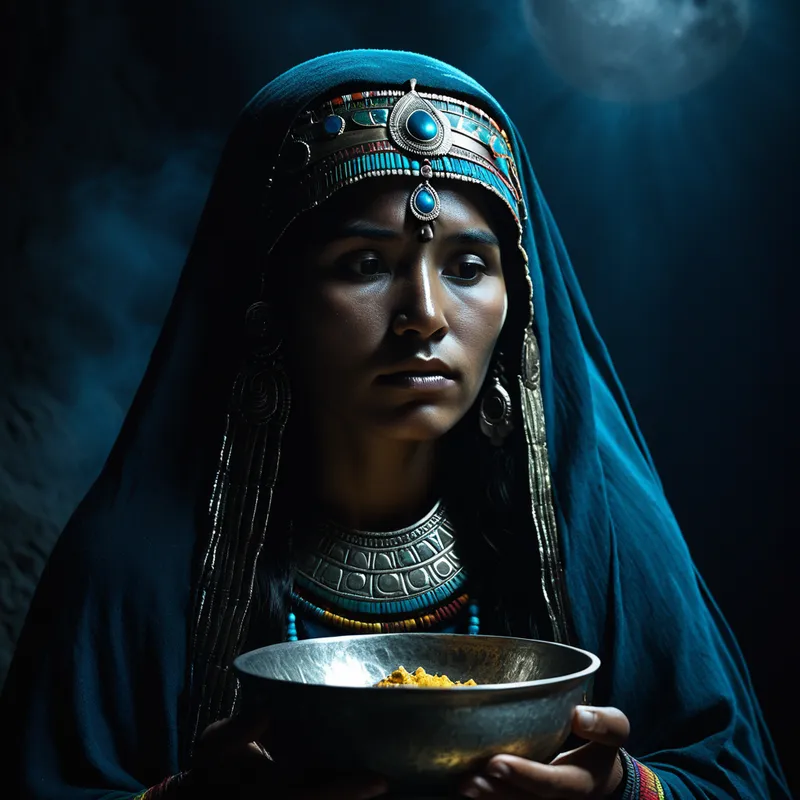
The festival is her balm. As the acllas pour libations of chicha into silver bowls, the liquid becomes a second moon, captured upon the earth. They offer the finest white llamas, animals as pale as her light. The women of the empire, from the Coya (Queen) to the humblest weaver, step into the moonlight, their movements in the ritual dances a silent language of empathy. They are mirroring her sorrow, sharing her burden, and in doing so, they are transforming it.
The conflict is not one of clashing swords, but of opposing principles: the unbearable solitude of consciousness (the moon) and the blinding totality of the source (the sun). The rising action is the ritual itself—the collective, somatic act of holding that tension. The women do not seek to banish the shadow on the moon’s face; they honor it. They acknowledge the grief, the flaw, the borrowed nature of their own light.
And in that acknowledgment comes the resolution. As the night reaches its deepest hour, a profound peace settles. Mama Quilla’s light, once a symbol of lonely reflection, becomes a gentle, embracing radiance that reveals the contours of the sacred land without the sun’s harsh judgment. She illuminates the hidden springs, the sleeping terraces, the quiet paths. Her festival does not erase the shadow; it reconciles it with the light, creating a wholeness that the sun alone could never achieve. The moon is made sovereign for a night, not in spite of her tears, but because of them.
Cultural Origins & Context
Coya Raymi, the "Queen's Festival," was one of the four principal ceremonial pillars of the Inca calendar, corresponding roughly to our September equinox. It stood in direct complement to Inti Raymi. While Inti Raymi was a public, masculine, and solar spectacle of state power and military might, Coya Raymi was its intimate, feminine, and lunar counterpart. Its primary participants were women, particularly the acllas and the noble Coya herself.
The myth was not a single, fixed story recited verbatim, but a living narrative embedded in ritual action. It was passed down through the choreography of dances, the specific preparations of ritual foods (like sancu, a sacred maize bread), and the duties of the female priesthood. Spanish chroniclers like Bernabé Cobo recorded its existence, though through a colonial lens that often missed its deeper psychological resonance. Societally, its function was multifaceted: it regulated the agricultural calendar (linking the moon to water and fertility), reinforced gender roles and the sacred status of women in the cosmic order, and served as a profound mechanism for social cohesion. By collectively performing the moon’s sorrow, the community cathartically processed shared grief, fear of the dark, and the mysteries of the feminine cycle, integrating these into the sanctioned order of the empire.
Symbolic Architecture
At its core, the myth of Coya Raymi is an archetypal drama of the anima and the reconciliation of opposites. Mama Quilla represents the reflective principle of consciousness—the psyche’s capacity to receive, hold, and transform the raw, often overwhelming energy of the solar source (Inti, the ego, or the conscious will).
The moon does not generate light; she receives it, softens it, and makes it meaningful for the shadowed realms of the soul. Her power is not in brilliance, but in reflection.
The "shadow" on her face is the critical symbol. It is not an imperfection to be removed, but the record of lived experience—the grief, the memory, the trauma, the depth that gives character to the light. In psychological terms, it is the personal and collective unconscious, the repository of all that the blinding light of ego-consciousness cannot bear to see directly. The festival ritual is a symbolic enactment of what Jung called the coniunctio oppositorum—the sacred marriage. Here, it is not between male and female persons, but between solar consciousness and lunar unconsciousness, between the drive for order and the acceptance of inherent, meaningful flaw.
The acllas, mediating between the Sapa Inca (solar authority) and Mama Quilla, symbolize the ego’s capacity to consciously engage with the unconscious. They are the ritual technicians of the soul, performing the precise, respectful actions that allow for a safe encounter with the shadow.
The Dreamer's Resonance
When the pattern of Coya Raymi stirs in the modern dreamer, it often signals a profound somatic and psychological process: the necessity of honoring the melancholic, reflective, and "borrowed" aspects of the self. One may dream of a brilliantly lit but empty room (the solar ego), while feeling drawn to a silvery, reflective pool or mirror in a forgotten courtyard (the lunar anima). The dream ego might be tasked with preparing a silent feast or performing a slow, deliberate dance under a full moon.
Somatically, this can correlate with feelings of profound fatigue that is not physical, a sense of carrying a sorrow one cannot name, or a cyclical, tidal pull in one’s energy levels. Psychologically, it is the process of moving from a mindset of "doing and shining" (the solar imperative) to one of "receiving and reflecting" (the lunar imperative). The dream is an invitation to stop generating from the ego and start listening to what the soul has already absorbed. It asks the dreamer to make a ritual space—a personal Coya Raymi—for the aspects of the self that feel secondary, derivative, shadowed, or stained by grief, and to grant them sovereignty for a night.

Alchemical Translation
The alchemical journey modeled by Coya Raymi is the transmutation of nigredo—the blackening, the melancholia, the shadow—into the luna phase, not as a step to be surpassed, but as a state to be perfected and honored. For the modern individual striving toward individuation, the myth outlines a non-heroic path.
The initial struggle is the ego’s rejection of its dependent, reflective nature. We wish to be pure, self-generated suns. The myth says: you are a moon. Your light is legitimate because it is reflected; your depth is created by your shadows. The alchemical operation is the ritual. It is the conscious, regular practice of withdrawing from solar activity (productivity, persona, extroversion) to create a sacred container (silence, meditation, art, therapy) where the lunar principle can govern.
Individuation is not becoming a brighter sun, but becoming a fuller moon—a being who consciously holds the brilliant reflection and the dark, pitted landscape in a single, whole orb.
The triumph is not the eradication of the flaw, but the realization that the flaw is the individuating mark. The grief, the shame, the memory—these are the craters that catch the light and create a unique topography of character. The transmuted psyche is one that no longer wars between its solar ambitions and its lunar realities. It has performed its own Coya Raymi, granting inner sovereignty to the reflective, feminine, receptive self, and in doing so, finds a wholeness that is serene, profound, and capable of illuminating the inner world with a gentle, accepting light.
Associated Symbols
Explore related symbols from the CaleaDream lexicon:
- Moon — The central deity and symbol of reflective consciousness, borrowed light, cyclical time, and the reconciliation of brilliance with inherent shadow.
- Mirror — Represents Mama Quilla’s face and the ritual bowls of chicha, symbolizing the psyche’s capacity for self-reflection, vision, and receiving projections from the deeper self.
- Ritual — The structured, sacred actions of Coya Raymi model the necessary container for safely engaging with unconscious material and transforming it through somatic practice.
- Shadow — The craters on the moon’s face, embodying the personal and collective unconscious, grief, memory, and the aspects of the self hidden from the light of day.
- Goddess — Mama Quilla as the archetypal feminine sovereign, representing the power of receptivity, emotion, intuition, and the governance of the nocturnal soul.
- Festival — The collective, celebratory framework that legitimizes and sanctifies the expression of sorrow, turning personal melancholy into shared, meaningful ceremony.
- Silver — The metal of the moon, symbolizing the value and beauty of the reflective, intuitive, and fluid aspects of the psyche, as opposed to solar gold.
- Dance — The primary ritual language of Coya Raymi, a somatic expression of empathy with the lunar rhythm, moving the body in alignment with cosmic and psychic cycles.
- Temple — The Coricancha and the ritual space itself, representing the inner sanctum of the soul where the sacred marriage of light and shadow is solemnized.
- Water — Linked to the moon’s influence on tides and fertility, and the chicha libations, symbolizing the fluid, emotional, and life-giving nature of the unconscious.
- Order — The precise, calendrical timing and structured ceremonies of the festival, showing that engaging the unconscious is not chaos, but a different kind of sacred law.
- Harvest Moon — Connects the myth to its agricultural context and the psychological concept of reaping what has been sown in the unconscious, gathering insights under a forgiving light.