Circe's Potions Myth Meaning & Symbolism
The sorceress Circe transforms men into beasts with a potion, a fate Odysseus overcomes through divine aid, symbolizing the confrontation with our primal nature.
The Tale of Circe's Potions
Listen, and I will tell you of a turning point in the long, salt-scarred voyage of a king. After the horrors of the Cyclops and the seductive oblivion of the Lotus-Eaters, the ships of Odysseus were drawn by a weary wind to an unknown shore. The island was Aiaia, cloaked in dense, whispering forests. From a clearing in the wood rose a palace of polished stone, from which came a sound both beautiful and chilling: the voice of a woman singing as she wove an immortal tapestry on an eternal loom.
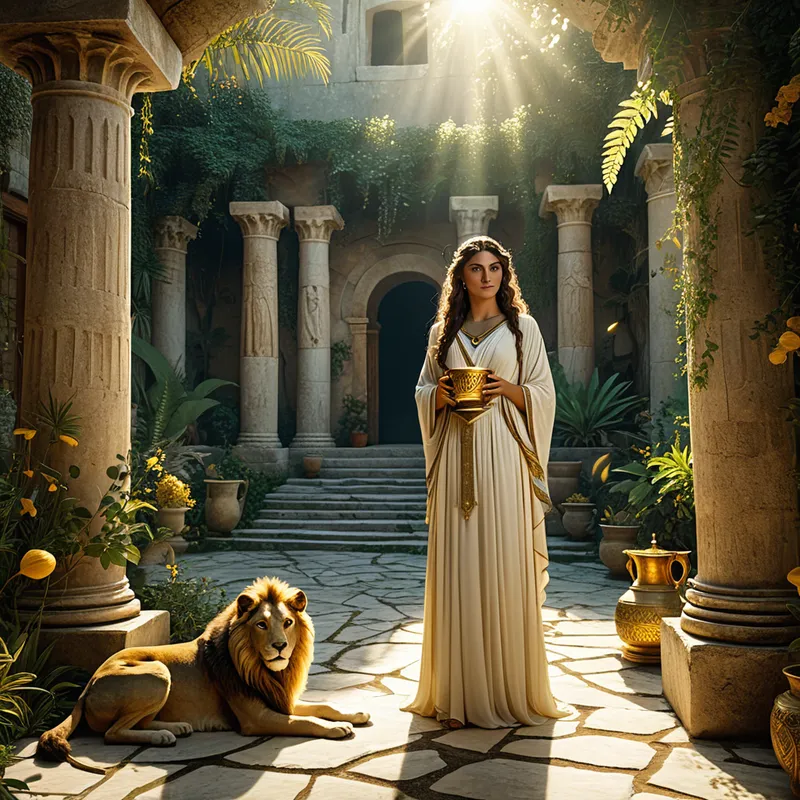
The men, heartsick for home, begged their lord to seek harbor. Cautious, Odysseus divided his crew. He sent a band of two-and-twenty, led by the loyal Eurylochus, to scout the source of the song. They approached the palace and were met not by monsters, but by a welcome. Mountain lions and great wolves padded from the trees—but they did not snarl. They rose on their hind legs, wagging their tails like friendly hounds, their eyes holding a deep, human sorrow. From the high doors emerged the singer herself: Circe. Her hair flowed like dark wine, her gaze was as deep and knowing as the earth. With a smile that held the warmth and danger of a hearth-fire, she beckoned them inside.
She seated them on high-backed chairs, served them a meal of cheese, barley, and honeyed wine—a feast for weary souls. But into the wine, with a murmur and a pass of her wand, she stirred a potion of powerful pharmakon. It was the essence of forgetfulness, a draught to unravel the soul’s own weave. The men drank deeply, thirsty for comfort. No sooner had the golden cups touched their lips than Circe sprang up, striking each man with her wand. “To your sties!” she cried. And they went. Their bodies shuddered, their forms melted and swelled. Bristles sprouted from skin, snouts elongated from faces, and human cries became the grunts of swine. Yet their minds remained, trapped, aware, drowning in animal instinct within the prison of a pig’s body. Only Eurylochus, who had hung back in suspicion, witnessed the horror. He fled through the woods, his breath ragged with terror, to bring the dreadful news to Odysseus.
Alone, the king girded his sword and set off to face the sorceress. But on the path, a god intervened. Hermes appeared, a young man with the glint of travel in his eye. “You go to your doom,” he said, “unless you take this.” From the root of the earth he drew a plant, its root black, its flower white as milk—the moly. “Take this in your hand, drink her potion, and when she strikes with her wand, draw your sword as if to run her through. Then she will yield.”
Odysseus entered the shining hall. Circe welcomed him, gave him the same cup, laced with the same oblivion. He drank, the moly a cool anchor in his heart. The wand tapped his shoulder. “To your sty with your friends!” she commanded. But he did not change. In a flash, he was upon her, the bronze point of his sword at her throat. With a cry that was both fear and awe, the goddess fell at his feet. “You are Odysseus,” she breathed, “the one foretold, whom no enchantment can hold.” She released his men from their swinish shapes, anointing them with a second salve that restored their human form, taller and more handsome than before. In that moment of confrontation, the spell was broken, not by brute force, but by a force greater: the protected, conscious self meeting the power of transformation and commanding it.

Cultural Origins & Context
The tale of Circe is woven into the grand tapestry of Homer’s Odyssey, an epic composed in the 8th century BCE but drawing on oral traditions far older. It was not mere entertainment for the fireside; it was a foundational narrative for the Greek psyche, performed by bards (rhapsodes) who were the keepers of history, ethics, and identity. The Odyssey functioned as a map of the soul’s journey home (nostos), and the episode on Aiaia is a crucial landmark on that map.
Circe belongs to a potent class of divine figures in Greek myth: the witch-goddess, often residing on the edges of the known world. As a daughter of Helios and the Oceanid Perse, she bridges the celestial and the chthonic, the rational light of the sun and the mysterious, fluid depths of the ocean. Her island, Aiaia, is a liminal space—not quite part of the human world, not quite of Olympus. It is a testing ground. The story served to illustrate profound cultural anxieties and truths: the dangers of untempered hospitality (xenia), the peril of losing oneself to sensual abandon, and the absolute necessity of divine guidance (Hermes) and cunning intelligence (metis) to navigate forces beyond ordinary human comprehension. Circe’s potions represent the ultimate foreign danger: the loss of one’s essential form and reason, the very things that defined a Greek man.
Symbolic Architecture
At its heart, Circe’s myth is an allegory of the encounter with the unconscious, specifically the animalistic, instinctual layer of the psyche that civilization seeks to repress.
The potion is not poison, but truth serum for the soul. It does not create the beast; it reveals the beast that was always there, sleeping beneath the veneer of identity.
Circe herself symbolizes the transformative, devouring, and ultimately integrative power of the anima. She is the captivating, dangerous aspect of the feminine that holds the key to a man’s deeper nature. To succumb to her without consciousness (like the crew) is to be devoured by one’s own complexes, to become a slave to untamed lust, greed, and fear—symbolized by the pig. The pig is not a random choice; in Greek culture, it was an animal of gluttony and unchecked appetite, but also of sacrifice and chthonic fertility, embodying the raw, earthly substance of life.
Odysseus’s journey represents the ego’s perilous voyage into this territory. The moly, given by Hermes, is the symbol of divine insight, the connecting thread to the transcendent function. Its black root in the earth and white flower reaching for the sky signify the union of opposites—consciousness grounded in the unconscious. It is the moment of recognition, the ability to see the enchantment for what it is and not be dissolved by it. The sword Odysseus draws is not ultimately for killing Circe, but for establishing a boundary. It is the sword of discrimination, the focused will of the conscious mind that says, “This far, and no further.” This confrontation forces the transformative power (Circe) to switch from a devouring to a nurturing mode. She becomes the hostess, the lover, and the guide who prepares him for the even deeper journey to the Underworld.
The Dreamer's Resonance
When this myth stirs in the modern dreamer, it often manifests as a profound somatic and psychological crisis of identity. One may dream of being in a beautiful yet oppressive place (a party, a workplace, a relationship) where they are offered a drink or food that feels ominously compelling. Upon consuming it, a terrifying metamorphosis begins: hands become paws, speech becomes growls, a mirror reflects an animal face. The overwhelming feeling is one of shame, horror, and entrapment—the soul caged within an instinctual pattern it cannot control.
This is the psyche signaling a confrontation with the Shadow. The “potion” in the dream represents an intoxicating complex—perhaps an addiction, a consuming rage, a paralyzing fear, or a regressive desire—that has been passively ingested. The transformation into a beast is the ego’s realization that it has been overtaken by this autonomous complex. The dream is a brutal, honest depiction of the state of possession. The somatic resonance is key: the dreamer may wake with a feeling of heaviness, a raw throat (from suppressed cries), or a sense of being physically “different.” This is the call to what James Hillman called the “animal soul”—not to glorify it, but to acknowledge its immense power and the danger of leaving it unconscious.

Alchemical Translation
The myth of Circe provides a precise model for the alchemical process of individuation, the psychic transmutation of base instinct into conscious wholeness.
The first stage is nigredo, the blackening. This is the crew’s transformation: the descent into the swinish state, the confrontation with the utterly base, shameful, and “unacceptable” parts of oneself. It is a necessary dissolution; the old, inflated ego-identity must be broken down. Odysseus, armed with the moly (the lapis, the philosopher’s stone in potentia), undergoes this not through possession, but through observation. He holds the tension of the opposites—human and beast, conscious and unconscious—within himself.
The confrontation is the albedo, the whitening. The drawing of the sword is the act of conscious differentiation. “I am not this enchantment. I contain it, but I am not possessed by it.” This forces a new relationship with the anima/Circe. She is no longer the devouring mother/witch, but becomes the soror mystica, the mystical sister who aids in the work.
The ultimate potion Circe offers is no longer one of forgetfulness, but of remembrance—the salve that restores the men, now improved. This is the rubedo, the reddening, where the integrated animal nature returns not as a master, but as a vitalized part of the whole self.
For the modern individual, the “Circe work” involves identifying the potions we blindly drink—the cultural narratives, the familial scripts, the addictive patterns that promise comfort but induce a psychic metamorphosis away from our true form. The “Hermes” moment is the sudden insight, often in therapy, meditation, or crisis, that provides the protective “moly”—a new perspective. The “sword” is the difficult, disciplined act of setting a boundary with these patterns. The triumph is not the slaying of one’s animal nature, but the redemption of it, finding the palace within the prison, and using that reclaimed energy for the next leg of the soul’s journey home.
Associated Symbols
Explore related symbols from the CaleaDream lexicon:
- Cup — The vessel of Circe's potion, representing the container of transformation, the offer of both poison and healing, and the risk of consuming unconscious contents.
- Forest — The dense, unknown woods surrounding Circe's palace, symbolizing the mysterious and untamed realm of the unconscious into which the conscious ego must venture.
- Mirror — The reflective surface that would show the men their horrifying transformation, representing the shocking moment of self-recognition when we see our shadow possession.
- God — Hermes in his role as psychopomp, the divine guide who provides the crucial tool (moly) for navigating the underworld of the psyche, symbolizing transcendent insight.
- Goddess — Circe as the powerful, autonomous feminine force of nature and magic, embodying the transformative, terrifying, and ultimately integrative power of the anima.
- Key — The moly plant itself, functioning as the key that unlocks Circe's spell, symbolizing the precise insight or virtue needed to solve a profound psychological riddle.
- Pig — The animal form of the enchanted men, representing the base instincts of gluttony, lust, and ignorance, but also the raw, earthy material awaiting transformation.
- Wand — Circe's instrument of transformation, symbolizing the focused application of magical (psychic) will to effect change, for better or for worse.
- Journey — The entire Odyssey, with Circe's island as a critical stage, modeling the soul's arduous path toward wholeness and homecoming through trials and transformations.
- Greek Amphora — The type of vessel that would hold Circe's potions, grounding the myth in its cultural materiality and symbolizing the ancient container of powerful archetypal forces.
- Shadow — The repressed, animalistic side of the men that is made manifest by Circe's potion, representing everything the conscious personality denies but which holds immense power.
- Herb — The moly, with its black root and white flower, symbolizing the union of opposites (conscious/unconscious) and the divine aid that grows at the intersection of crisis and grace.
- Magic Potion