Carlos Gardel's Spirit Myth Meaning & Symbolism
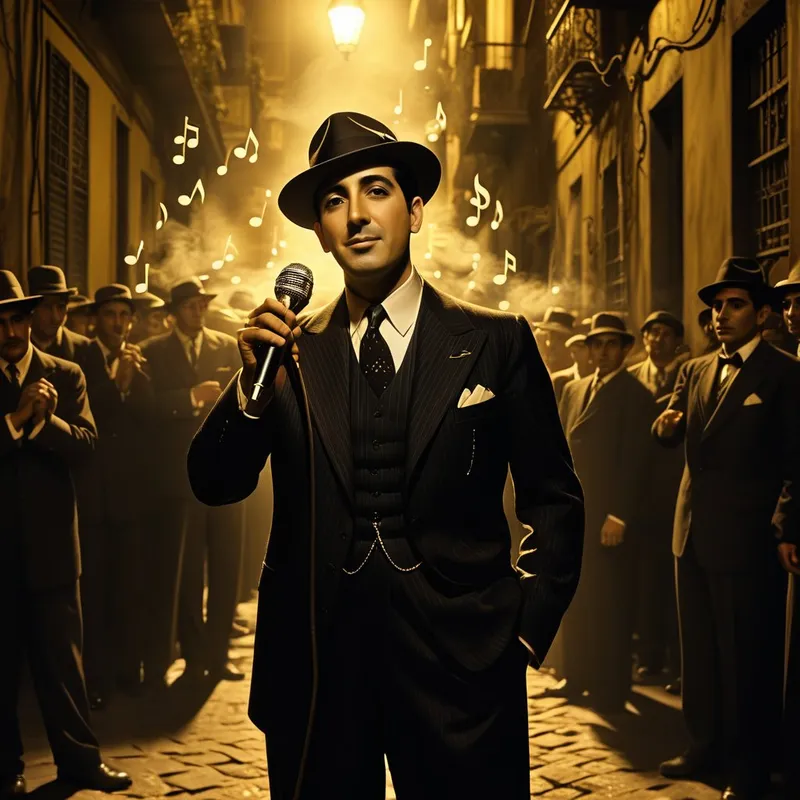
The myth of the tango singer's undying spirit, a cultural ghost who eternally returns to sing for the people, embodying collective memory and unbroken identity.
The Tale of Carlos Gardel's Spirit
Listen. In the city that breathes with the sigh of the river and the ache of forgotten afternoons, a story is woven into the very cobblestones. It begins not with a birth, but with a death that refused to take.
In the year when the world was tilting toward shadow, the Sun of Buenos Aires was extinguished. Carlos Gardel, the man whose voice was a caress and a knife-thrust to the heart, was taken in a blaze of metal and fire in a distant land. The city wept a rain of black bandoneón notes. They buried him, but the earth of the Cementerio de la Chacarita could not hold him. For how can you bury a voice that has already seeped into the brickwork of the tenements, the smoke of the cafés, the very blood in the veins of the port city?
So, he began to return.
Not as a ghoul, but as a presence—a scent of cologne and tobacco on a still night in the Abasto. A stranger, impeccably dressed in a suit that never wrinkles, would appear at the end of the bar in a corner boliche. He would order a coffee, untouched, and listen. And when the amateur guitarist fumbled a tango phrase, a low, perfect hum would resonate from the empty seat, correcting the note, guiding the rhythm. Then, the stranger would be gone, leaving only a chill and the scent of a gardenia.
The tales multiplied. A taxi driver, lost in a fog of despair over a lost love, would find his cab filled with the sudden, clear strains of “Mi Buenos Aires Querido” from a broken radio, the voice so vivid it would dry his tears. An old milonguero, dancing alone in his kitchen at three in the morning, would feel a firm, guiding hand on his back, executing a perfect corte he could never manage alone.
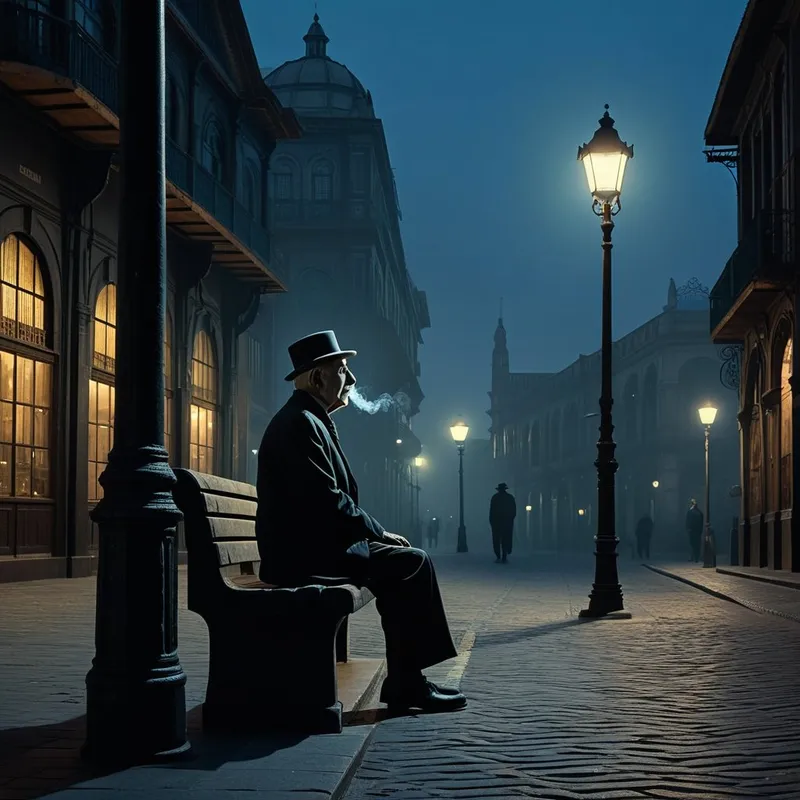
His most faithful haunt is the street where he once lived. On the anniversary of his passing, or on any night when the collective loneliness of the city grows too heavy to bear, a figure is seen. He leans in the doorway of his old house, a glowing cigarette tip punctuating the darkness. He does not speak. He sings. A thread of melody, pure and undimmed by time, winds through the alleyways, a sonic balm for every cracked heart, every immigrant’s longing, every bet lost and love remembered. He sings until the first light threatens the horizon, and then he dissolves—not into nothing, but into the collective memory that summoned him. The conflict is not his, but ours: the struggle against oblivion. His rising action is every whispered story that adds to his legend; his resolution is the eternal return, the promise that what is truly loved never dies.
Cultural Origins & Context
This is not an ancient myth of gods and monsters, but a modern, urban folklore born in the 20th century from the very real, seismic cultural impact of Carlos Gardel. His death in 1935 in a plane crash in Medellín, Colombia, was a national trauma for Argentina and the entire Rioplatense world. He was the archetypal immigrant success story—born in uncertainty, perhaps in France, perhaps in Uruguay, but who forged his identity in the crucible of Buenos Aires. He gave voice to the tango-canción, transforming it from a dance of the underworld to a poetry of the soul.
The myth of his spirit emerged spontaneously from the people. It was passed down in family kitchens, over mate, in taxi cabs, and in the backrooms of tango clubs. It is a folklore of oral tradition, where each teller adds their own “friend of a friend” encounter. Its societal function is profound: it serves as a vessel for collective grief, a guardian of cultural identity, and a democratization of sanctity. In a culture with deep Catholic roots, Gardel’s spirit operates outside the church—a secular saint of the neighborhood, the compadrito of the afterlife, who performs miracles of emotional resonance rather than physical healing. He is the eternal compadrito, who even in death remains loyal to his people.
Symbolic Architecture
At its core, the myth of Gardel’s Spirit is a powerful symbol of the psychopomp who guides not through the underworld, but through the labyrinth of memory and emotion. Gardel represents the anima of the culture itself—the soulful, expressive, melancholic, yet irresistibly vital feminine principle that balances the often-macho, fractured history of the Argentine identity.
The voice that does not die is the part of the Self that refuses to be silenced by trauma, time, or exile.
He symbolizes the indestructible core of personal and cultural identity. The plane crash is the brutal, fragmenting trauma—of a nation, of a personal life. The returning spirit is the psyche’s insistence on reassembling itself, on making the shattered pieces cohere again through narrative and song. The cigarette, the suit, the perfect pitch—these are the precise, unchanging details of memory, the anchors we cling to to prove that what was real remains real. He is the guardian of the genius loci of Buenos Aires, a psychic anchor point for the diaspora. To invoke him is to invoke home.
The Dreamer's Resonance
When this mythic pattern surfaces in a modern dream, it seldom appears as the literal figure of Carlos Gardel. Instead, it manifests as the Dream of the Unaging Guide. The dreamer may encounter a deceased loved one who appears not as they were at death, but in their prime, offering not words but a song, a piece of music, or a perfect, wordless gesture of reassurance. Or, the dreamer may find themselves in a vast, empty ballroom, and a timeless, authoritative voice from a hidden speaker instructs them on the steps of a complex, beautiful dance they never learned but somehow know.
Somatically, this dream is often accompanied by a profound feeling of nostalgia—not as mere sentimentality, but as the Greek nostos, the aching for homecoming. There may be a tightness in the chest that releases into warmth, or the sensation of being orchestrated, of moving in sync with a larger, benevolent pattern. Psychologically, this dream emerges during periods of dislocation—after a move, a loss, a career change, or any event that threatens one’s sense of continuous identity. The spirit in the dream represents the autonomous, self-healing function of the psyche, the inner “old soul” that knows the tune and can lead you back to your own emotional truth.
Alchemical Translation
The alchemical process modeled here is not of turning lead to gold, but of turning grief into art, absence into presence, and silence into enduring song. Gardel’s physical death (nigredo—the blackening, the descent) is the necessary dissolution. The decades of silence and forgetting that follow are the albedo—the whitening, the purification in the moonlit realm of memory.
The myth teaches that the true product of the alchemical work is not a static gold, but a perpetual, living return—the circumambulatio of the soul around its own central fire.
The rising of the spirit—the reports of sightings and sensations—is the citrinitas, the yellowing, the dawning of a new understanding: that the essence is not gone. Finally, the eternal, cyclical return to sing is the rubedo, the reddening, the culmination. The spirit does not achieve a heavenly, static rest; it achieves a dynamic, eternal relevance. It becomes a function of the living community.
For the modern individual, the alchemical instruction is clear: what profound loss or trauma in your life feels like a fatal crash, a silencing? The myth argues that from that very site of annihilation, the most essential part of you—your unique “voice,” your core identity—can be refined and return. Not as the old ego, but as a spirit-guide to your own soul. It must be invoked by the community of your inner parts (your memories, your values, your loves) and it will return to perform its service: to sing your particular, unbreakable song back to you when you are lost in the night. The work is to listen for it, to cultivate the inner boliche where that ghost is always welcome to take a seat, light a cigarette, and hum your melody back into being.
Associated Symbols
Explore related symbols from the CaleaDream lexicon: