
Candomble Orixas in Brazil Myth Meaning & Symbolism
A myth of divine forces surviving the Middle Passage, taking root in a new world, and guiding the human soul through nature's rhythms and ancestral memory.
The Tale of Candomble Orixas in Brazil
Listen. The story does not begin on the shores of Bahia, but in the deep, remembering blood. It begins in the hold of the ship, in the darkness that swallowed the sun. Here, the gods did not die. They could not. They were pressed into the grain of wood, whispered between chained breaths, hidden in the rhythm of a heart refusing to break. Olodumare had breathed them into being from the very clay of Ayé, and not even the ocean’s abyss could untie that sacred knot.
When the feet of the people touched the strange, red earth of a new world, the gods touched it with them. They felt the unfamiliar heat, smelled the alien spices, heard the harsh tongue of the masters. The people were told their memories were dead, their names were gone, their spirits were empty. But at night, in the senzalas, the old rhythms found the new earth. A hand patted the ground—boom. A foot stamped—bash. A voice, low and guttural, called a name into the darkness: "Yemanjá." And from the salt of their sweat and tears, the first drop of the ocean appeared.
Then came "Ogum," and the clang of the blacksmith’s hammer became a prayer. "Xangô," and the crack of the overseer’s whip was answered by a rumble in the distant hills. "Oxóssi" slipped into the canefields, becoming the whisper in the leaves. "Oxum" found her mirror not in a golden river of Africa, but in the humble water jar, reflecting a beauty that could not be enslaved.
They had to wear masks. To the masters, Exu became the Devil at the crossroads. The fierce, nurturing Iansã was hidden behind the veil of Saint Barbara. The ancient, earthy Nanã was folded into the image of an aged saint. This was the great cunning, the divine survival. The Orixás danced in the bodies of their children, not as statues in temples, but as living, breathing forces—in the whirl of a skirt, the flash of a blade, the ecstatic roll of eyes, the healing touch of leaves. They took root. Not as visitors, but as the very soul of the land itself, a sacred axé flowing from Africa to Brazil, unbroken.
Cultural Origins & Context
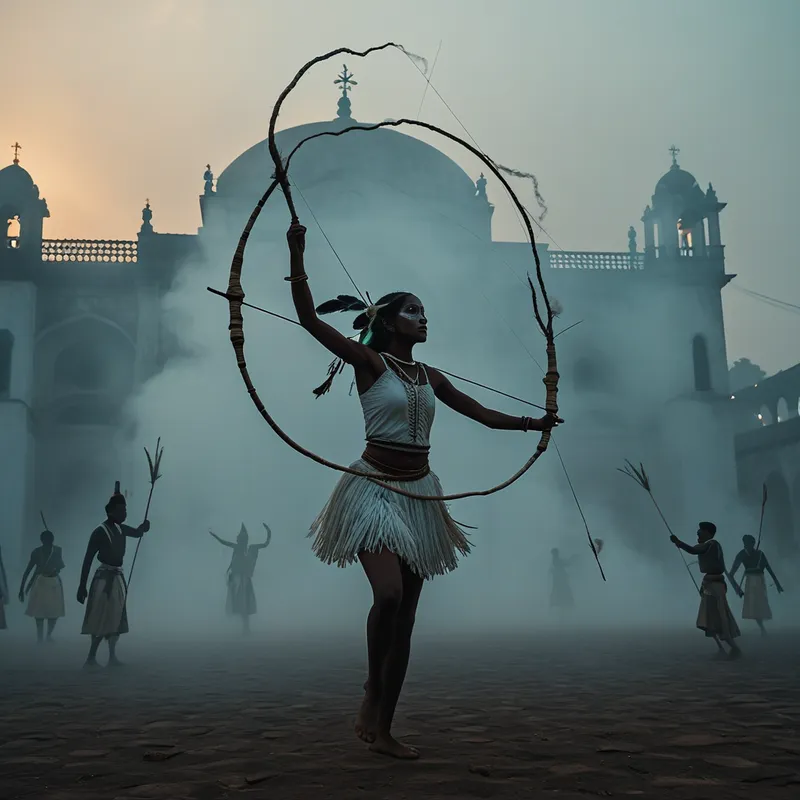
This is the myth of memory insisting on its future. The Candomblé Orixás are the divine heart of a religious and cultural system born from the Yoruba, Fon, and Bantu peoples of West and Central Africa, forcibly transplanted to Brazil through the transatlantic slave trade. The myth is not a single narrative but a living cosmology, a pantheon of forces that govern every aspect of nature and human life. It was passed down not through written texts, but through the body—through dance, drumming, song, and the profound ritual of possession, where the devotee (iaô) becomes the vessel for the Orixá.
Its societal function was, and remains, multifaceted: a fortress of identity against cultural genocide, a system of physical and spiritual healing, a court of community justice, and a map for understanding one’s character and destiny. Each person has a "head Orixá" that guides their temperament and path. The myth survived the brutal conditions of slavery and persecution through syncretism with Catholicism, a strategic layering that allowed the old gods to be worshipped under the names of new saints. In the terreiros (temple communities), under the guidance of Mães and Pais-de-santo (Mothers and Fathers of the saint), the Orixás are fed, praised, and called down to dance among their people, affirming that the ancestral chain, the orí (individual destiny and inner head), was never severed.
Symbolic Architecture
The Orixás represent the archetypal forces of nature internalized as facets of the human psyche. They are not distant, moralistic judges but embodied energies with complex personalities, flaws, and domains. The cosmology presents a world where divinity is immanent, participatory, and deeply relational.
The myth teaches that the soul is not a monolithic entity, but a community of forces. To be whole is not to achieve a sterile unity, but to host a harmonious council of these divine powers.
Exu symbolizes the necessary chaos, communication, and potential at every life decision. Yemanjá is the deep, unconscious, the source of life and emotional depth. Xangô represents righteous anger, authority, and the lightning flash of clarity. Nanã embodies the wisdom of decay, the swamp where life ends and is recycled into new beginnings. The system is a profound symbolic architecture for a holistic psyche, where the "forest" (Oxóssi) of intuition and the "forge" (Ogum) of will must both be honored.
The Dreamer's Resonance
When this myth stirs in modern dreams, it often signals a profound process of re-membering—of gathering scattered parts of the soul. To dream of an Orixá is to encounter a specific, potent archetype knocking at the door of consciousness.
A dream of Oxum by her mirror may surface when one’s relationship with self-love, beauty, or diplomacy is calling for attention. The thunder of Xangô in a dream can erupt during a life situation demanding fierce justice and the clearing of lies. The winding, unpredictable paths of Exu might manifest in dreams of confusing intersections, signaling a critical choice or a blocked communication needing to be opened. Somaticly, one might awaken with the sensation of salt on the skin (Yemanjá), the smell of ozone (Iansã), or an ache in the joints as if from holding a heavy tool (Ogum). The dream is an invitation to identify which inner "force of nature" is seeking expression, nourishment, or re-integration into the waking life.
Alchemical Translation
The core alchemy of this myth is the transmutation of fragmentation into a sacred community within the self. The diaspora experience is the ultimate metaphor for the modern psyche: fractured, displaced, forced to wear masks, and longing for a lost, integrated homeland. The Candomblé response is not a return to a pure, imagined past, but a courageous act of syncretic creation.
Individuation here is not a solitary hero’s journey to a mountain top, but the difficult, joyous work of building an inner terreiro—a sacred space where all one’s inner gods can be acknowledged, fed, and allowed to dance.
The process begins with recognizing the "slave ship" within—the parts of ourselves we have chained and denied (our rage, our grief, our wildness, our softness). The "syncretism" is the psychological work of finding the acceptable, conscious language (our personal "Catholic saints") through which these powerful, unconscious forces ("Orixás") can safely emerge. We learn to make offerings to our inner Ogum (our willpower) with acts of discipline. We honor our inner Oxum by cultivating beauty and self-care. We acknowledge our inner Exu by respecting life’s chaotic, trickster-like turns. The ultimate goal is to become a balanced conduit for axé—the vital force—allowing the full council of our inner deities to guide us, resulting not in a bland uniformity, but in a vibrant, resilient, and authentically powerful human being.
Associated Symbols
Explore related symbols from the CaleaDream lexicon:
- Water — The primordial element of Yemanjá and Oxum, symbolizing the deep unconscious, emotion, fertility, purification, and the fluid memory of the Middle Passage.
- Dance — The central ritual act of Candomblé, through which the Orixás descend and possess their children, representing ecstatic surrender, embodied knowledge, and the celebration of divine force in motion.
- Forest — The domain of Oxóssi, symbolizing the untamed realm of instinct, herbal wisdom, intuition, and the hunt for one's true purpose and sustenance.
- Iron — The sacred metal of Ogum, representing will, technology, civilization, strength in conflict, and the tools used to both enslave and liberate.
- Mirror — The attribute of Oxum, symbolizing self-reflection, vanity, deep self-knowledge, the surface of consciousness, and the beauty of the soul.
- Thunder — The voice and weapon of Xangô, representing sudden, clarifying justice, divine anger, the shattering of falsehood, and raw masculine power.
- Crossroads — The domain of Exu, symbolizing choice, potential, communication, the meeting point of worlds, and the moment where destiny can be altered.
- Earth — The body of Nanã and all Orixás, representing groundedness, fertility, the ancestral grave, ultimate nourishment, and the physical reality where the divine takes root.
- Ritual — The structured practice of offering, song, and dance that maintains the connection to the Orixás, symbolizing the conscious container needed to safely engage with powerful archetypal forces.
- Mask — Representing the historical syncretism where Orixás were hidden behind Catholic saints, symbolizing adaptation, survival, the persona, and the hidden truth behind appearances.
- Drum — The sacred heartbeat of the ceremony that calls the Orixás, symbolizing rhythm, memory, the pulse of life (axé), and the bridge between the human and divine realms.
- River — The specific domain of Oxum, symbolizing the flow of love, prosperity, and beauty through life, as well as the journey of the soul and the passage from one state to another.