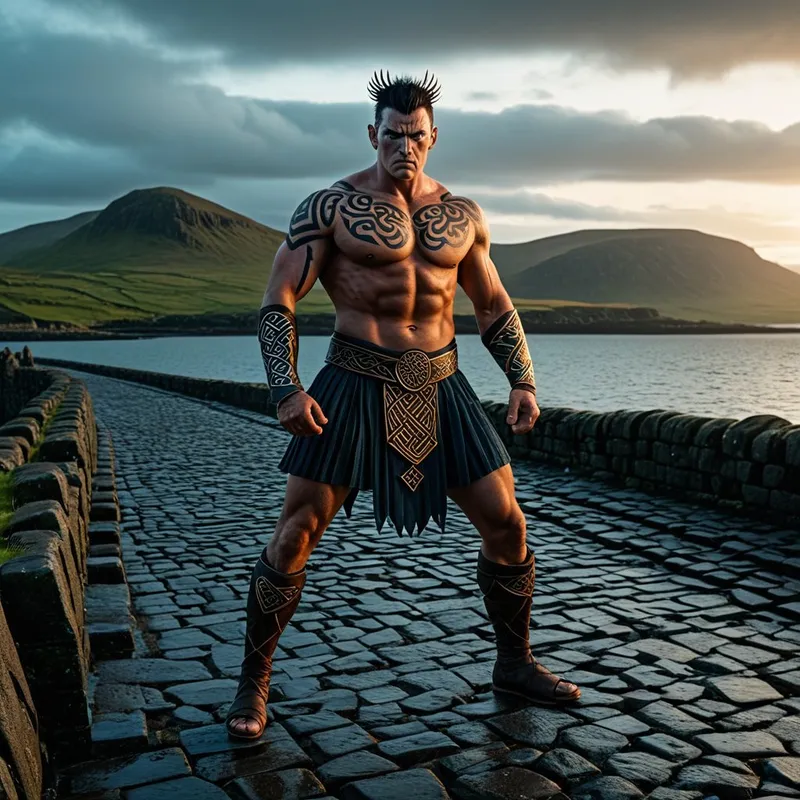
Cú Chulainn Myth Meaning & Symbolism
The story of a demigod warrior bound by geasa, whose superhuman rage and tragic loyalty illuminate the cost of a life lived at the edge of the self.
The Tale of Cú Chulainn
Hear now the tale of the Hound of Culann, a story not of a man, but of a force of nature given human shape, and the terrible price of such a gift.
In the mist-shrouded kingdom of Ulster, a boy was born of two worlds. His mother was Deichtine, sister to King Conchobar, and his father, some say, was the sun god Lugh himself. They named him Setanta. From his first breaths, he burned with a fire not of this earth. As a child, hearing the warriors of the Craobh Rua boast of their strength, he took up his toy hurley and ball and set out for the royal fort of Emain Macha. The boy-troop guarding the fort, seeing this determined child, moved to block him. With the fury of a god sparking in his eyes, Setanta defeated all one hundred and fifty of them, until King Conchobar himself had to calm the child’s battle-rage.
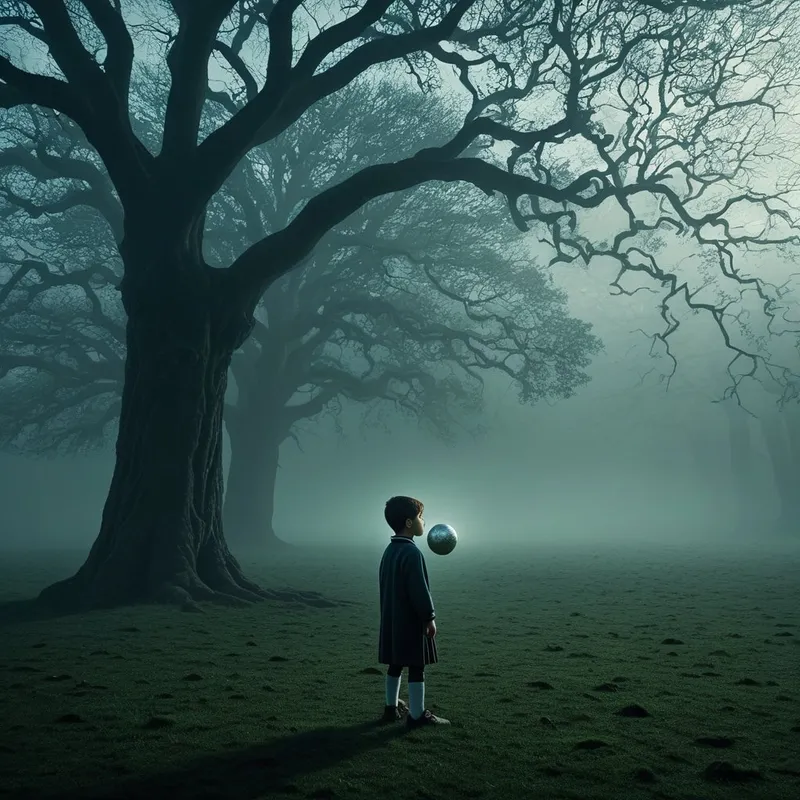
His destiny was sealed not in battle, but at a feast. The smith Culann invited the king to a grand meal. Conchobar, impressed by the boy, invited him along. Setanta said he would follow after his game. When he arrived later, Culann’s massive guard hound, a beast as big as a pony, lunged to kill the intruder. With no weapon but his ball and hurley, Setanta drove the sphere down the beast’s throat, killing it instantly. Culann despaired, for the hound protected all he had. Without hesitation, the boy declared, “I will guard your property until a pup of that hound is grown. Until then, I will be your hound.” And so, Setanta became Cú Chulainn.
He grew into a warrior whose beauty was matched only by his terror. He trained with the warrior-woman Scáthach in the realm of shadows, learning the secrets of the warp-spasm, the ríastrad. When this fury took him, he became a spectacle of nightmare: one eye sucked into his skull, the other bulging out; his hair stood erect with sparks of blood; his body twisted backwards inside his skin. In this state, he was unstoppable.
His greatest trial came in the <abbr title=""The Cattle Raid of Cooley," the central epic of the Ulster Cycle">Táin Bó Cúailnge. While the men of Ulster lay cursed by the Machae, Cú Chulainn alone, not yet a man, held the frontier against the invading army of Queen Medb. For days, he fought champion after champion at the fords, a one-man border between order and chaos. He fought with a terrible joy and a deepening sorrow, bound by the warrior’s code.
His end was woven not by a mighty army, but by the cunning of his enemies and the inexorable pull of his own geasa. Tricked into breaking one geis by eating dog meat—the flesh of his own namesake—and another by taking up arms against the sea itself, his strength ebbed. He tied himself to a standing stone so he might die on his feet, facing his foes. Even in death, his terror held them at bay, for a light of heroism shone about his head. It was only when a crow, the Morrígan in disguise, landed on his shoulder that they knew the Hound was truly dead. The land of Ulster wept.
Cultural Origins & Context
This is not a story from a book, but from the edge of memory, carried on the breath of bards. It belongs to the Ulster Cycle, preserved in manuscripts like the Lebor na hUidre, but its roots are older than parchment. These tales were the property of the fili, the poet-seers who could recite them for hours, keeping the lineage of kings and the codes of heroes alive.
The society reflected in Cú Chulainn’s story is one obsessed with honor, contract, and the terrifying glory of the individual warrior. His exploits were not mere entertainment; they were a social mirror. They explored the tension between the raw, divine power of the hero and the complex web of social obligations (Brehon Law, kinship, geasa) that bound even the greatest individual. He was the ideal and the warning: the perfect warrior whose very perfection made him a danger to the community he protected and ultimately doomed him. The myth functioned as a container for discussing loyalty, the limits of rage, the price of fame, and the intimate relationship between a hero and his land.
Symbolic Architecture
Cú Chulainn is not merely a hero; he is an embodiment of the psychic force that erupts when the conscious personality is fused with an archetypal power. He represents the awesome and terrifying energy of the animus or the warrior archetype in its raw, undomesticated form.
The hero is not the one who conquers the monster, but the one who becomes the monster to defend the threshold, and in doing so, must forever dwell on its border.
His birth from a mortal woman and the god Lugh symbolizes the incarnation of a divine principle—skill, light, fiery will—into the fragile vessel of human life. His childhood name, Setanta, represents the latent, unformed self. His taking of the name Cú Chulainn is the moment of vocation, where the individual accepts a fate-bound identity, a role defined by service and ferocity. The ríastrad is the ultimate symbol of this. It is the shadow of the hero, the psychic inflation where the ego is completely overwhelmed by archetypal energy. The body’s distortion mirrors the soul’s: the beautiful youth becomes a monster, for the power he channels is not human.
His geasa are the symbolic architecture of his soul. They are the paradoxical rules that both empower and entrap him, representing the internal contradictions of his nature (e.g., to never eat dog meat, yet to be named “Hound”). They are the psychological boundaries that, when honored, grant integrity, and when broken—often through trickery or circumstance—spell disintegration.
The Dreamer's Resonance
When the pattern of Cú Chulainn stirs in the modern dreamer, it speaks of a psyche under immense pressure, where a colossal inner force is demanding expression. To dream of his battle-frenzy is not to dream of anger, but of a transformative, somatic uprising—a feeling that one’s very form cannot contain the intensity of the energy within. It may feel like a distortion, a grotesque power that is both terrifying and potent.
Dreams of holding a ford alone, of single-handedly facing an endless onslaught, point to a life situation where the dreamer feels solely responsible, bearing a burden that should be shared by a community (the cursed men of Ulster). This is the psyche’s image of burnout, of heroic inflation where the ego has taken on a god-sized task.
The dream of breaking a geis—perhaps eating forbidden food or breaking a solemn, personal vow—signals a profound crisis of identity. The dream ego has acted in a way that violates its own core code, leading to a sense of impending doom or dissolution. It is the shadow’s cunning trick, showing how our own unconscious complexes can lead us to betray our deepest principles.
Alchemical Translation
The alchemical journey of Cú Chulainn is not one of redemption to a higher self, but of the nigredo—the blackening, the confrontation with the primal, chaotic shadow—carried to its ultimate, tragic conclusion. It is a map for the part of individuation that involves the conscious assimilation of one’s most destructive and potent energies.
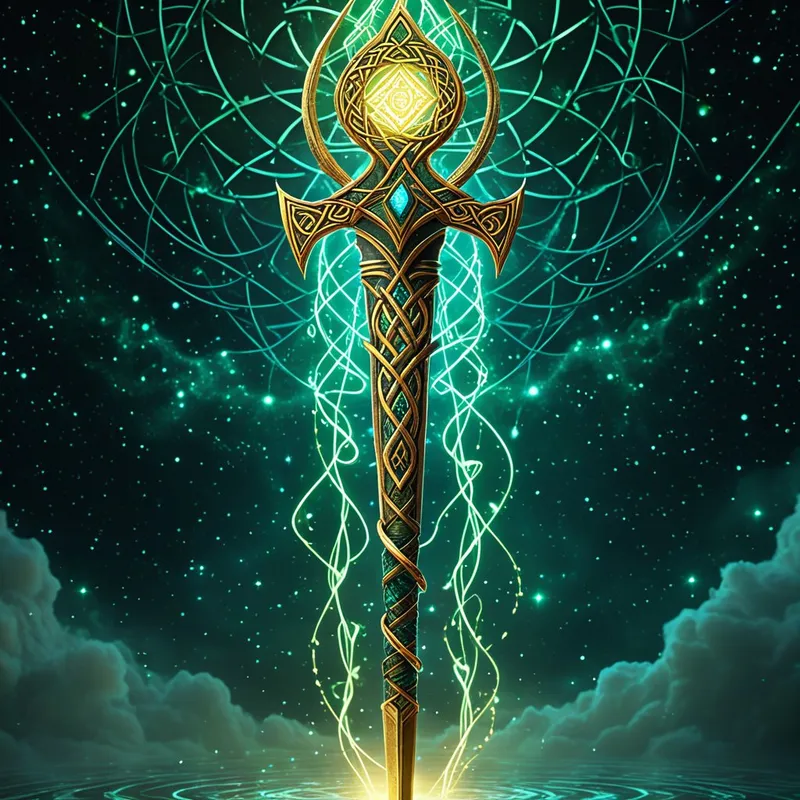
The spear Gáe Bulg is not just a weapon; it is the focused, irreversible intent of the differentiated will, a force that, once deployed, creates wounds that cannot be fully healed.
The process begins with the Coniunctio of Setanta and the Hound—the marriage of the innocent child-self with a fierce, protective, animalistic power. This creates the heroic persona, Cú Chulainn. The training with Scáthach (“The Shadowy One”) represents a descent into the unconscious to structure this raw power, to give it skill and form. The Separatio is his lonely vigil at the ford, where he is utterly set apart, his consciousness isolated in its task.
The climax of the transmutation is the ríastrad, the ultimate Solutio (dissolution) where all form is melted in the fire of archetypal possession. For the modern individual, this translates to those moments of crisis where our familiar identity shatters under an influx of passion, rage, or inspiration. The goal is not to live in this state, but to survive its visitation and integrate its power without being identified with it—a task at which Cú Chulainn ultimately fails.
His death, tied to the stone, is the final Coagulatio (coagulation). The volatile spirit is fixed. He becomes a monument to his own paradox: the defender who is destroyed by the very codes that made him. The alchemical lesson is stark: to wield such fierce, divine energy in a human life is to invite a tragic end unless one can find a container stronger than stone—the container of a consciousness that can hold the paradox without being torn apart. We are asked not to become Cú Chulainn, but to witness his fire, to honor his loyalty, and to learn from his fatal bindings, so we might navigate our own geasa with a little more wisdom, and a little less glorious ruin.
Associated Symbols
Explore related symbols from the CaleaDream lexicon: