Barong and Rangda Myth Meaning & Symbolism
The eternal struggle between the benevolent beast Barong and the demon queen Rangda, embodying the cosmic balance between order and chaos.
The Tale of Barong and Rangda
Listen. In the emerald heart of Bali, where the air is thick with the scent of frangipani and incense, a story breathes. It is not merely told; it is danced, it is drummed, it is lived. This is the story of two forces, ancient as the first volcanic stone, locked in a dance that holds the world together.
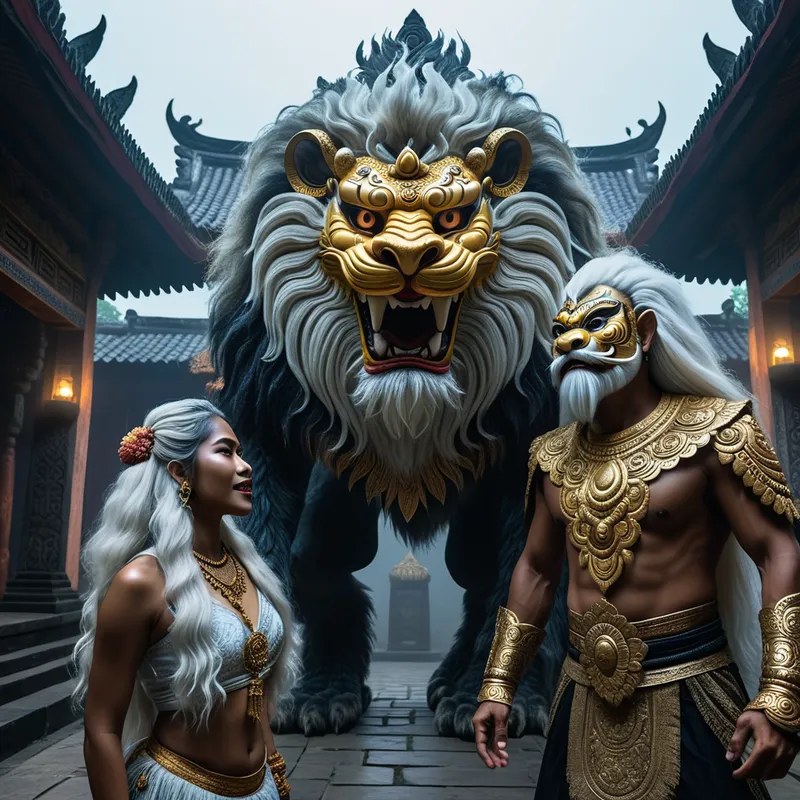
There is Barong. He is not a god, but a spirit king, a creature of magnificent paradox. He wears the form of a shaggy lion, yet his face is a mask of gilded benevolence, carved with the wisdom of the ancestors. His body, animated by two men moving as one, is a tapestry of mirrored scales, cowrie shells, and gilded leather. Where Barong walks, the earth feels firm. Children laugh. The rice grows tall. He is the spirit of the village itself—its order, its community, its protective, playful strength.
And there is Rangda. She is the widow, the sorceress, the queen of Leyaks. Her hair is a wild cataract of white, streaming like a curse. Her face is a nightmare mask: bulging eyes that see all secrets, a lolling tongue of fire, and long, curved fangs. Her breasts are pendulous and empty. She commands the dark magic of the crossroads and the graveyard. Rangda is dissolution. She is the fever that burns the body, the jealousy that poisons the heart, the chaos that unravels the social order. She is not evil; she is a necessary, terrifying force of nature.
The conflict ignites. Rangda, in her wrath or her boundless hunger, casts a plague upon a kingdom. She turns the king’s own court against him, weaving spells of madness and betrayal. The land sickens. The people turn on one another. Order crumbles into suspicion and violence.
Barong rises. He gathers his loyal followers, the villagers who still remember harmony. They confront Rangda’s legion of possessed subjects in a clearing sacred to both. This is the moment the drums pound for. Rangda unfurls her white magic, a length of cloth that is the very fabric of corruption. She waves it, and the king’s men, now her puppets, turn their kris daggers upon themselves, compelled to self-destruction.
But Barong stands between. He is a bulwark of life. His power, a counter-magic of pure vitality, protects the men. The daggers press against their chests but cannot pierce the skin. The men writhe in the agony of this impossible tension—the suicidal urge of Rangda’s magic pushing inward, the life-force of Barong holding them back. They are caught in the field between two colossal magnets.
There is no victor. The dance reaches its crescendo and then… a stillness. The forces balance. Exhausted, potent, and eternally opposed, Barong and Rangda withdraw. The trance breaks. The men lower their daggers, unharmed but forever changed. The plague may lift, the immediate threat may recede, but the tension remains. The world is not saved from chaos; it is saved by the eternal, dynamic struggle with it. The performance ends, but the dance goes on, tomorrow and forever.
Cultural Origins & Context
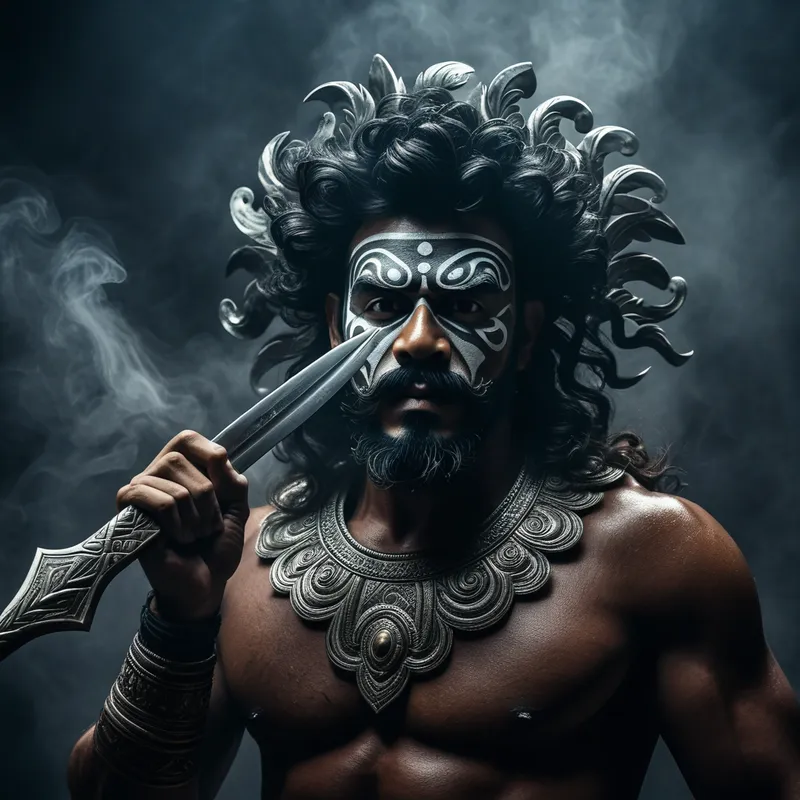
This myth is the living heart of Balinese Topeng and Legong dance-drama. It is not a fossilized legend in a book but a ritual enacted in temple courtyards (Pura) during religious ceremonies. The performers are not merely actors; through intense meditation and offerings, they become vessels for the energies they portray. The men who dance Barong and the dancer who embodies Rangda undergo spiritual preparation to handle these immense archetypal forces.
The societal function is profound. The performance is a Ritual of cosmic hygiene. By dramatically staging the conflict between order (Dharma) and chaos (Adharma), the community participates in its resolution. It externalizes the inner fears of social collapse, disease, and internal strife. Witnessing the stalemate—the terrifying yet safe containment of Rangda’s power by Barong’s strength—reaffirms the village’s resilience. It teaches that darkness is not to be annihilated, but acknowledged, faced, and balanced. The myth is a communal psychotherapy, a way of saying, "We see the chaos within and around us, and we have a way to dance with it."
Symbolic Architecture
Barong and Rangda are not characters in a simple morality play. They are the two poles of existence. Barong symbolizes the collective conscious—the structured, protective, life-affirming principles of society, family, and agriculture. He is the "masculine" principle of form and containment, but in a gentle, nurturing guise.
Rangda is the necessary Shadow of the collective. She is the repressed fury, the untamed wildness, the destructive potential that civilization must curb but cannot—and must not—utterly destroy.
Rangda is the Shadow of the collective. She embodies the raw, amoral power of nature (earthquakes, volcanoes, epidemics), the "feminine" principle in its devouring, transformative aspect. She is also the archetype of the outcast—the widow, the sorceress—who threatens the social order from its edges. Psychologically, she represents the personal and collective unconscious in its most terrifying form: the rage, grief, and primal fear we disown.
The pivotal moment of the kris daggers turned inward is the ultimate symbol. It represents the human psyche caught in civil war. The ego (the king’s men) is possessed by self-destructive impulses (Rangda’s magic) but is simultaneously protected by a deeper, instinctual will to live and integrate (Barong’s power). The drama externalizes the inner conflict between the death drive and the life force.
The Dreamer's Resonance
When this myth pattern stirs in modern dreams, the dreamer is at a critical juncture of psychic polarization. You may dream of being attacked by a terrifying feminine figure with wild hair, or of a comforting, powerful animal guardian. More tellingly, you may dream of being forced to hurt yourself, or of being trapped between two overwhelming, opposing forces.
Somatically, this can feel like a clenching in the chest—the pressure of the kris. Psychologically, it is the process of confronting a "Rangda complex": a powerful, seemingly destructive force within, perhaps a long-buried rage, a consuming grief, or a shameful desire that threatens to unravel your carefully constructed identity (your personal "Barong"). The dream signals that this repressed content is now too potent to ignore; it is actively possessing aspects of your behavior, leading to self-sabotage. The appearance of the protective beast signifies that the resources for integration—self-compassion, courage, or a call to community—are also activating. The dream is the psyche’s ritual drama, staging this conflict for a potential resolution that doesn’t involve destroying a part of yourself, but facing it.
Alchemical Translation
The individuation process modeled here is not about the heroic ego slaying the dragon of the unconscious. It is far more sophisticated and demanding. It is the alchemy of holding the tension of opposites.
The goal is not victory for Barong or Rangda, but the creation of a sacred space—the temple courtyard of the self—where their eternal dance can be witnessed without being torn apart.
First, one must recognize the "Barong" within—the persona, the adaptive self that seeks order, goodness, and social belonging. Then, one must have the courage to summon the "Rangda"—to consciously engage with the chaotic, "evil," or terrifying aspects of the shadow. This is the nigredo, the blackening, a descent into what feels like madness or self-destruction.
The critical alchemical stage is the coniunctio oppositorum (the conjunction of opposites), represented by the stalemate in the myth. The ego, holding the dagger of discernment, stands in the middle. It feels the suicidal pull of identifying wholly with the shadow ("I am my rage") and the spiritual bypassing of identifying wholly with the persona ("I am only light"). The transmutation occurs in maintaining that excruciating tension without acting out either extreme. From this sustained tension, a third thing emerges: a conscious awareness that can contain both beast and witch. The individual no longer is the conflict but has the conflict, and in that space, true psychological sovereignty—akin to the sacred balance of the Balinese universe—is born.
Associated Symbols
Explore related symbols from the CaleaDream lexicon:
- Mask — The sacred masks of Barong and Rangda are not disguises but vessels, representing the archetypal forces that wear us as much as we wear them.
- Dance — The eternal, ritualized movement between order and chaos, symbolizing that balance is not a static state but a dynamic, ongoing process.
- Ritual — The formalized enactment of the myth, which provides a safe container to confront collective and personal shadow material.
- Shadow — Rangda is the quintessential embodiment of the Jungian Shadow, the terrifying yet vital repressed aspects of the self and the collective.
- Chaos — The raw, creative, and destructive force personified by Rangda, necessary for transformation and rebirth.
- Order — The structuring, protective principle embodied by Barong, which gives form to life and community.
- Hero — Not as a conqueror, but as the individual or community who dares to stand in the field of tension between these two forces.
- Balance — The ultimate teaching of the myth: not the eradication of one force by the other, but their eternal, dynamic equilibrium.
- Sacrifice — Symbolized by the men turning daggers on themselves, representing the ego's necessary sacrifice of one-sidedness to achieve wholeness.
- Spirit — Both Barong and Rangda are spiritual entities, reminding us that the psyche's deepest struggles have a transpersonal, sacred dimension.
- Fear — The primary emotion Rangda evokes, representing the essential fear that must be faced and integrated, not fled from, on the path to wholeness.
- Heart — The target of the kris daggers, symbolizing that this cosmic struggle is felt most acutely at the center of our being, in our capacity for both compassion and breaking.