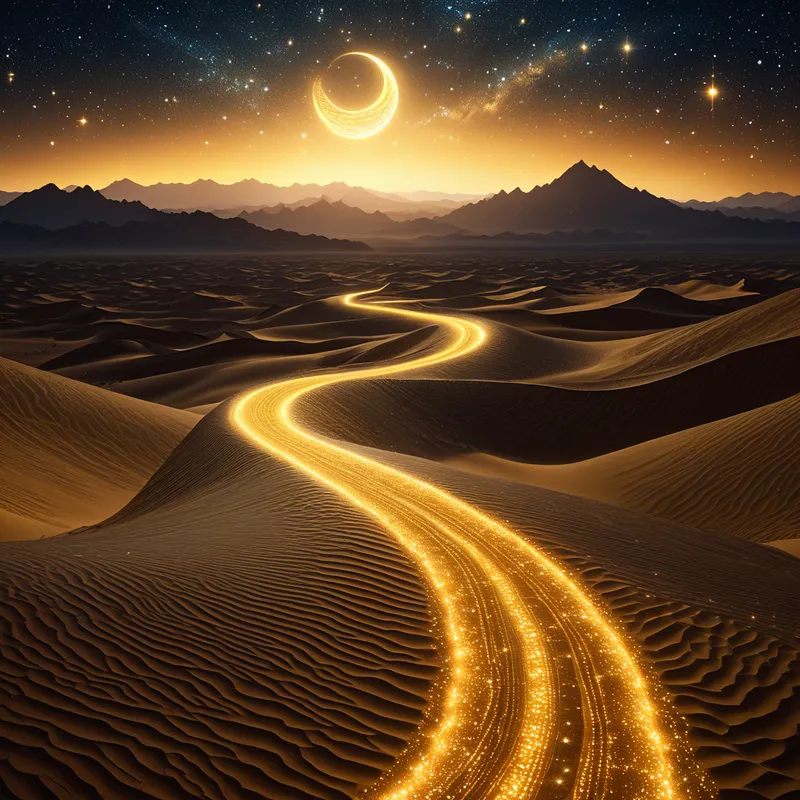
Silk Road Myth Meaning & Symbolism
A mythic tapestry of exchange where silk becomes a celestial thread weaving empires, gods, and the human soul into a single, breathing pattern.
The Tale of Silk Road
Listen. Before it was a route on a map, it was a whisper in the wind, a longing in the blood. It began not with a caravan, but with a breath—the breath of the Jade Emperor upon the mulberry leaves of the Middle Kingdom. From this divine exhalation sprang the silkworm, a humble creature of earth destined to spin a thread of heaven.
In the court of the Huangdi, the secret of silk was a sacred trust, guarded more fiercely than any treasure. It was the cloth of emperors and the shroud of the stars. But secrets, like water, seek their own level. They yearn to flow. And so the thread began to dream of distance.
The first to hear its call was a man with dust in his soul and the mandate of heaven in his heart: Zhang Qian. His mission was born of strategy—to find allies against the nomadic shadows of the north—but his journey became a psalm. He walked where the earth cracked like old pottery, through the Taklamakan Desert, where bones of lost travelers glimmered like pale jade in the sun. He was captured, imprisoned, yet the thread within him never snapped. For thirteen years, he carried the memory of silk—not the fabric, but its idea: connection.
He returned with tales that set the imperial court ablaze. Not of armies, but of horses that sweated blood in the Ferghana Valley, of grapes like amethysts in Bactria, of civilizations that mirrored their own yet danced to different celestial drums. The Emperor listened, and in his eyes, a new map was drawn—not of borders, but of possibilities.
Then the caravans began. They were not mere trains of merchants; they were slow, breathing dragons of commerce and culture. They groaned under the weight of bolts of silk that held the sheen of moonlight, of lacquerware that captured forest depths, of porcelain as fragile and strong as a promise. Westward they trudged, following the sun’s setting path, guided by the Beidou at night.
And in return, the world flowed back. Strange spices that tasted of foreign suns, cobalt blue for porcelain dreams, glass that trapped light in solid liquid, and the haunting melodies of Central Asian lutes. Buddhism traveled on lotus feet along these very paths, its sutras wrapped in silk. The road became a living artery. At caravanserais under immense, indifferent skies, Zoroastrian priests debated with Nestorian monks, while Sogdian traders bartered in a tongue of gestures and gold. The silk was no longer just a commodity; it was a currency of trust, a scroll upon which the stories of humanity were being written.
The myth finds its resolution not in an ending, but in a perpetual becoming. The Silk Road never truly concluded. It faded, was reborn, was buried by sand, and remembered in song. It became the world’s first web—a tangible, dusty, glorious network of human curiosity. The conflict was the separation of worlds; the rising action was the courageous step into the unknown; the resolution was the enduring pattern of exchange itself, proving that to give one’s secret treasure is to receive the universe in return.
Cultural Origins & Context
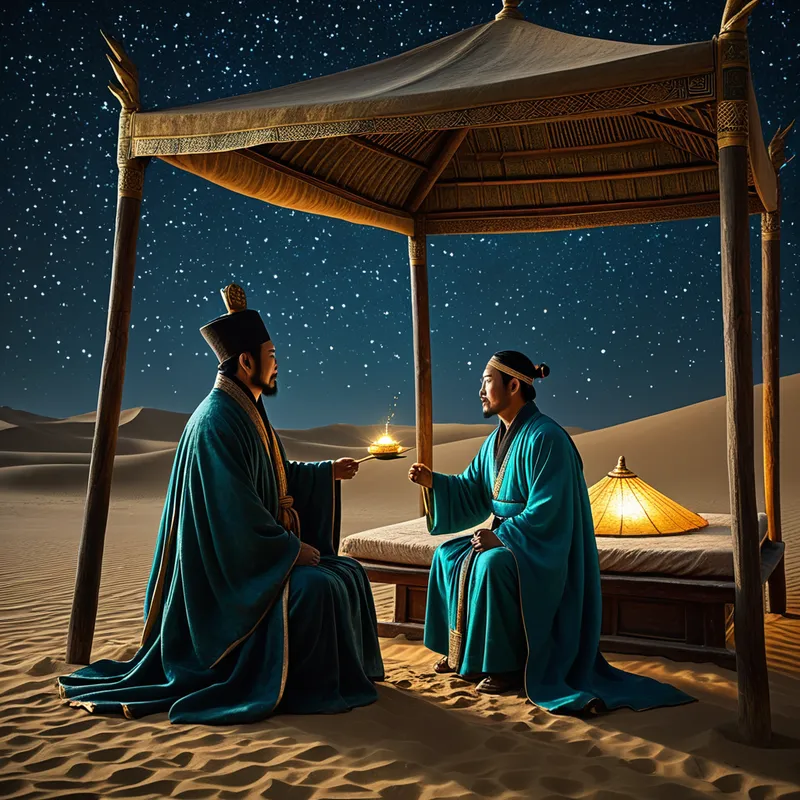
The myth of the Silk Road is a unique cultural artifact. It is not a single, codified story with named gods, but an emergent, collective narrative born from historical fact and elevated by centuries of poetic reflection, official chronicles, and folk memory. Its primary “storytellers” were the historians of the Twenty-Four Histories, who recorded the exploits of figures like Zhang Qian with a sense of epic grandeur. It was also told by the merchants, monks, and soldiers whose lives were the threads of the tapestry.
Its societal function was multifaceted. For the imperial state, it was a narrative of cosmological legitimacy and soft power. The Emperor, the Tianzi, demonstrated his virtue and the wealth of his realm by engaging in “tributary exchange” that radiated Chinese civilization outward. For the populace, it was a story of wonder and worldly engagement, a proof that the Middle Kingdom was indeed the central, civilizing force in a world of fascinating, distant “others.” It transformed geography into destiny and trade into a civilizing mission, weaving practical economics into the sacred mandate of order and connection.
Symbolic Architecture
At its core, the Silk Road is a supreme symbol of the connecting principle. It represents the psyche’s innate drive to bridge conscious and unconscious, known and unknown, self and other.
The silkworm’s cocoon is the isolated ego; the unspooling thread is the act of consciousness reaching out. The road itself is the extended psyche, the necessary risk of connection that transforms isolation into a network of meaning.
The cán is the foundational archetype: a humble, earthbound creature that undergoes a radical metamorphosis to produce a substance of unearthly beauty and strength. This mirrors the alchemical process where base, unconscious material (the worm) is sacrificially transformed into a vehicle for transcendence (the silk). The desert, the Taklamakan, represents the terrifying but fertile tabula rasa of the unconscious, the daunting stretch of inner work that must be traversed to reach new psychic territories.
The caravanserai is a symbol of the temenos, the sacred resting place and container where opposites meet. It is the psychological space—perhaps in therapy, art, or deep dialogue—where disparate aspects of the self (or between self and other) can encounter one another without immediate assimilation or destruction, allowing for true exchange.
The Dreamer's Resonance
When the myth of the Silk Road activates in the modern dreamscape, it often signals a profound process of psychic integration and the longing for meaningful exchange. To dream of walking an endless, ancient road suggests a soul-level journey is underway, often during life transitions, career changes, or periods of intellectual or spiritual seeking.
Dreaming of being a merchant, bartering unfamiliar goods, points to an unconscious negotiation of values, skills, or identities. What are you offering to the world? What are you seeking in return? The somatic sensation is often one of weary determination coupled with anticipation—the weight of the pack on one’s shoulders, but also the thrill of a distant, glowing oasis.
A dream of a single, unbroken thread stretching across a vast landscape speaks directly to the dreamer’s need for connection—perhaps mending a broken relationship, integrating a lost part of the self, or finding a coherent narrative through fragmented life experiences. The thread is the line of life, and the dream asks: Where does it lead? What is it connecting?
Alchemical Translation
For the individual, the Silk Road myth models the entire journey of individuation. The starting point is the sealed kingdom of the ego, hoarding its “silk”—its unique talents, perspectives, and psychic wealth—in isolation. This is a state of potential, but also of stagnation. The call to adventure, like Zhang Qian’s mission, often comes through a crisis: a feeling of enclosure, a threat from the “nomadic” unconscious (depression, anxiety, meaninglessness), or simply an irresistible curiosity about the wider world of the soul.
The alchemical gold is not found in the treasure vault, but forged in the exchange at the crossroads. To give one’s silk is to receive the philosopher’s stone of a transformed perspective.
The arduous journey through the desert is the confrontation with the shadow. It is the difficult, often lonely work of facing one’s own barren places, fears, and forgotten aspects. This is non-negotiable; the road to the wider psyche goes straight through the heart of one’s personal wilderness.
The act of exchange is the crucible of transformation. Psychic individuation is not about conquering or collecting parts of the self, but about engaging in a fair and respectful trade. One must offer up a rigidly held attitude (a bolt of ego-silk) to receive a new feeling, insight, or value from the “foreign land” of the unconscious or the external other. This could be trading perfectionism for creativity, or intellectual certainty for embodied wisdom.
Finally, the myth teaches that the Self is not a fixed destination, but the living, breathing network itself. The individuated person is not a fortified imperial city, but a vibrant caravanserai—a dynamic, connected node where inner and outer, familiar and strange, continually meet, exchange, and enrich one another. The road remains open, the silk continues to flow, and the pattern of the soul becomes ever more intricate and complete.
Associated Symbols
Explore related symbols from the CaleaDream lexicon: