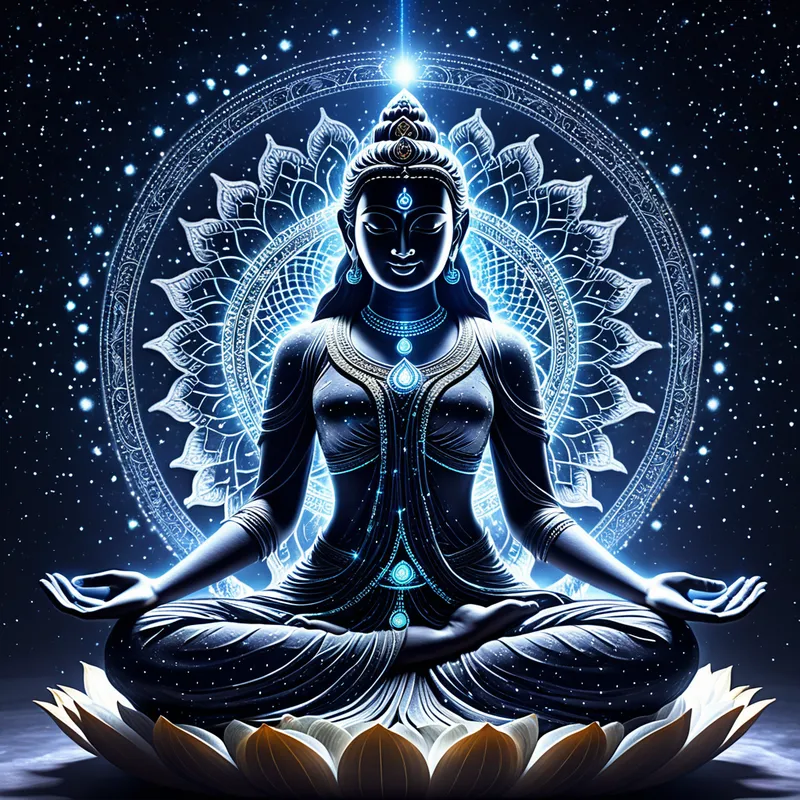
Sutra Myth Meaning & Symbolism
The myth of Sutra reveals the universe as a single, divine thread weaving all existence, consciousness, and destiny into an interconnected whole.
The Tale of Sutra
In the beginning, before the first breath of Brahma, there was neither being nor non-being. There was only a profound, pregnant silence—a darkness that was not dark, a stillness that hummed with potential. Then, from the heart of that boundless, unmanifest Brahman, a single intention arose. It was not a sound, but the possibility of sound; not a form, but the desire for form.
And so, the thread was spun.
Imagine a loom whose frame is the horizon of all existence. The weaver is the unseen consciousness itself. With a movement that is both thought and act, the first strand is drawn—a filament of pure, intelligent light. This is Sutra. It is the axis, the spine, the central cord from which the tapestry of reality begins to depend.
The thread sings as it stretches. Its vibration is the primordial Aum. Where it passes, space crystallizes. Where it loops, time begins to coil. The weaver’s hands, invisible and everywhere, guide the Sutra. It plunges into the abyss to become the subterranean rivers of the underworld. It arcs high to become the path of the sun and the track of the stars. It knots itself into the dense, fiery core of matter and spins out into the delicate, whispering veil of thought.
Now, witness the weaving of a world. The Sutra becomes the warp. Across it, the weaver throws the shuttle of causality, the weft of action—Karma. Each crossing, each intersection, is a moment, a life, a galaxy. The thread binds the mountain to the root, the ocean to the cloud, the predator to the prey, the lover’s sigh to the distant supernova’s death. The great sages, the Rishis, in deep meditation, hear the hum of this weaving. They perceive the Sutra not as a metaphor, but as the literal, luminous anatomy of the cosmos. They see the thread passing through their own subtle bodies, connecting the heel to the crown, the heartbeat to the thought, the individual soul—the Atman—to the universal soul.
The drama is one of connection versus fragmentation. The illusion, Maya, is the dazzling, distracting beauty of the tapestry’s finished picture, making us forget the single thread that holds it all together. The hero’s journey is to trace the glittering pattern back, against the current of distraction, to feel for the taut, true line running through the center of all things. The resolution is not an end, but a realization: to see that you are not merely a static figure in the weave, but are yourself the very fiber of the living thread, eternally being woven.

Cultural Origins & Context
The concept of Sutra is not a singular myth with characters and plot, but a foundational metaphysical principle woven into the very fabric of Vedic and post-Vedic thought. Its most famous exposition is found in the Brihadaranyaka Upanishad (3.7.1-2), where the sage Yajnavalkya describes the Self as the "inner controller" and the "seer unseen" who is "sewn together" with all beings. This imagery is the bedrock.
This was not a story told around a fire for entertainment, but a truth transmitted from guru to disciple in the forest hermitages, the ashramas. It was a tool for contemplation. The societal function was profound: it provided a cosmological model that explained unity in diversity. In a culture that observed staggering multiplicity—countless gods, castes, life forms, and duties (Dharma)—the Sutra was the philosophical glue. It justified the intricate structure of society and ritual (every rite was a symbolic re-weaving) while simultaneously offering a path to transcend it. It taught that the priest and the warrior, the elephant and the ant, were all strung on the same divine thread, performing their ordained role in the maintenance of the cosmic order, Rta.
Symbolic Architecture
The Sutra is the ultimate symbol of non-dual interconnection. It represents the hidden architecture of reality, the continuum that underlies apparent separation.
The thread is not between things; it is the things, and the space between them, and the intelligence that relates them.
Psychologically, the Sutra represents the thread of consciousness itself. It is the through-line of the psyche, connecting the conscious ego to the deep unconscious, linking one thought to the next, one memory to a future aspiration, one trauma to a present-day trigger. It is the narrative thread of our personal identity. The knots along the Sutra symbolize complexes—those tangled clusters of emotion, memory, and perception that create the illusion of a separate, suffering self. The goal of yoga and meditation, in this symbolic reading, is to "unknot" the heart, to make the thread straight and luminous once more, allowing the free flow of consciousness from the personal to the universal.
The weaver is the archetypal Self, the organizing center of the total psyche, engaged in the perpetual act of creation that is our lived experience. The tapestry is the phenomenal world of our perceptions and our life story, beautiful but ultimately a secondary reality.
The Dreamer's Resonance
When the motif of the Sutra appears in modern dreams, it rarely presents as an ancient sage or a literal thread. Its presence is more subtle, more somatic. One might dream of finding a single, unbreakable wire running through the walls of every house they’ve ever lived in. Another might dream of tracing a vein of glowing ore through a mountain, realizing it connects to the circuitry of their own nervous system. A common pattern is the dream of a network—telephone lines, mycelial networks, subway maps—that is revealed to be a single, continuous loop.
These dreams signal a psychological process of re-membering. The psyche is working to integrate disparate parts. The dreamer may be experiencing fragmentation—feeling torn between roles (professional/personal), identities, or conflicting truths. The Sutra dream is the unconscious affirming the existence of a central, organizing principle beneath the chaos. It is often accompanied by a somatic sense of "lining up," of things clicking into place, or a profound relief. It’s the dream equivalent of finding the missing piece that makes the puzzle coherent. The conflict in the dream is the tension between seeing the beautiful, confusing picture (the tapestry of Maya) and the effortful, focused work of tracing the single, simple thread back to its source within.
Alchemical Translation
The individuation process, the alchemical Opus, is precisely this work of tracing the Sutra. It is the journey from identifying with the isolated image on the tapestry to identifying with the thread that forms it.
Individuation is not about becoming a more intricate and isolated knot; it is about becoming conscious of the thread you share with the whole loom.
The modern individual begins in a state of projection. We see our soul, our meaning, and our fate as separate from the world "out there." This is the enchantment of the tapestry. The first alchemical stage, nigredo or the dark night, often feels like the thread snapping—a loss of meaning, depression, disintegration. But in the mythic view, the thread cannot snap; it can only be obscured. This despair is the necessary burning away of the false images.
The work of therapeutic and introspective practice is the albedo, the washing. It is the careful, patient tracing of the thread through the knots of our complexes: "Why does this criticism hurt? What ancient thread does it pull?" We follow it back through parental patterns, cultural conditioning, and personal trauma.
As we trace, a paradox occurs. We expect to find a tiny, isolated ego at the end of "our" thread. Instead, we find it merges with other threads, loses its claim to sole ownership, and ultimately disappears into the hand of the weaver—the Self. This is the rubedo, the reddening, the realization of the philosopher's stone. The triumph is not a triumph of the ego, but of the ego’s surrender to its role as a conscious length of the universal Sutra. One becomes a conscious participant in the weaving, responsible for the quality of one’s own stretch of the thread, yet humbled by its infinite connections. The struggle is the illusion of separation; the transmutation is the lived experience of being the connective tissue of the universe itself.
Associated Symbols
Explore related symbols from the CaleaDream lexicon: