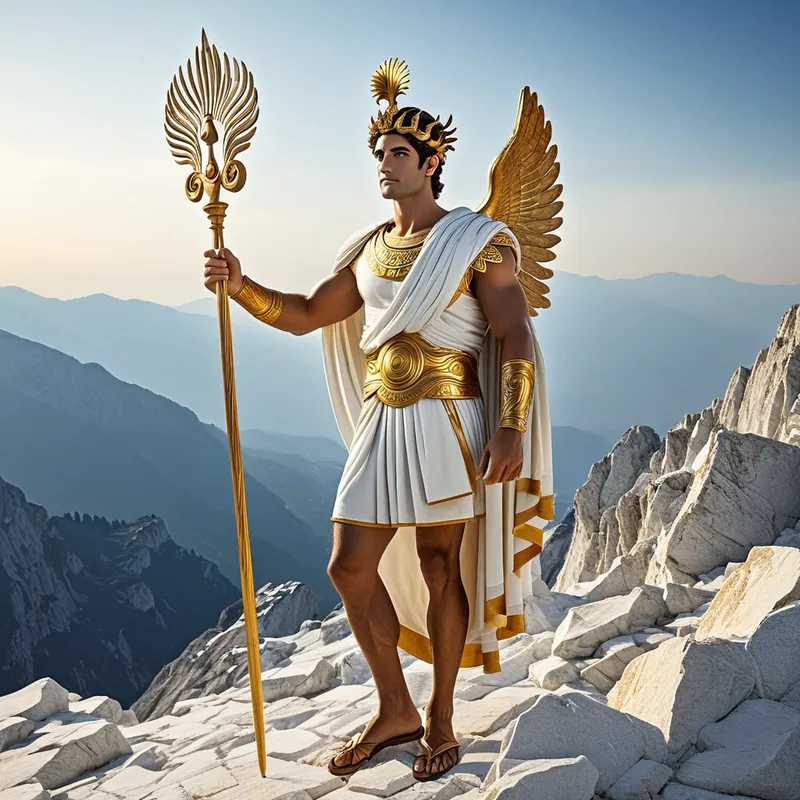
Apollo Myth Meaning & Symbolism
The radiant god of the sun, music, and prophecy, whose myth embodies the struggle to impose luminous order upon the chaotic depths of the soul.
The Tale of Apollo
Hear now the tale of the Shining One, the god who was born into strife and rose to become the very voice of order. Leto, great Titaness, heavy with the twins of mighty Zeus, wandered the earth, hounded by the serpentine jealousy of Hera. No land dared offer her refuge, for fear of the Queen of Heaven’s wrath. At last, a barren, floating rock, Ortygia, took pity. There, clutching a palm tree, Leto brought forth first Artemis, who then became her mother’s midwife for the second birth. And so Apollo entered the world, and immediately the sterile isle blossomed with gold.
From his first breath, he was not an infant, but a god full-formed. “Give me my lyre,” he declared, his voice not a cry but a clear command. “Give me my curved bow. I shall proclaim to men the unfailing will of Zeus.” And he set forth, a streak of gold against the blue.
His path was one of fierce establishment. He journeyed to Delphi, where the ancient serpent Python, child of Gaia, coiled around the sacred spring, its breath fouling the prophetic vapors. With arrows that never missed, Apollo, the Far-Shooter, slew the great beast, piercing its dark heart. He claimed the oracle for his own, casting Python’s body into a fissure of smoking rock. But this was no mere conquest; it was a purification. From the chthonic mists of the earth-mother, he raised a temple of light and reason, where his priestess, the Pythia, would breathe the same vapors and speak his clear, if riddling, truths.
Yet his light could burn. When the satyr Marsyas dared challenge him with the flute, Apollo played his lyre upside down, a feat Marsyas could not match. For his hubris, Marsyas was flayed alive, his cry a reminder that the god’s harmony demanded absolute respect. When the mortal Cassandra spurned his love, he left her the gift of true sight, but twisted it with the curse of disbelief—a torment of clarity in a world of deafness. His light revealed all, beautiful and terrible, and his justice was as exacting as a mathematical proof, leaving no shadow for error to hide.

Cultural Origins & Context
The worship of Apollo coalesced in the Greek world during the so-called Dark Ages, emerging as a defining force of the emerging Classical ethos. Unlike the older, chaotic chthonic powers, Apollo represented a new divine principle: intellectual order, civic law, and artistic discipline. His primary cult centers, Delos and Delphi, became the spiritual and political hubs of the Hellenic world. Delphi, in particular, functioned as the “navel” of the earth, where city-states and kings sought guidance not through omens of entrails, but through the interpreted words of the Pythia. The myths were preserved and transmitted by epic poets like Homer and Hesiod, and later by lyric poets and tragedians who explored the god’s complex nature. In Roman culture, he was adopted directly, losing none of his key attributes. His myth served a critical societal function: it modeled the transition from primal, earth-bound mystery to the civilized ideals of clarity, prophecy (which is forethought), and the arts that soothe and civilize the savage breast.
Symbolic Architecture
Apollo is the archetypal principle of consciousness itself. He represents the psychic force that seeks to differentiate, clarify, and impose structure upon the undifferentiated chaos of the unconscious—symbolized by Python, the serpent of the earthy depths. He is not the source of life (that is his father Zeus, or the Earth Mother Gaia), but the one who gives life form and meaning.
Apollo is the light of the mind that names the shadows, transforming primal fear into knowable boundary.
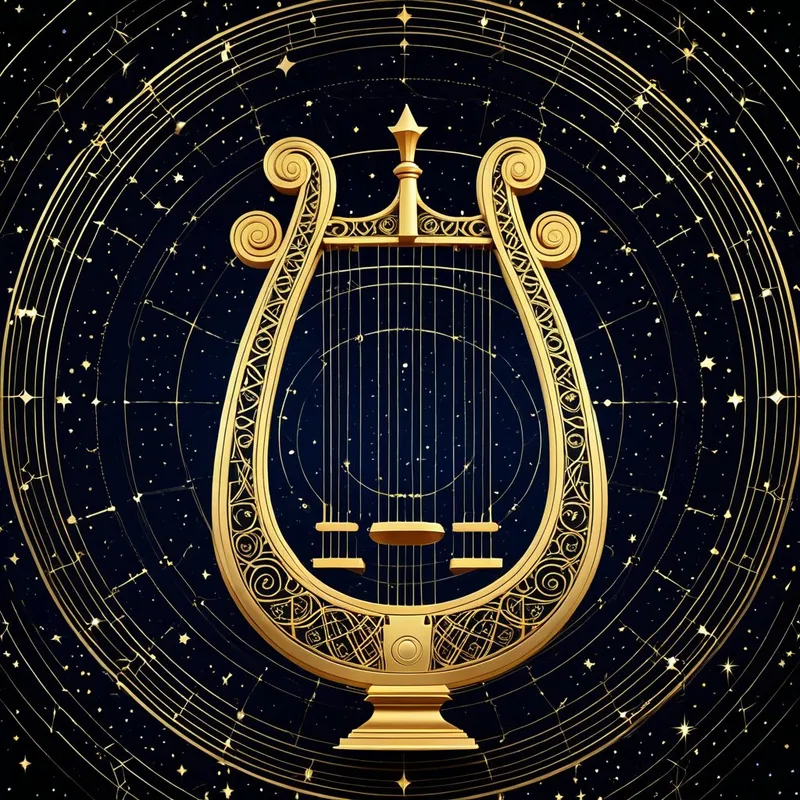
His domains are a coherent symbolic system: the Sun is the illuminating light of awareness; the Lyre is the harmonic ordering of raw emotion and instinct into culture and art; the Bow is the focused, penetrating intellect that discriminates and targets truth; and the Laurel is the crown of victory earned through such disciplined pursuit. He is the god of healing because he brings the “fever” of chaos into the “temperate” state of order, and the god of plague because an excess of this same analytical, critical light can scorch and sterilize the soul. His tragic entanglements—with Daphne (who becomes a tree to escape him), Hyacinthus (who dies by a discus), and Cassandra—all speak to the peril of consciousness when it fails to integrate the other: the autonomous life of nature, the vulnerability of human love, the painful truth it itself reveals.
The Dreamer's Resonance
To dream of Apollo is to dream of a pressing need for order, clarity, or recognition in the dreamer’s psyche. It often manifests during life phases requiring decisive action, intellectual mastery, or the “bringing to light” of a hidden truth. One might dream of a brilliant, blinding light that reveals a cluttered room (the inner state), or of trying to tune a complex musical instrument that refuses to hold its note (the struggle to harmonize conflicting parts of the self).
Somatically, this can feel like tension in the forehead or eyes—the place of vision and thought—or a restless energy seeking a channel. Psychologically, it is the process of the conscious ego strengthening its position. The shadow side appears if the dream-light becomes harsh: dreams of being judged by a cold, statuesque figure, or of a beautiful garden being meticulously trimmed until it is lifeless. This signals an over-inflation of the critical, ruling consciousness at the expense of instinct, emotion, and organic growth—the very Python-energy Apollo sought to subdue.

Alchemical Translation
The individuation journey modeled by Apollo is the opus of bringing the latent, often chaotic, contents of the self into the clear light of conscious understanding and disciplined form. The first stage is the “Slaying of Python”: confronting and integrating the primal, unconscious patterns (childhood wounds, inherited complexes, instinctual drives) that coil around our inner wellspring of truth. This is not an act of annihilation, but of claiming sovereignty over one’s inner oracle.
The alchemical gold Apollo seeks is not power over others, but the sovereign self, where the lyre of the soul is in tune with the cosmic law.
The subsequent trials—mastering the arts, enduring the curse of Cassandra (seeing painful truths others deny), mourning lost loves like Hyacinthus—are the ongoing refinements. The lyre represents the conjunctio oppositorum, the marriage of disciplined structure (the frame) with inspired emotion (the strings) to create transcendent beauty. The ultimate goal is not to live in sterile sunlight alone, but to become like Delphi itself: a sacred site built over the chthonic fissure, where the smoky, irrational vapors of the deep are transformed into articulate prophecy. The modern individual undergoes this alchemy whenever they take a raw, emotional experience and, through reflection, art, or therapy, give it a form that both contains and expresses it, thereby transforming personal chaos into personal cosmos.
Associated Symbols
Explore related symbols from the CaleaDream lexicon:
- Yellow
- Sunny
- Presentation
- Blond
- Tan
- Arrow
- Beat
- Conscious
- Straw Sunhat
- Sunshine Yellow
- Canary Yellow
- Translucent Silica
- Sunbeam Through Clouds
- Sun Halo
- Wistful Calendula
- Crowned Flower
- Petunia Wave
- Dappled Sunlight
- Glimmering Sunflower
- Stage Spotlight
- Sincere Journalist
- Detective's Magnifying Glass
- Flute
- Fiddle
- Ornate Clavichord
- Illusive Lyre
- Fantasy Violoncello
- Melodic Harp
- Illuminated Zither
- Wooden Clarinet
- Celestial Lute
- Celestial Tuning Fork
- Archery Target
- Dartboard
- Shooting Game
- Ring Toss
- Xylophone Keys
- Bow and Arrow
- Photography Ring Light
- Archery Bow
- Van Gogh's Sunflowers
- Robin Hood's Bow
- Roman Laurel Wreath
- George Washington's Cherry Tree
- Mozart's Sheet Music
- Roller Brush
- Highlighter
- Highlighter Glow
- Piano Tuner
- Plectrum
- Lute of Light
- Ascendant Symphony
- Radiating Light
- Aletheia (Truth)
- Winged Arrow
- Arrows with Flint Tips
- Obsidian Arrowhead
- Arrowhead
- Handcrafted Arrowhead
- Rustic Bow
- Amaterasu Sun
- Ultrasound
- Ultrasonic Pulse
- Solar Wind
- Radiation
- Declarative
- Denotative
- Reveal
- Tiphareth
- Xray
- Diagnosis
- Photosphere
- Gamma
- Eucalyptus
- Radiance
- Brightness