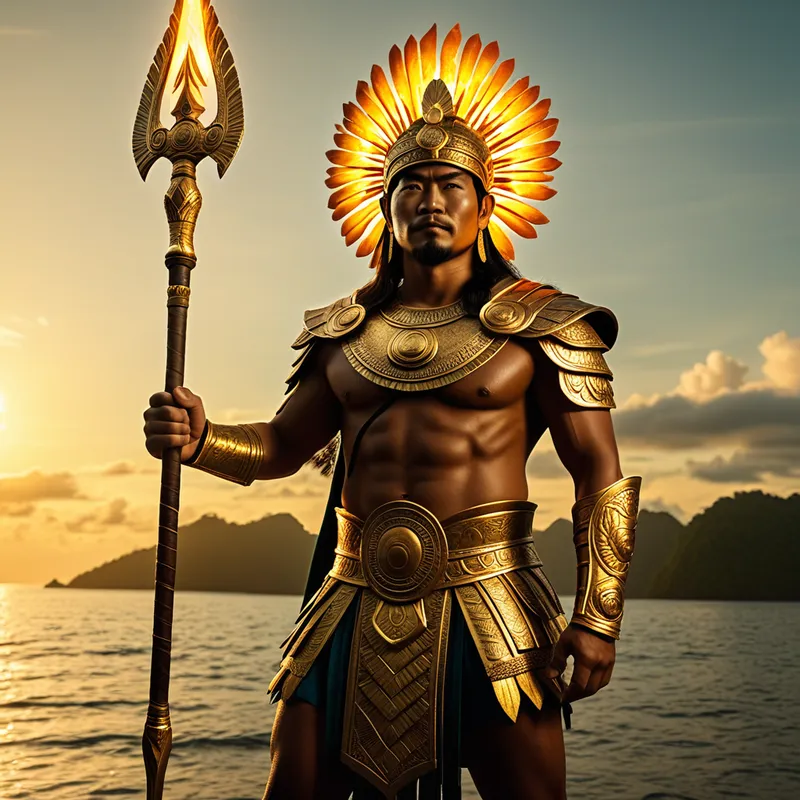
Apolaki Myth Meaning & Symbolism
The myth of Apolaki, the sun god of war, tells of a celestial battle for sovereignty, symbolizing the fiery struggle to forge a conscious, radiant self.
The Tale of Apolaki
Listen. Before the world knew its name, there was only the great, yawning Chaos of the sea and sky. From this womb emerged the first parents, Bathala, the breath of order, and a great, serpentine earth. Their children were the first lights in the darkness.
Among them shone Mayari, whose eye was a pool of cool, silver light, casting gentle dreams upon the waters. And there was Apolaki, whose gaze was a forge of golden fire, burning away mist and shadow to reveal the shape of the world. For an age, they ruled in harmony, their light a balanced dance across the canopy of heaven.
But when the great parent passed into the mystery, a question hung in the air, heavier than any mountain: who would now hold the sky? Apolaki, fierce and brilliant, stepped forward. "The world needs a strong, single light," he declared, his voice like the crackle of noon. "The sun must rule alone, to give clarity and strength." Mayari, calm as the deep tide, countered, "The world needs rest and reflection as much as it needs growth. The moon must have her domain, for secrets and tides and the softening of edges."
Words turned to sparks, and sparks to a fire of divine will. In the vast courtyard of the heavens, they met. Not with armies, but with their very essence. Apolaki, a being of pure solar fury, wielded a spear of condensed daylight. Mayari, a warrior of serene resolve, held a sickle</ab title> of sharpest moonlight. The clash was not of mere metal, but of principles—of relentless revelation against gentle concealment, of outward action against inward knowing.
The battle was catastrophic in its beauty. Where Apolaki's spear struck, stars were born and died. Where Mayari's sickle swept, nebulae swirled into being. They were matched, strength for grace, fire for tide. But in a fateful moment, as Apolaki fought with the unbridled force of his nature, his blow struck true—not to defeat, but to wound. Mayari's luminous eye was marred, dimming its silver radiance.
The universe held its breath. The fire in Apolaki's heart guttered, quenched by a sudden, profound tide of grief. He saw not an opponent, but his sister, her light wounded by his own hand. The rage for sovereignty dissolved, revealing the deeper bond beneath. He cast his spear aside; its light faded into the fabric of the dawn.
From this rupture flowed not defeat, but a new covenant. "I have wronged you," Apolaki said, his voice now the warmth of a healing hearth. "We shall share the sky, as we were meant to. Rule the night, and I shall rule the day. And in the times of balance—at dusk and dawn—we shall meet and remember." And so it was. The sun, Apolaki, reigns with fierce benevolence. The moon, Mayari, rules with gentle mystery, her one bright eye a reminder of cost and compromise. Their eternal dance is the first law of the world: that even among gods, wholeness is found not in conquest, but in sacred agreement.

Cultural Origins & Context
The myth of Apolaki and Mayari is rooted in the pre-colonial belief systems of the peoples of Katagalugan, primarily the Tagalog. It was not a story confined to parchment, but a living cosmology passed down through the oral tradition of the babaylan (shaman-priestesses) and the community elders. This transmission was performative, woven into rituals, epic chants, and the very rhythm of agricultural life.
The societal function of this myth was multifaceted. On a practical level, it explained the celestial mechanics of day and night, sun and moon. On a deeper, social level, it encoded a profound political and spiritual philosophy. It presented a model of governance not as absolute, autocratic rule, but as a form of shared sovereignty and balanced power. The resolution of the conflict between the solar and lunar principles served as a divine precedent for pagkakasundo (harmonious agreement) and the necessity of different, complementary strengths within a community. The myth warned against the hubris of singular, unchecked power (Apolaki's initial claim) and championed the wisdom of reconciliation and defined domains of responsibility.
Symbolic Architecture
At its core, the myth is a profound allegory for the birth of consciousness itself. Apolaki represents the solar principle: the active, discriminating, penetrating light of the ego-consciousness. He is the force that separates, defines, and acts. Mayari embodies the lunar principle: the receptive, intuitive, and unconscious psyche. She governs memory, reflection, the ebb and flow of feeling, and the hidden depths.
The great battle in the heavens is not fought with swords, but with glances. It is the primordial struggle between the eye that seeks to illuminate everything outside itself, and the eye that gazes inward to perceive the everything within.
Their conflict is the inevitable tension that arises as the conscious mind (Apolaki) seeks to establish its rule, often at the expense of its connection to the unconscious (Mayari). The wounding of Mayari's eye is the critical moment—the point where the ego's unchecked aggression damages its own link to the soul's deeper wisdom. This is not a victory, but a catastrophic loss of wholeness. Apolaki's subsequent grief and compromise represent the moment the conscious mind realizes it cannot exist in isolation; it is part of a greater psychic ecology. The resulting division of day and night symbolizes the necessary rhythm between conscious engagement and unconscious integration, between doing and being, between the persona and the shadow.

The Dreamer's Resonance
When this mythic pattern stirs in the modern dreamer, it often manifests as dreams of intense, unresolved conflict with a sibling, a rival, or a part of oneself that feels both intimately connected and diametrically opposed. One may dream of a fierce competition for a "throne" or a position of authority, or of a brilliant light that is somehow blinding or destructive.
Somatically, this can correlate with a feeling of being "burned out"—the solar principle running too hot without the cooling, restorative lunar tide. It can also manifest as insomnia (an inability to surrender to the "night" of the unconscious) or as a pervasive sense of one-sidedness, where the dreamer feels they are all action and no reflection, or all outward presentation and no inner truth. The psyche is signaling an imbalance. The "battle" in the dream is the psyche's attempt to dramatize an internal civil war between the need for autonomous self-assertion and the need for relational, intuitive connection. The dream asks: What part of your inner Mayari have you wounded in your drive to succeed? What luminous, reflective wisdom have you dimmed?

Alchemical Translation
The journey of Apolaki is a precise map for the alchemical process of individuation. It begins in the nigredo, the blackening: the chaotic, undifferentiated state following the "death" of the old order (Bathala). Here, the nascent ego (Apolaki) emerges, but in a inflated, heroic form, claiming total sovereignty. This is a necessary, if painful, stage of differentiation.
The battle represents the albedo, the whitening, where opposites are starkly contrasted and brought into fierce confrontation. The critical alchemical operation here is not winning, but the wounding. The injury to Mayari is the moment of profound disillusionment, where the ego's project reveals its catastrophic flaw. This is the dissolution of inflation.
The alchemical gold is not forged in the fire of victory, but in the crucible of remorse. The spear must be abandoned before the crown can be worn.
Apolaki's grief and proposed compromise signify the rubedo, the reddening. This is the integration of the opposites. The conscious mind, humbled and enlightened by its own capacity for damage, consciously makes space for the unconscious. It agrees to a rhythm, a partnership. The ego does not vanish; it assumes its proper role as the ruler of the "day"—the realm of conscious life—but now in respectful dialogue with the lunar "night" of the soul. The resulting individual is not a solitary sun-king, but a sovereign who rules the inner kingdom through a balanced council of its own diverse energies. The myth teaches that true power, the philosopher's gold of the Self, is a reconciled duality.
Associated Symbols
Explore related symbols from the CaleaDream lexicon:
- Sun — The radiant, conscious ego and the principle of active, discriminating light that Apolaki embodies, representing clarity, vitality, and sovereign will.
- Moon — The reflective, unconscious psyche and the principle of receptive intuition that Mayari embodies, governing dreams, tides, memory, and the hidden self.
- Warrior — The archetypal energy of Apolaki, representing the necessary fight to establish boundaries, defend values, and forge an independent identity.
- Shadow — The wounded aspect of Mayari and the unconscious contents initially opposed by the solar ego, which must be acknowledged and integrated for wholeness.
- Spear — The penetrating, focused will of the conscious mind (Apolaki's weapon), which can reveal truth but also inflict psychic injury when wielded without integration.
- Crown — The achieved sovereignty of the integrated Self, earned not through conquest of the other, but through reconciliation and the establishment of balanced, inner rule.
- Light — The fundamental principle of consciousness and revelation, which in its dual solar and lunar forms creates the rhythm of all psychic life.
- Chaos — The primordial, undifferentiated state from which the divine siblings emerge, representing the unconscious matrix before the light of consciousness acts upon it.
- Order — The cosmic structure established by the pact between Apolaki and Mayari, symbolizing the inner psychic order born from reconciling opposing forces.
- Goddess — The divine feminine principle embodied by Mayari, representing the intuitive, nurturing, and cyclical powers of the psyche that complement the solar masculine.
- Ritual — The eternal, celestial dance of day and night established by the myth, reflecting the internal rituals needed to maintain balance between conscious and unconscious life.
- Dream — The native domain of Mayari, representing the nightly journey into the unconscious that is essential for healing, reflection, and dialogue with the solar self.