Aphrodite's Chariot Myth Meaning & Symbolism
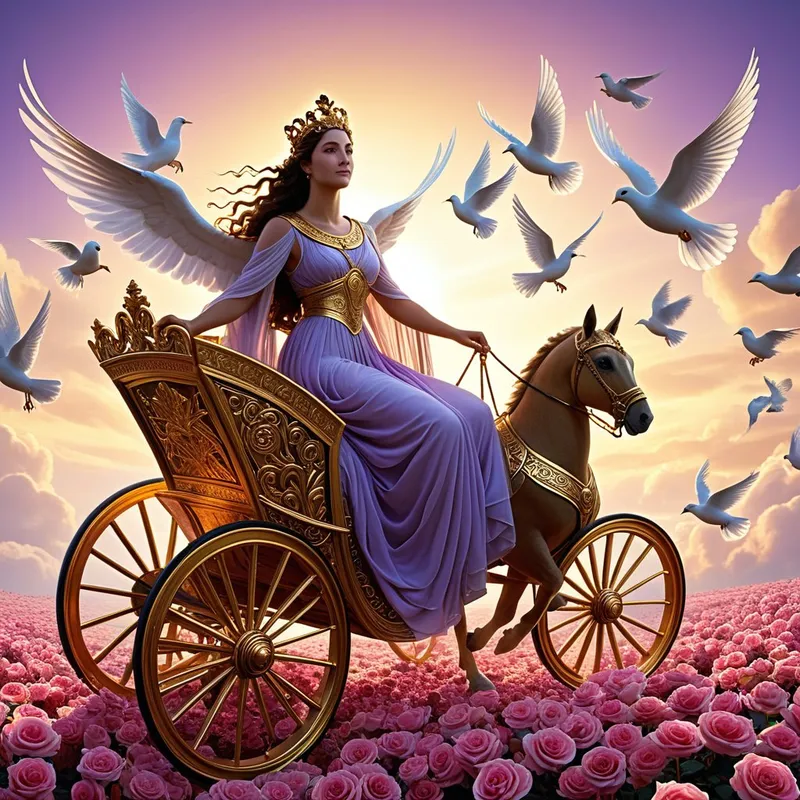
Aphrodite, wounded by Diomedes, flees to Olympus in her chariot drawn by doves, a myth of love's vulnerability and triumphant return to source.
The Tale of Aphrodite's Chariot
Hear now a tale not of love’s gentle whisper, but of its screaming wound. The air over the Scamander plain was thick with the bronze stench of war, the groans of dying men, and the furious will of gods made manifest in mortal flesh. Amidst the chaos, Aphrodite moved, a shimmer of unbearable beauty in a field of gore. Her son, the Trojan prince Aeneas, lay fallen, struck down by the Greek warrior Diomedes, who raged with the blessing of Athena herself.
With a mother’s cry that held the anguish of all creation, Aphrodite swept down. She threw her radiant arms around her beloved son, casting a shimmering veil about him to shield his body from further blows. But in that moment of tender, vulnerable rescue, she exposed not her power, but her nature. Diomedes, his eyes seeing through the divine glamour, knew her. This was not a warrior to be awed by beauty. He lunged, his spear—guided by Athena’s grim purpose—finding its mark. The bronze point tore through the goddess’s immortal flesh, piercing the wrist where her divine pulse beat.
A sound escaped her that was not human. It was the sound of a perfect note shattered. Golden ichor, not blood, streamed from the wound, a luminous sap of life and passion spilled upon the dust. The pain was a shock of pure existence, a reminder that even the force that binds the cosmos can be hurt. She dropped Aeneas. Her power flickered. With a gasp that drew the breath from the battlefield, she fled.
But her flight was not a crawl. In her moment of deepest wounding, her essence called forth its true vessel. From the ether, or perhaps from the very longing in the hearts of all who watched, it came: her chariot. Not a war-chariot of thunder and iron, but a delicate, sublime carriage of gold and grace. And before it, not stallions, but her sacred birds: a pair of doves, their wings beating a rhythm of frantic peace. Eros, her son, was there too, his small hands reaching for her. She stumbled into the chariot, her ichor staining the gold, her immortal form trembling not with fear, but with the profound insult of pain.
The doves lifted. They rose above the spears, above the cries of "Troy!" and "Achaia!", ascending on a path only they knew—a straight line to Olympus. They flew through the layered airs of the world, past the realm of mortals, into the divine ether. And there, in the hall of the gods, she went not to her own chambers, but straight into the arms of her mother, Dione. The mighty Zeus looked upon his wounded daughter, the golden flow, and smiled a father’s weary, knowing smile. "My child," he said, his voice the rumble of distant order, "the works of war are not for you. Tend to the gentle arts of love." And Hephaestus, her husband, perhaps saw in her wound a vulnerability he knew too well. Dione stroked the hurt away, the wound sealed, but the memory—the shocking, humanizing memory of pain—remained, etched into her divinity. The chariot, its doves now calm, stood ready. It had carried her from violation to sanctuary, from fragmentation back to the source of her being.
Cultural Origins & Context
This pivotal episode is immortalized in Book V of Homer’s Iliad, the foundational epic of Greek culture. For the audiences of the 8th century BCE and beyond, hearing this tale recited by a bard was not merely entertainment; it was a theological and psychological lesson. The Iliad is a poem of menis—wrath—and the terrifying intimacy of gods and mortals. Aphrodite’s wounding served a crucial cultural function: it delineated domains.
In the rigid, honor-based world of the epic, where kleos was won on the battlefield, Aphrodite’s realm of love, desire, and beauty was portrayed as fundamentally alien to the sphere of Ares (war) and Athena (strategic combat). Her failure and flight reinforced the Greek ideal of proper spheres of influence. A goddess could be supremely powerful in her domain, yet vulnerable and "out of place" in another. The chariot, drawn by doves, visually cemented this separation. It was her specific, non-violent vehicle, a symbol that her travel—and her power—operated on a different axis than the chariots of Achilles or Hector.
The myth was passed down through the oral tradition, a vivid set-piece that would have elicited complex reactions: awe at Diomedes’ audacity, pity for Aphrodite’s pain, and perhaps a subtle reassurance. It showed the gods as relatable in their suffering, yet ultimately transcendent in their ability to return to an undamaged state—a hope forever beyond mortal reach, yet one that gave meaning to the rituals and prayers aimed at appeasing these capricious, wounded, glorious beings.
Symbolic Architecture
At its core, the myth of Aphrodite’s Chariot is a profound map of a psychic process: the wounding of a primary life principle and its necessary return to source for reconstitution.
The Wound is central. Aphrodite is not wounded in her own realm of seduction or creation, but while performing a nurturing, protective act. This signifies how our core capacity for love, connection, and beauty (the archetype of the Lover) is most easily injured not in its expression, but when it is exposed and vulnerable in a context that does not honor its nature—the battlefield of harsh reality, criticism, or trauma.
The chariot does not appear in triumph, but in retreat. It is the vehicle summoned by the soul when it recognizes it can no longer fight on the terms of the wounding world.
The Chariot and Doves are the symbolic answer to the wound. The doves represent not brute force, but the guiding power of anima—the soul’s gentle, persistent, peace-seeking impulse. They do not fight the wind; they navigate it. The chariot is the temenos, the sacred container, that holds the wounded self during this critical journey. It is the psychic structure—perhaps a creative practice, a deep retreat into nature, or the vessel of a loving relationship—that allows for transport out of the sphere of injury.
The Ascent to Olympus is the journey to the psychic "high place," the realm of the parental or primordial archetypes. Aphrodite goes to Dione (the mother) and Zeus (the father/authority). Psychologically, this is the movement from a personal complex ("I am wounded") to the archetypal ground of being ("The principle of Love itself is wounded, yet eternal"). It is a depersonalization for the sake of healing. The smile of Zeus is the recognition from the ruling principle of consciousness (the ego-Self axis) that this force has its own rightful place, separate from the heroic ego’s battles.

The Dreamer's Resonance
When this mythic pattern stirs in the modern dreamer, it often manifests not as a literal chariot, but as a profound somatic and emotional sequence. The dreamer may experience:
- The Wound: A dream of being hurt, often in the arm or hand (the capacity to reach out and connect), in a situation where they felt exposed while trying to protect or nurture something tender. The setting is frequently a "battlefield"—a hostile workplace, a fraught family gathering, a competitive arena.
- The Flight: A sudden, urgent need to escape the dream scene. The means of escape are telling: a graceful but fragile vehicle (a glass elevator, a small boat, a flock of birds carrying one away), often appearing miraculously. There is a palpable sense of retreat as survival.
- The Ascent: The dream landscape shifts vertically. The dreamer finds themselves moving upward—scaling a cliff to a calm plateau, riding an elevator to a serene penthouse, or simply floating upward toward a soothing, golden light. The atmosphere changes from one of threat to one of potential solace.
The psychological process is one of instinctive self-preservation of the heart. The dreaming culture.") psyche is rehearsing the withdrawal of a vulnerable emotional or creative function from a context that is actively harming it. The somatic feeling upon waking is often a deep relief mixed with residual ache—the signature of the archetype re-establishing its boundaries.

Alchemical Translation
For the individual on the path of individuation, Aphrodite’s journey models the alchemical stage of solutio—dissolution. The hardened, armored persona that ventures into life’s battles is pierced, and the fluid, golden essence within is released. This is not a failure, but the beginning of transmutation.
The first step is to honor the wound as divine. To acknowledge that the pain felt when our capacity for love, beauty, or creativity is scorned is not a sign of personal weakness, but a sign that something sacred has been touched. Like Aphrodite’s ichor, it is a substance different from ordinary blood; it is the pain of the soul, not just the ego.
Next, one must summon the personal chariot. This is the conscious act of creating or recognizing the container that can hold you in your wounded state. It is the therapy session, the journal, the trusted friend’s silence, the walk in the woods—the practice that allows for a retreat from the front lines without collapsing into chaos.
The journey home is not a regression, but a recalibration. One does not return to the battlefield the same. The healed wound becomes a place of greater sensitivity and, paradoxically, greater strength—a knowing vulnerability.
Finally, the ascent to the inner Olympus is the work of relating the personal injury to the transpersonal pattern. It is asking: "How is the Lover in me wounded? How is the principle of Connection itself under assault in my life?" This shifts the healing from a personal grievance to a cosmic realignment. The "smile of Zeus" is the hard-won insight from the Self that this wounded part has a destiny separate from the ego’s conflicts. It is meant to create, to attract, to beautify, not to fight.
The chariot remains, a permanent symbol in the psyche. It signifies that the soul now possesses a vehicle for navigating between the realms—the ability to descend into life’s engagements with passion, and to return to the nourishing source when wounded, carrying the golden ichor of experience back to be transformed into wisdom. The doves forever know the way.
Associated Symbols
Explore related symbols from the CaleaDream lexicon: