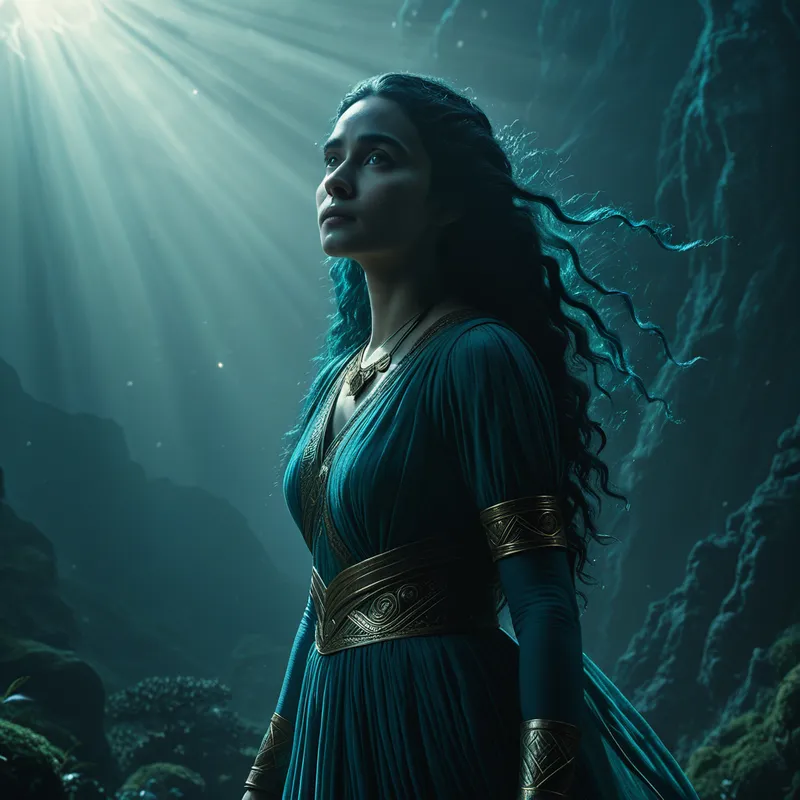
Ameno-Uzume Dance of Dawn
The Shinto goddess whose joyful, bawdy dance coaxed the sun from hiding, restoring light to the world through laughter and divine trickery.
The Tale of Ameno-Uzume Dance of Dawn
The world was born from the churning brine, but it was plunged into a profound and terrifying silence. The sun goddess, Amaterasu-Ōmikami, radiant sovereign of the heavens, had retreated into the Ame-no-Iwato, sealing the entrance with a mighty stone. Grief-stricken and enraged by the cruel transgressions of her brother, the storm god Susanoo, her light vanished from the sky. Darkness, cold, and a cacophony of wailing spirits descended upon the plain of high heaven and the world below. The eight million kami despaired, their divine council echoing with fear. The order of creation was unraveling into primordial night.
It was in this abyssal stillness that a different kind of power stirred. Ameno-Uzume-no-Mikoto, the goddess of the dawn and of revelry, stepped forward. While the other kami lamented, Uzume perceived not just a crisis of light, but a crisis of spirit—a divine depression that had swallowed the cosmos. The solution, she intuited, would not be found in force or solemn plea, but in a radical inversion. She called for a gathering before the sealed cave.
With the other kami as her uneasy audience, Uzume began her work. She overturned a wooden tub before the cave’s entrance. Then, with a wild, knowing glint in her eye, she began to dance. But this was no ordinary performance. It was a dance of raw, unfettered life. She stamped her feet upon the upturned tub, a rhythm like a frantic, joyful heartbeat against the silence. Her movements grew more abandoned, more provocative. She loosened her garments, letting them fall, revealing her body in a act of shocking, divine bawdiness. The assembled kami, first stunned, then caught the infectious spark. A great, roaring laughter erupted from them, a wave of collective mirth that shook the very plain of heaven.
Within her stony solitude, Amaterasu heard the commotion. The world was dark, the gods were in mourning—what could possibly inspire such uproarious joy? Curiosity, that subtle thief of despair, pricked at her. She heard Uzume’s ecstatic cries and the thunderous laughter of the others. Peering through a crack she made in the rock door, she called out, “How can you all laugh when I have hidden myself away?”
Uzume, in the midst of her ecstatic performance, replied with cunning delight, “We rejoice because there is a deity more glorious than you!” As she spoke, the other kami held aloft the Yata-no-Kagami, a mirror of perfect craftsmanship. Drawn by the claim of a rival splendor, Amaterasu opened the door wider to see. In that instant, her own radiant reflection—a brilliance she had forgotten—flared back at her from the mirror’s polished face. Captivated by this sudden, unexpected vision of her own light, she leaned further out. The god of strength, Ame-no-Tajikarao, who had been waiting in readiness, seized the moment. He grasped the rock door and with a mighty heave, flung it aside forever.
Light flooded back into the world. The dawn, embodied by Uzume’s triumphant dance, had literally coaxed the sun from its cave. Laughter and embodied joy had succeeded where solemnity and force had failed, restoring cosmic order through a trick of divine psychology.
Cultural Origins & Context
This central myth, recorded in the 8th-century texts the Kojiki and Nihon Shoki, is not merely an etiological tale for the sunrise. It is a foundational narrative encoding core Shinto principles. Shinto, as the indigenous spiritual tradition of Japan, perceives the world as inherently sacred, imbued with kami residing in natural phenomena, objects, and ancestral spirits. The conflict here is not a battle between good and evil, but a disruption of harmony (wa) that must be restored through proper ritual and engagement.
Uzume’s role is critical. She is not a marginal figure but a central, powerful kami associated with dawn, meditation, and the arts—particularly kagura, the sacred dance performed to entertain the deities. Her actions in the myth directly model the function of ritual performance in Shinto practice: to attract the kami, to please them, and to facilitate their beneficial presence. The myth validates laughter, dance, and even ribaldry as potent, sacred forces capable of affecting the cosmic order. It presents a worldview where the divine is not distant and austere, but responsive to joy, curiosity, and vibrant, embodied life.
Symbolic Architecture
The myth’s power lies in its precise symbolic components, each a tool in Uzume’s psychological and spiritual intervention.
The Cave is not just a hiding place; it is the archetypal womb of regression, the dark night of the soul where the conscious self (the light) retreats from a wounding world. It represents profound depression, isolation, and the ego’s withdrawal from its creative and life-giving duties.
The Dance is the antithesis of the cave’s stagnation. It is pure, spontaneous expression—the life force asserting itself against entropy. Uzume’s dance is unplanned, erotic, and chaotic, representing the necessary chaos that must sometimes be introduced to break a pathological order (in this case, the order of eternal night).
The Mirror is perhaps the most profound symbol. It does not command or plead; it reflects. By showing Amaterasu her own obscured radiance, it performs an act of divine psychotherapy. The mirror facilitates self-recognition, pulling the goddess out of her narcissistic wound (turned inward upon itself) and re-presenting her essence back to her, reminding her of her own identity and purpose.
The laughter of the gods is the cathartic release that seals the transformation. It is the sound of the universe re-knitting itself, the acknowledgment that the spell of despair has been broken not by a sword, but by a joke.
The Dreamer's Resonance
To encounter Uzume in dream or active imagination is to meet the aspect of the psyche that specializes in breaking paralyzing spells. When the soul has retreated into a cave of depression, grief, or shame—when one’s inner light feels extinguished by trauma or betrayal—the Uzume principle awakens. She does not come with rational analysis or stern encouragement. She arrives with an impulse toward movement, however awkward; toward sound, however raw; toward a reclaiming of the body and its instincts.
She represents the therapeutic power of creative expression, humor, and even irreverence in the face of towering psychological blocks. Her dance suggests that sometimes the way back to the self is not through direct confrontation with the darkness, but through a sideways gambit—by engaging a different, neglected faculty (the body, joy, play) to lure the sequestered self back into the world. She is the archetype that knows healing can begin with a rhythm, a howl of laughter, or a moment of foolish, brave spectacle.

Alchemical Translation
The myth describes a complete alchemical cycle of solve et coagula: dissolution and coagulation. The world is dissolved into darkness (the nigredo), the blackening. Uzume’s dance initiates the albedo, the whitening, not through purity but through the chaotic, lunar light of reflection and revelation. Her performance is the catalytic agent that stirs the stagnant mixture.
The pivotal operation is one of enchantment and reflection, not conquest. Uzume does not storm the cave; she makes the outside world so curiously vibrant that the self within chooses to emerge. This is the alchemy of attraction, of reminding the lost essence of its own beauty. The mirror is the alchemical vessel where this recognition occurs—where the spiritus (the hidden light) recognizes itself and is integrated.
The final coagulation is the restoration of the world in light, but it is a light now tempered by the memory of darkness and redeemed by laughter. The restored sun is not a naive, untroubled light, but one that has known concealment and was recalled by joy. The ritual, modeled forever after in kagura, becomes the technology for repeatedly performing this alchemy, for maintaining the cosmic and psychological balance between hiding and revelation.
Associated Symbols
Explore related symbols from the CaleaDream lexicon:
- Dance — The primal language of the soul and body, used to invoke, celebrate, and transform reality through patterned, ecstatic movement.
- Mirror — A tool of profound self-revelation, reflecting not mere appearance but the hidden essence, forcing a confrontation with one's true image.
- Cave — The archetypal place of retreat, introspection, and hidden potential, but also of stagnation and fear of the outer world.
- Light — Consciousness, awareness, revelation, and the fundamental creative force that dispels the chaos of formlessness.
- Ritual — A prescribed, symbolic performance designed to bridge the human and the divine, to enact change through sacred repetition.
- Mask — A persona donned for transformation, performance, or protection, allowing hidden aspects of the self to be expressed or deities to be invoked.
- Trickster — The archetypal agent of change who works through cunning, humor, and rule-breaking to disrupt stagnation and provoke evolution.
- Laughter — The explosive, cathartic sound of release, connection, and the sudden shift in perspective that breaks spells of despair.
- Dawn — The moment of transition from darkness to light, symbolizing hope, new beginnings, and the fragile, beautiful return of clarity.
- Goddess — The divine feminine principle, here manifest as both the hidden source of light and the playful force that coaxes it into being.