Amaterasu and Susanoo
A Shinto myth of sibling deities—the sun goddess Amaterasu and storm god Susanoo—whose conflict and reconciliation embody cosmic balance and familial strife.
The Tale of Amaterasu and Susanoo
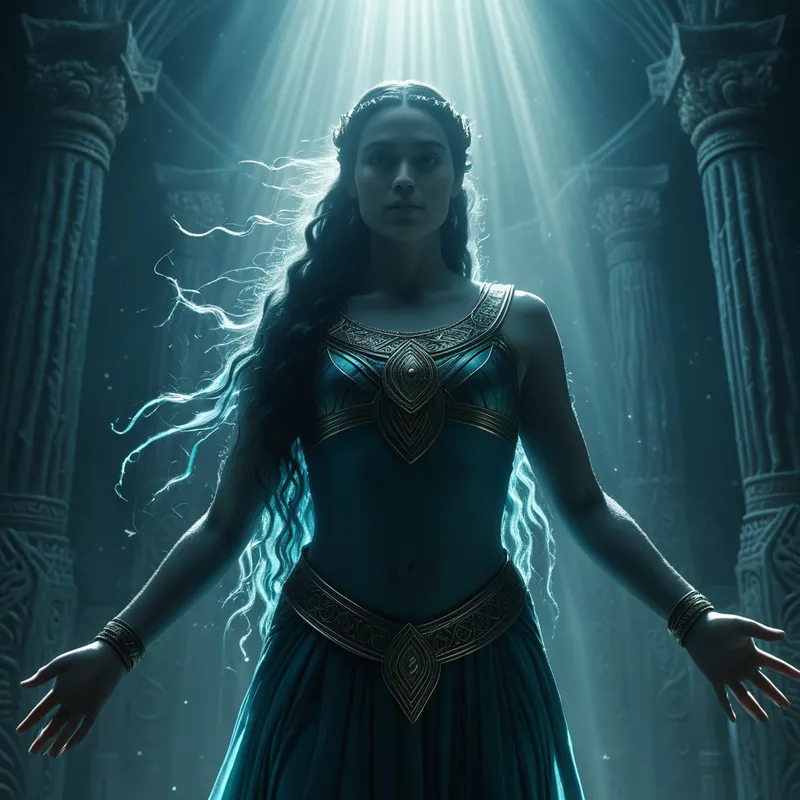
In the time when the world was still young and the High Plain of Heaven, Takamagahara, shone with a light not yet seen below, the great sun goddess Amaterasu ruled with a radiant and orderly grace. Her light was the promise of life, of cycles, of a benevolent and predictable world. Her brother, Susanoo, the impetuous storm god, was her opposite in every way. Where she was steady, he was volatile; where she brought clarity, he brought the chaotic, fecund darkness of the tempest.
Their father, the primordial deity Izanagi, had divided the cosmos between them. To Amaterasu, he gave his sacred necklace and dominion over the heavens. To Susanoo, he gave the vast, roiling seas. Yet Susanoo, in his grief for his mother Izanami who dwelt in the land of the dead, refused his domain. He wept and raged until the mountains withered and the rivers ran dry. Declaring he would go to the underworld to be with his mother, he sought a final audience with his sister in her celestial weaving hall.
Amaterasu, wary of her brother’s destructive nature, met him armed and armored. Susanoo proposed a contest to prove the purity of his heart. They would each take an object belonging to the other and from it create new deities. Amaterasu took Susanoo’s sword, broke it into three pieces, chewed them, and breathed out three majestic goddesses. Susanoo took Amaterasu’s strand of jewels, chewed them, and breathed out five powerful gods. Susanoo claimed victory, for the gods were born from his sister’s regalia, proving his spirit was fertile and creative, not merely destructive. But Amaterasu, seeing the masculine deities as proof of his unruly and invasive nature, was not appeased.
Emboldened by his claimed victory, Susanoo’s chaos erupted. He broke the ridges of Amaterasu’s sacred rice paddies, filled her irrigation ditches, and defiled her solemn harvest ritual by flinging a flayed heavenly pony through the roof of her sacred weaving hall. One of Amaterasu’s weaving maidens was struck by the loom and died. This was the final, unforgable violation.
In a silence more terrible than any of Susanoo’s roars, Amaterasu turned away. The light of the world retreated with her. She entered the Ama-no-Iwato, the Heavenly Rock Cave, and sealed the entrance with a mighty stone. The universe was plunged into an endless, stagnant night. All rhythm ceased; chaos reigned not through storm, but through utter absence.
The eight million kami gathered in desperation before the cave. They devised a ruse of joy to lure her out. They hung a sacred mirror and jewels from a tree, and the goddess Ame-no-Uzume began a wild, ecstatic dance upon an upturned tub, stamping and disrobing in divine frenzy. The laughter of the gods shook the very heavens. Curiosity pierced Amaterasu’s grief. Peering out, she saw her own dazzling reflection in the mirror—a light she did not recognize as her own, thinking it a rival goddess of even greater splendor. As she stepped forward to investigate, the god of strength, Ame-no-Tajikarao, pulled her forth, and another deity stretched a sacred rope behind her, barring the return to darkness.
Light was restored to the world. For his transgressions, Susanoo was cast out of heaven. His punishment became his destiny. Descending to the land of Izumo, he underwent a transformation from celestial destroyer to culture hero, slaying the monstrous eight-headed serpent Yamata-no-Orochi and retrieving the legendary sword Kusanagi from its tail—a sword that would become part of Japan’s imperial regalia, a symbol of power born from chaos mastered. Brother and sister were forever separated, yet through their conflict, the world found its necessary, precarious balance.
Cultural Origins & Context
This myth is the central narrative of the Kojiki (Records of Ancient Matters, 712 CE) and the Nihon Shoki (Chronicles of Japan, 720 CE), texts compiled to legitimize the divine ancestry of the imperial line, which traces its descent directly from Amaterasu. It is not merely a story of gods, but the foundational drama of the Japanese state and the Shinto worldview. Amaterasu’s sun is not a distant ball of gas but the living, conscious source of order, fertility, and imperial authority. Susanoo’s storms are not mere weather but the necessary, violent forces that cleanse, fertilize, and challenge static order.
The myth exists within a polytheistic framework where deities are not omnipotent but are embodiments of natural and psychological forces (kami). Their interactions are deeply familial, reflecting the importance of clan structures and the complex obligations and resentments within them. The resolution is not the annihilation of one force by the other, but their separation and the establishment of distinct, interdependent realms. Susanoo’s exile to the earthly realm of Izumo signifies the integration of the wild, chaotic, but ultimately productive forces into the human world, while Amaterasu remains the celestial sovereign.
Symbolic Architecture
The myth is a masterclass in symbolic polarity. Amaterasu and Susanoo represent the fundamental binary of cosmos: order and chaos, light and shadow, heaven and earth, feminine and masculine principles not in opposition, but in necessary, creative tension. The cave is the womb of the world and the tomb of light—the place of transformative retreat where the psyche must go when wounded to its core. The mirror is perhaps the most profound symbol: it does not show Amaterasu who she is, but who she could be, reflecting not her familiar self but her latent, transcendent potential. It is the tool of illusion that reveals a deeper truth.
The reconciliation is not between the siblings, but within the cosmos itself. Amaterasu’s return is conditional upon the acceptance of Susanoo’s exiled, transformed role. The light only shines because the storm has been given a world to roam.
Susanoo’s journey from heaven to earth, from destroyer to dragon-slayer, maps the archetypal path of the exiled energy finding its purpose through engagement with the monstrous aspects of the material world. His gift of the Kusanagi sword—born from the serpent he slew—completes the cycle. The chaos he embodied becomes the instrument of sovereign power (the imperial regalia) that protects the order his sister embodies.
The Dreamer's Resonance
To dream of this myth is to encounter the fundamental conflict within one’s own psyche. The “Amaterasu” within is that part of us that seeks order, clarity, identity, and productive routine. It is our conscious ego, the face we show the world. The “Susanoo” is the repressed tumult: the grief we cannot express, the rage that shames us, the creative madness that threatens to dismantle our careful lives. When Susanoo runs rampant, it feels like self-sabotage—the sudden, violent ruin of our inner “rice paddies,” the projects and relationships we’ve tended with care.
Amaterasu’s retreat into the cave is a profound psychological truth. It is not weakness, but a necessary defense. When the unconscious (Susanoo) violates the sanctum of the conscious self, the ego withdraws. We experience this as depression, creative block, or a loss of meaning—a world gone dark. The cure is not to force the light, but to stage an intervention of the whole psyche (the gathering of the kami). The ecstatic dance of Ame-no-Uzume represents the liberating power of instinct, humor, and embodied joy to lure the withdrawn self back into the world. We must sometimes be tricked by our own reflection, by a vision of a greater self we do not yet own, to step back into life.
Alchemical Translation
In the alchemical vessel of this myth, the prima materia is the undifferentiated sibling bond, a unity containing both solar gold and stormy quicksilver. The initial conflict is the nigredo, the blackening—the death of the old relationship and the plunging of the world into night. The cave is the sealed alchemical flask where the transformation occurs in darkness. The gathering of the gods and the elaborate ritual before the cave is the intricate work of the alchemist, applying multiple operations (laughter, dance, reflection) to effect change.
The mirror is the lapis philosophorum, the philosopher’s stone. It does not transform base metal into gold; it transforms the perception of the self. Amaterasu, seeing her own light as other, is catalyzed into a new relationship with her own power. The final product is not a unified deity, but a differentiated cosmos: gold (Amaterasu’s light) and silver (Susanoo’s sword) separated yet forever linked in the imperial regalia, a symbol of the integrated, sovereign Self.
Susanoo’s slaying of the serpent is the separatio and coagulatio—the separation of the pure spirit (the sword) from the monstrous, undifferentiated chaos of the unconscious (the eight-headed serpent). His exile is not a failure, but the projection of that transformed energy into the world of action and culture-building. The myth thus describes the alchemy of individuation: the painful separation of opposites within the psyche, their independent refinement, and their ultimate reconciliation at a higher level of order.
Associated Symbols
Explore related symbols from the CaleaDream lexicon:
- Amaterasu Sun — The radiant, ordering principle of consciousness, divine authority, and the life-giving, predictable cycles of the cosmos.
- Susanoo Storm — The chaotic, fertilizing, and destructive power of the unconscious, representing untamed emotion, creative frenzy, and necessary disruption.
- Mirror — A tool of illusion that reveals profound truth, reflecting not the superficial self but the latent, transcendent potential of the soul.
- Cave — The womb of transformation and the tomb of light; a place of necessary retreat for the wounded psyche to undergo its deepest alchemy.
- Sword — An instrument of separation and sovereignty, born from conquered chaos, representing discernment, will, and the power to define boundaries.
- Dance — Ecstatic, embodied expression that bypasses intellect to summon joy, liberation, and the lure of life from the depths of withdrawal.
- Family — The primal container for the most intense archetypal conflicts, where love, obligation, rivalry, and separation forge individual destiny.
- Balance — The dynamic, precarious state achieved not through the fusion of opposites, but through their respectful separation and interdependent existence.
- Light — Consciousness, revelation, and the return of meaning after a period of profound psychic darkness or depression.
- Chaos — The raw, undifferentiated state of potential from which both destruction and new creation inevitably spring.