Almas the Wild Man Myth Meaning & Symbolism
A mythic being dwelling between worlds, Almas embodies the untamed wilderness of the soul and the forgotten kinship between humanity and nature.
The Tale of Almas the Wild Man
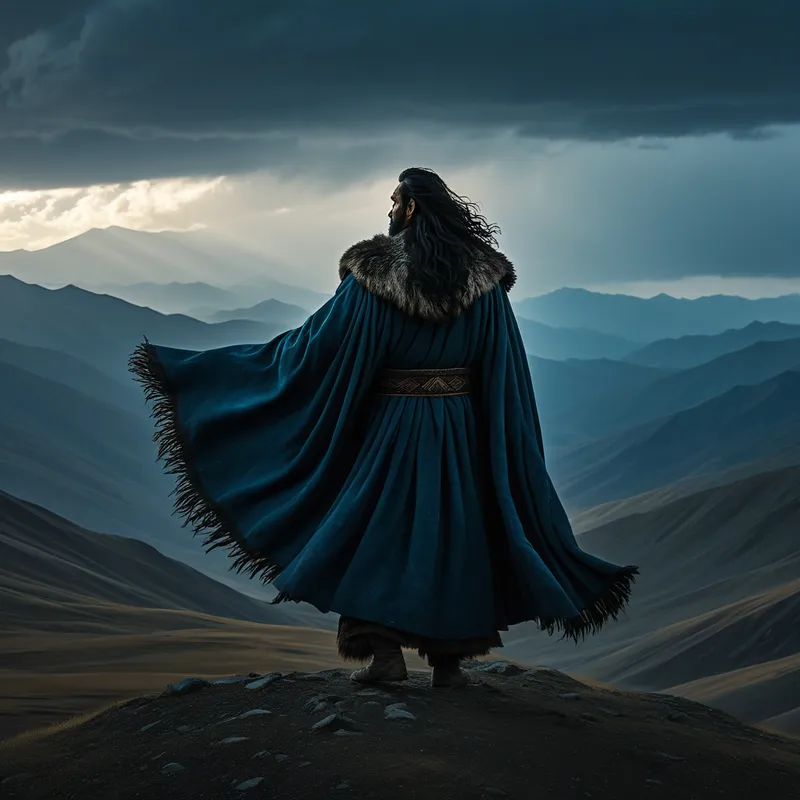
Listen. The wind that howls down from the Altai peaks carries more than ice. It carries a memory. In the time when the world was a tapestry of spirit and stone, when the sky was a bowl of milk held by the Eternal Blue Heaven, there lived a being in the high, silent places. He was not a man, and not a beast. He was Almas.
His home was the realm where the last larch trees cling to rock, where the argali treads paths no human knows. His body was a mountain itself—powerful shoulders draped in the thick, matted hide of a khainag, his hair a black river tangled with pine needles and the down of eagles. His eyes, when glimpsed in a flash of lightning or the glow of embers, held the deep, patient knowledge of the oldest stone.
He moved as a shadow moves, a part of the land. The herdsmen who drove their sheep to the high summer pastures would sometimes find their flocks undisturbed, but a giant footprint, pressed deep into the mud by a spring, would greet the dawn. A hunter, separated from his brothers and lost in a sudden whiteout, would feel a presence—a warmth at his back, a guiding pressure—that would lead him to the mouth of a sheltered cave where the remains of a fire still held a whisper of heat. No words were ever exchanged. Only the language of the wind, the crunch of snow, and the profound, unsettling sense of being seen by something that remembered your name before you were born.
The conflict was not one of battle, but of essence. The world of the felt-walled ger, of spoken histories and named lineages, was spreading. The wild, unbounded spirit of the steppe and mountain was being mapped, known, and in the knowing, tamed. Almas was the last echo of that unbounded spirit. He was the boundary-dweller, the one who watched the campfires from the darkness, a living reminder of what was left behind in the march toward the hearth.
His story is not one of slaying or conquest, but of gradual retreat. With every new settlement, every fence line imagined on the wind, he would withdraw deeper—further up the mountain, further into the labyrinth of forgotten valleys. His resolution was his persistence. He did not die; he faded into the mythic fabric of the land itself, becoming a story told to children, a shape seen in the corner of the eye during a lonely watch, the reason why a hunter might leave a sliver of meat on a high rock after a successful kill. He became the silent third, the wilderness that watches, the untamed self that walks just beyond the circle of firelight.
Cultural Origins & Context
The tales of Almas are not the grand, state-sanctioned epics of kings and empires, like the Secret History of the Mongols. They are the stories of the land, passed in whispers and warnings. They belong to the oral tradition of nomadic herders, hunters, and shamans—those whose lives are intimately woven with the unpredictable, immense landscapes of Mongolia, Southern Siberia, and the Altai region.
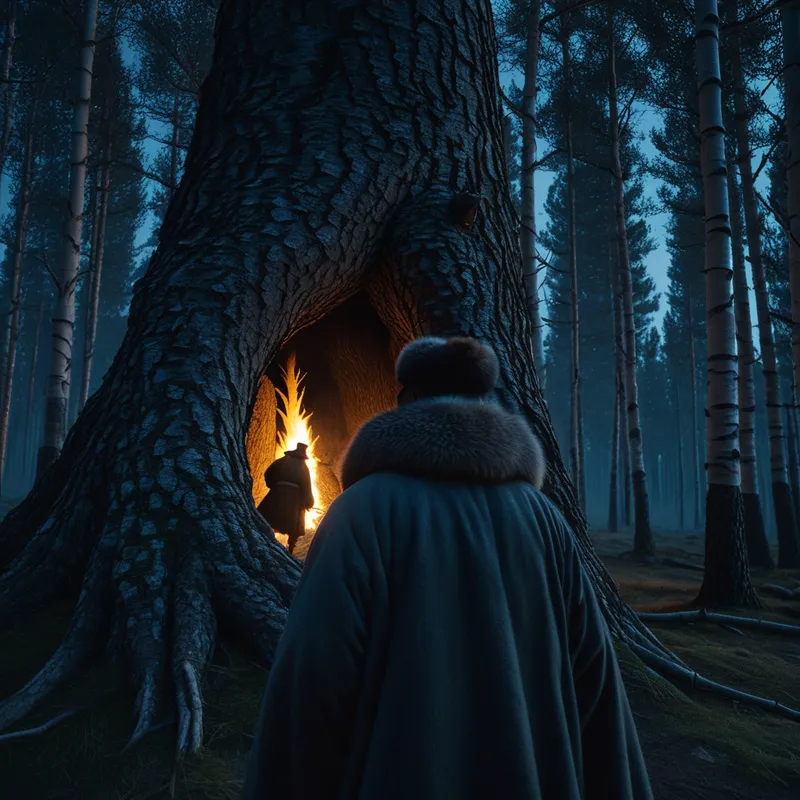
Told around evening fires in the ger or during long, watchful nights guarding livestock, the Almas narrative served multiple functions. On a practical level, it was a cautionary tale for children and herders, explaining strange noises, missing animals, or the inherent dangers of venturing too far alone into the high mountains. On a deeper, cultural level, it personified the wilderness itself. In a cosmology where every mountain, river, and forest has a spirit (ezen), Almas was a potent, physical manifestation of that spiritual reality—a bridge between the purely animistic world of nature spirits and the human world.
His enduring presence in folklore speaks to a profound cultural ambivalence. The nomadic life is a constant negotiation with the wild, a dance of reliance and respect tinged with fear. Almas embodies that relationship. He is not inherently evil, but he is profoundly other. He represents the part of the environment that cannot be domesticated, the mystery that remains even to those who know the land best.
Symbolic Architecture
Psychologically, Almas is a masterful representation of the Shadow. He is not the shadow of personal failings, but the collective, primordial shadow—the raw, instinctual, and untamed layer of the psyche that civilization seeks to suppress. He is the body's ancient knowledge, the hair and hunger and silent movement we have traded for language and law.
The Wild Man is not our enemy, but our forgotten ancestor. He holds the parts of the soul that we, in building our houses of identity, left outside in the cold.
He symbolizes the autonomy of the instincts. He lives by no human rule, follows no herd but his own. His appearance—often described as human-like yet covered in hair—signifies a state of being between. He is between animal and human, nature and culture, instinct and consciousness. This liminality is his power and his curse. He is a living question mark posed to our assured humanity: How much have you gained, and what essential thing have you lost?
Furthermore, Almas represents the anima mundi—the world soul—as it manifests in a specific, terrifying, yet awe-inspiring form. He is the land made conscious and walking. To encounter him is to encounter the psyche of the place itself, looking back at you with ancient eyes.

The Dreamer's Resonance
When the archetype of Almas stirs in the modern dreamscape, it signals a profound somatic and psychological process. It is the psyche's response to an over-civilized, over-structured, or sterile life. The dreamer may be experiencing a deep sense of disconnection from their body, their instincts, or the natural world.
To dream of seeing Almas watching from a distance often correlates with a feeling of being observed by a neglected part of the self. There is a looming, patient presence that will not be ignored. It can feel threatening, but the threat is one of exposure, not annihilation. The somatic signature might be a heightened awareness of the body—its hair, its breath, its animal rhythms—breaking through the numbing routines of daily life.
Dreams of being chased by or fleeing from Almas indicate a active repression of vital, instinctual energies—perhaps creativity, sexuality, or a necessary rage. Conversely, a dream of turning to face him, or even following him, marks the beginning of a courageous engagement with the Shadow. The dreamer is being called to reclaim their own inner wilderness, to acknowledge the powerful, non-rational forces that move beneath the surface of their polished persona.

Alchemical Translation
The myth of Almas models a specific path of psychic transmutation, one that does not end in the hero slaying the monster, but in recognizing the monster as a lost part of the self. The process of individuation, in this context, is not about conquering the wild, but about re-establishing a conscious relationship with it.
The first alchemical stage is separatio—the experience of alienation from our own nature. This is the civilized ego, safe in its "ger" of identity, perceiving the wild man as a terrifying outsider. The call of Almas is the call to begin the nigredo, the blackening—the descent into the dark, unknown aspects of the psyche represented by the high, lonely mountains.
The goal is not to become the Wild Man, but to invite him to the hearth. To offer him a seat not as a master, nor as a slave, but as a respected, if fearsome, kinsman.
The core struggle is one of integration. The "triumph" is not Almas's capture or death, but the moment the hunter stops fleeing and simply meets his gaze. This is the coniunctio oppositorum—the conjunction of opposites. It is the conscious ego acknowledging the sovereignty of the instinctual self. The modern individual undergoes this alchemy when they stop pathologizing their raw emotions, their bodily needs, or their longing for wild spaces, and instead begin to listen to them as sources of ancient intelligence.
The transformed psyche is one that can move between the campfire and the forest. It possesses the social grace of the human community and the deep, silent knowing of Almas. It is a psyche that is grounded, embodied, and whole, recognizing that the wilderness is not outside, but within—a sacred, untamed territory that must be visited with respect, for it is the source of all vitality and authenticity.
Associated Symbols
Explore related symbols from the CaleaDream lexicon:
- Mountain — The sacred, liminal space where Almas dwells; it represents the lofty, challenging, and isolating terrain of confronting the primordial self.
- Forest — The dense, unconscious realm of instinct and mystery where Almas moves unseen, symbolizing the untamed complexity of the psyche.
- Shadow — Almas is the quintessential embodiment of the psychological Shadow, the repressed, instinctual, and wild aspect of the personality.
- Cave — The sheltered, hidden space Almas might lead a lost traveler to, representing the womb of the unconscious and a place of primal refuge and insight.
- Wilderness — The core domain and essence of Almas, symbolizing the parts of the soul and the world that exist beyond human order and control.
- Mirror — The unsettling moment of recognition when one sees the wildness of Almas reflected in one's own potential, a confrontation with the inner other.
- Journey — The necessary, often solitary trek into the high places required to encounter the Almas archetype, mirroring the inward journey of self-discovery.
- Fear — The primary human response to Almas, representing the ego's terror of the uncivilized, unknown, and powerful forces within the self.
- Wind — The voice and presence of Almas and the wilderness, an invisible force that carries both warning and the breath of a more ancient life.
- Fire — The boundary between the human world (the campfire) and the wild world (Almas in the darkness), representing both comfort and the lure of the untamed.
- Hunter — The conscious ego-figure who ventures into the wild, whose encounter with Almas forces a transformation of his understanding of self and other.
- Silence — The primary language of Almas, representing the pre-verbal, intuitive knowledge of the body and the unconscious that words cannot capture.