A Midsummer Night's Dream fairies Myth Meaning & Symbolism
A tale of fairy monarchs, magical flowers, and mortal lovers lost in an enchanted wood, revealing the chaotic, creative heart of the unconscious mind.
The Tale of A Midsummer Night's Dream fairies
Hear now a tale spun not from history’s loom, but from the very warp and weft of a dream. It begins on a night that is not quite night, in a wood outside Athens that is not quite a wood. It is Midsummer’s Eve, when the moon hangs heavy and the air thrums with unseen life.
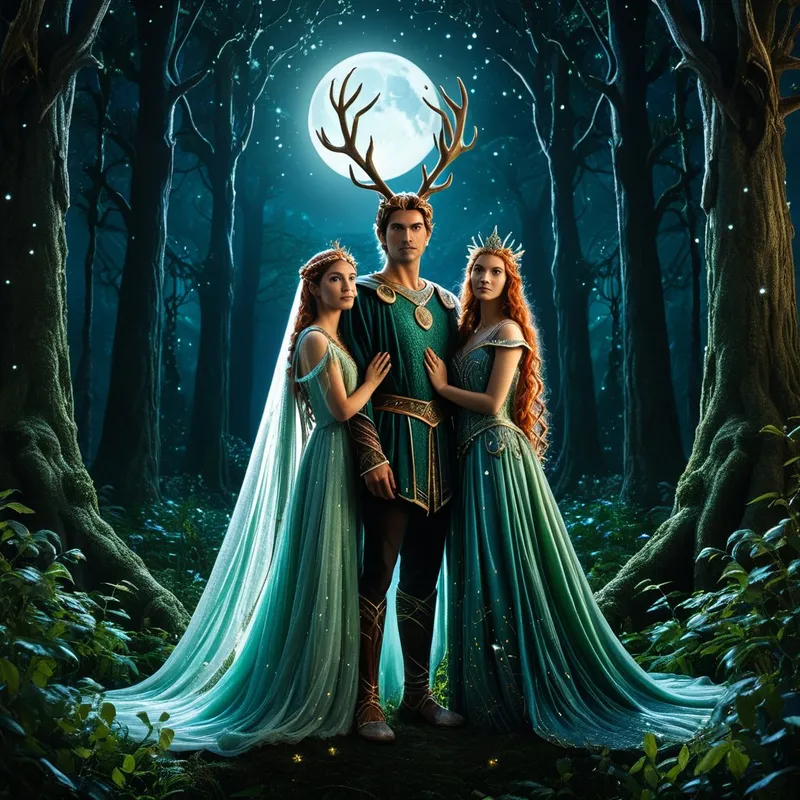
In this liminal realm rule two sovereigns of shadow and starlight: Oberon and Titania. Their court is not of stone, but of root and petal; their subjects, the quick, invisible spirits of the earth. But a cold wind blows through their bower. They are at war—a war of hearts and stolen charms—over a changeling child, a mortal boy of surpassing beauty. Titania will not yield him, and Oberon’s pride is a frost that kills the summer flowers.
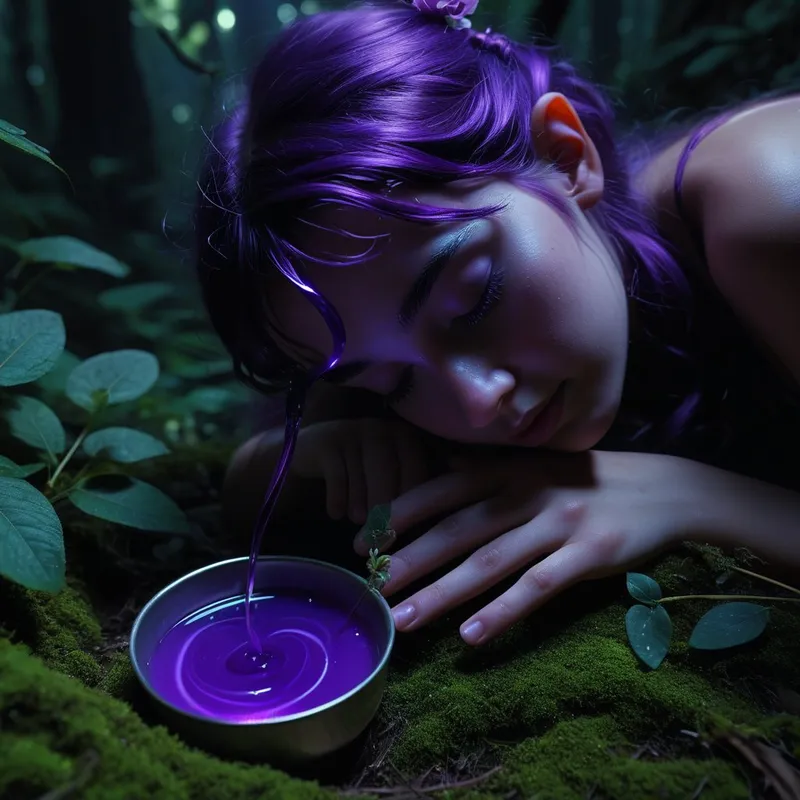
To humble his proud queen, Oberon summons his most cunning and capricious servant, the hobgoblin Puck. “Fetch me the little western flower,” he commands, “that maidens call love-in-idleness.” Its juice, struck by Cupid’s bolt, holds a potent madness: to make the sleeper dote on the next live thing they see.
Into this divine quarrel stumble four mortal hearts, lost and lovesick. Hermia loves Lysander, but is betrothed to Demetrius, who is loved by Helena. A tangled knot of desire! They flee into the very wood where the fairy monarchs rage. Oberon, pitying the scorned Helena, bids Puck anoint the eyes of the disdainful Demetrius. But the hobgoblin, in his merry mischief, mistakes the Athenian youth and pours the purple juice upon the sleeping Lysander. Chaos blossoms. Lysander awakes and, seeing Helena first, renounces Hermia with cruel passion. The world turns upside down; love becomes betrayal in the blink of a drugged eye.
Meanwhile, Oberon steals to Titania’s bower. As she sleeps, surrounded by her fairy train, he squeezes the enchanted nectar on her eyelids. “What thou seest when thou dost wake,” he whispers, “do it for thy true-love take.” The first creature her royal gaze falls upon is not a fairy lord, but Bottom the Weaver, his head transmuted by Puck into that of an ass. The majestic Queen of Faerie, under the flower’s spell, falls into a doting, ridiculous passion for this monstrous hybrid, crowning his hairy temples with musk-roses.
The forest becomes a theatre of lunacy. Mortals chase and rail, fairy royalty debases itself, and Puck, the spirit of chaos, revels in the “jangling” he has made. But even chaos must find its balance. Seeing the wreckage, Oberon commands a remedy. The juice of another herb, Dian’s bud, is applied. The spell breaks. Titania, horrified, is reconciled to her king. The mortals awaken, their loves now rightly ordered as if the nightmare were but a dream. They stumble from the wood at dawn, blinking in the new light, the wild night’s logic already fading, leaving only the echo of a strange, sweet memory.
Cultural Origins & Context
This is not a myth of ancient temples, but of the Elizabethan playhouse. Its bard, Shakespeare, was not recording a static dogma but performing a brilliant act of cultural alchemy. He drew from deep wells: the English countryside’s fear and fascination with “fairies” or “elves,” who were often seen as amoral, sometimes malicious spirits of place, not the tiny, benign sprites of later sentiment. From classical sources, he took the setting of Athens and the names of the fairy monarchs (Oberon from medieval romance, Titania from Ovid). The play, performed for both the common folk and the court, served as a societal pressure valve. It allowed the exploration of taboo subjects—irrational desire, female power, the subversion of social order—within the “safe” frame of a dream and the realm of faerie, a space where the normal rules were suspended. It was a story passed not from priest to acolyte, but from actor to audience, its power lying in collective, theatrical enchantment.
Symbolic Architecture
The Athenian wood is the primary symbol: it is the unconscious itself. To enter it is to leave the daylight world of reason, law, and social order (Athens) and descend into the primal, tangled realm of instinct, emotion, and archetype.
The forest is the psyche in its wild state, where the ego loses its way and the contents of the shadow and the anima/animus dance freely, often in conflict.
Oberon and Titania represent the ruling, yet divided, principles of the unconscious. Oberon is the willful, strategic, sometimes vengeful masculine spirit; Titania is the generative, nurturing, and possessive feminine spirit. Their quarrel over the changeling boy symbolizes a psychic imbalance—a conflict between different forces within the Self that disrupts the inner and outer world (causing storms and blighted seasons).
Puck is the archetypal Trickster. He is the unpredictable, amoral energy of the unconscious that carries out the will of the deeper powers (Oberon) but does so with chaotic literalism. He embodies the psyche’s capacity to shatter our conscious plans and identities, forcing confrontation with unrecognized parts of ourselves.
The love-in-idleness flower is the symbol of projection. It does not create love, but compels the soul to project the inner image of the beloved (the anima/animus) onto the nearest available object, however absurd (an ass-headed weaver, a formerly scorned friend). It represents the irrational, possessive, and often comical nature of infatuation when it is driven by unconscious forces, not genuine recognition.

The Dreamer's Resonance
When the motifs of this myth surface in modern dreams, the dreamer is navigating a period of profound psychic disorientation and re-ordering. Dreaming of a magical, confusing forest where paths shift and loved ones act out of character signals that the conscious ego has lost its map. The dreamer may be “under a spell”—in the grip of a powerful projection, an infatuation that feels fated but is blinding them to reality, or an ideological possession that distorts their perception.
Dreaming of a trickster figure (a Puck-like character) causing merry havoc suggests the unconscious is actively dismantling a too-rigid conscious attitude. It can feel unsettling, even frightening, as core relationships and self-concepts are thrown into chaos. The somatic experience is often one of restless sleep, a feeling of being “tossed about” in the dream. The resolution—awakening to a new, clearer dawn—indicates the process is one of necessary correction, a breaking of projective spells so that the soul can see itself and others truly, perhaps for the first time.
Alchemical Translation
The myth models the alchemical process of individuation not as a heroic quest, but as a necessary descent into folly and the reconciliation of opposites through the mediation of irrational, even comic, means.
The goal is not to avoid the chaotic wood, but to consent to be lost within it, to have one’s certainties dissolved by the love-juice of projection and the trickster’s pranks, so that a more authentic order can emerge.
The initial state is one of divisio (division): Oberon and Titania are at war, the mortal lovers are in disordered pairs. This reflects a psyche where conscious will (Oberon) is at odds with the natural, instinctual self (Titania), and one’s affections are governed by social obligation or immature desire, not true connection.
The middle, chaotic phase is the nigredo—the blackening, the chaos. This is the work of Puck and the flower. The ego is humbled, forced to see its own capacity for absurd passion (Titania with Bottom) and cruel inconstancy (the lovers’ quarrels). This humiliation is essential. One must wear the ass’s head, must be made a fool by one’s own unconscious, to break the spell of inflation and false identity.
The application of Dian’s bud represents the albedo—the whitening, the clarifying insight. It is the moment of lucidity where projections are withdrawn. We see the ass-head for what it is, and the true beloved for who they are. This allows for the conjunctio: the sacred marriage of Oberon and Titania (the reconciling of will and nature within the psyche) and the proper pairing of the lovers (the integration of the anima/animus in relationship).
The final awakening in the Athenian dawn symbolizes the return to the conscious world, but transformed. The dream-work is complete. The chaos was not meaningless, but a purgatorial comedy orchestrated by the deeper Self to burn away false loves and force a more mature, integrated order upon the soul. We emerge, like the lovers, with our vision cleared, carrying the memory of the dream as a testament to the transformative madness that resides, ever-potent, in the midsummer night of our own unconscious.
Associated Symbols
Explore related symbols from the CaleaDream lexicon: