The Alchemy of Paradox: When the Psyche Holds Two Truths
The Somatic Echo
It begins not as a thought, but as a tremor in the foundation of the self. A deep, unsettling hum in the bones, a feeling of being simultaneously pulled in two directions with equal, undeniable force. The stomach hollows out, not with fear, but with the vertigo of a ground that is no longer reliable. It is the visceral sensation of a door being both open and shut, of a word being spoken and swallowed in the same instant. The body registers the paradox first—a silent, screaming tension in the musculature of the soul, a held breath that cannot be released because both inhalation and exhalation are demanded at once. This is the somatic prelude to a dream of paradox: the system’s alarm that its core operating logic has encountered a fatal, and fertile, error.
The Dreamer's Log
I am standing in a vast, silent server room, the air humming with a deep, sub-audible frequency. On the floor, a pool of perfectly still, obsidian-black water reflects the blinking lights of the racks above. In the center of the room, a single sphere of pure, white data floats just above the water’s surface. I know, with absolute certainty, that to understand everything, I must shatter the sphere. I also know, with the same unshakable conviction, that to understand anything, I must protect it at all costs. I stand frozen, this dual imperative locking my joints.
The alchemical interpretation: The dream presents the essential tension between the need to deconstruct a cherished truth (shatter the sphere) to evolve, and the need to preserve a core identity (protect it) to remain coherent.

The False Lead
A dream of paradox is not a sign of mere confusion or indecision. It is not the mind’s equivalent of a "404 Error." To mistake it for simple bad luck, a "damned if you do, damned if you don’t" scenario, is to pathologize a sacred process. The paradox is not a problem to be solved with better logic; it is a condition to be inhabited. It is the structural shift itself, the cracking of the eggshell, not the mess of the yolk. The anxiety it produces is not a symptom of failure, but the friction of two profound, internal truths grinding against each other, each valid, each refusing to be subsumed by the other.
Psychological Architecture
Here, Shadow work is not about bringing a single, hidden aspect to light. It is about confronting the fact that the light itself casts a shadow, and that both are true. The psyche, in its movement toward Individuation, often builds sophisticated structures: the Responsible Adult, the Free Spirit, the Healer, the Leader. A paradox arises when two of these foundational "parts" or internal families—each with its own history, wisdom, and survival logic—arrive at a conclusion that is mutually exclusive, yet utterly valid. The Responsible Adult knows you must stay, build, and secure. The Free Spirit knows you must leave, wander, and risk. Both are right. The ego, the manager of this internal system, is tasked with choosing one, but its choice feels like a betrayal of the other, a self-amputation. The paradox dream is the system forcing the ego to its knees, showing it that its managerial tools—choice, preference, hierarchy—are insufficient. The only way forward is to stop choosing between them and start building a container that can hold both. This is the death of the old, binary ego and the painful, glorious birth of a consciousness complex enough to contain multitudes.
Mythic Resonance
We see this eternal process in the myth of the Norse god Odin, who hangs himself on the World Tree, Yggdrasil, for nine nights, pierced by his own spear. He is both the sacrificer and the sacrificed, the agent and the victim of his own quest for wisdom. He gives an eye to drink from the Well of Mimir, trading literal sight for prophetic insight—becoming both blind and all-seeing. His journey is not one of conquest, but of submitting to an impossible condition to achieve a transformation that linear logic could never permit. The paradox is the crucible. Similarly, the Taoist concept of yin-yang is not a symbol of balance but of dynamic, co-creative paradox. The dark swirl contains a seed of light; the light swirl holds a core of dark. Each is defined by, and contains, its opposite. They are not at war; they are in a necessary, generative tension that creates the ten thousand things—the manifest world. Our psyche is a microcosm of this same principle.
Symbolic Nodes
- Mirrors Showing Opposite Reflections: The self confronting a version of itself that acts or believes the inverse.
- Doors That Are Both Open and Shut: A pathway that is simultaneously accessible and forbidden.
- Objects That Are Two Things at Once: A clock that is also a flower; a book whose text is also flowing water.
- Time Loops or Reversed Causality: Experiencing the effect before the cause, or being trapped in a sequence that defies linear time.
- Speaking But Making No Sound / Hearing a Silent Command: The transmission of an imperative that exists outside normal channels of communication.
- A Guide Who Gives Contradictory Instructions: An authority figure (wise elder, inner self) who insists on two mutually exclusive paths.
Archetypal Resonance
The Magician Archetype is the master of paradox, for the Magician’s domain is the liminal space where opposites meet and are transcended. The Shadow Magician, as the Manipulator or Illusionist, uses paradox to confuse and control, creating smoke and mirrors to trap others in false dilemmas. The active, integrated Magician, however, does not resolve the paradox; they wield it. The somatic echo of paradox—that tense, humming stillness—is the Magician’s sacred pause, the moment before the transmutation. The Magician’s core energy is transformation, and paradox is the raw material, the prima materia, of that transformation. Its alchemical potential lies precisely in its unresolvable nature, forcing consciousness to expand beyond either/or into the realm of the tertium non datur—the third thing not given, which must be created.
The Alchemical Process
The alchemical transmutation of paradox requires the heat of sustained tension. This is the psychological solve et coagula—dissolve and coagulate. First, one must consciously, courageously refuse the ego’s desperate urge to resolve, to pick a side, to declare one truth the winner and exile the other to the shadow. This refusal creates immense internal pressure. You must hold the Responsible Adult and the Free Spirit in your awareness, feeling the full validity and desperation of each, without acting to appease either. This is the nigredo, the blackening, a state of utter confusion and despair where all known paths are blocked. The pressure cooks the psyche. Slowly, within this heated container, a third perspective begins to emerge—not a compromise, but a synthesis born of a higher order. Perhaps the Responsible Adult learns the responsibility of honoring one’s deepest spirit, and the Free Spirit learns the freedom found in committed, deep-rooted creation. The old, fragmented parts don’t disappear; they are integrated into a new, more sovereign whole. The grief and terror of the paradox are the fuels for this fire, and the resulting sovereignty is the philosopher’s stone: the ability to generate meaning from the collision of truths.

The Integration Protocol
Question 1: In the dream, where did you feel the tension most acutely in your body? What two opposing impulses or knowings were creating that somatic pull?
Question 2: If you gave a voice to each side of this paradox, what is the core, non-negotiable truth that each is trying to protect? What is each part most afraid would be lost if it surrendered?
Question 3: Imagine a version of yourself that has already integrated this tension. What new quality, perspective, or capacity does this "future self" possess that your current self cannot yet fully access?
Action 1 (The Bilateral Breath): Sit quietly and bring the paradox to mind. As you inhale, focus on the truth of "Side A," feeling its validity fill one side of your body. As you exhale, release it. On the next inhale, focus on the truth of "Side B," filling the other side of your body. Exhale and release. Do not seek a resolution. Simply breathe the two truths alternately, allowing your body to be the container that holds the rhythm of both.
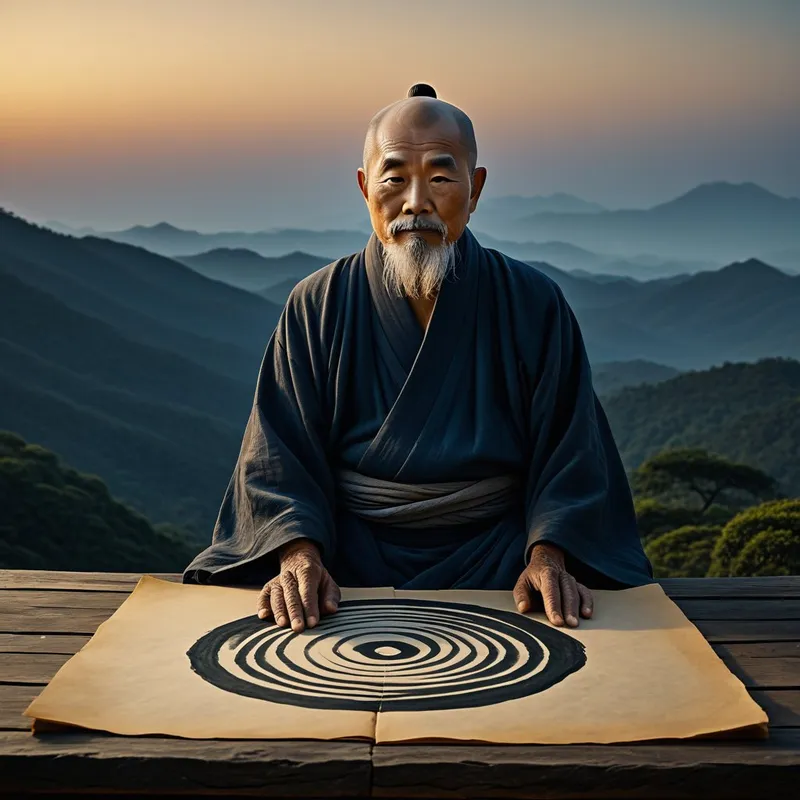
Action 2 (Paradox Mandala): Using paper and any drawing/writing tools, create a circular image (a mandala). In one half, use shapes, colors, and words to represent the first truth of the paradox. In the opposite half, represent the second, opposing truth. In the very center, leave a small, empty circle. Over the next days, as you live with the tension, allow any symbol, color, or hint of a "third thing" that emerges to gradually fill that center. Do not force it.
Action 3 (The Ritual of And): Find two small objects that symbolically represent the two poles of your paradox (e.g., a heavy stone for stability, a feather for freedom). At a chosen time, place them on a small cloth or altar space. Light a candle. Speak aloud, addressing each object: "I see you. Your truth is valid." Then, place both objects into a single, beautiful bowl or container. Let them sit together there. Your task is not to make them one, but to honor the fact that they now share a single, defined space within your realm of care.
Final Validation
To dream in paradox is to be chosen by a profound and difficult grace. It means your psyche is no longer satisfied with the simple stories, the easy choices that fracture you into pieces. It is demanding a more complex, more resilient wholeness. The tension is unbearable because it is the birth pang of a new way of being. You are not breaking down; you are being forged in the one fire hot enough to melt separate truths into a unified, sovereign alloy. Hold the tension. It is holding you, shaping you, into someone capable of containing the beautiful, terrible, and glorious contradictions of a fully lived life.