
The Tao Myth Meaning & Symbolism
The story of the unnamable source, the Way that gives rise to all things, and the paradoxical path of return to effortless being.
The Tale of The Tao
Before the First Word was spoken, before the First Thought took form, there was the Uncarved Block. It was not a thing, but the womb of all things. It had no name, for to name is to separate, and it was the seamless whole. The sages, in their desperation to point toward it, called it Tao.
In the time of fading virtue, in the dusty archives of the Zhou court, there lived a keeper of records named Laozi. He was old, so old his beard was like a waterfall of snow, and his eyes held the stillness of a deep, mountain pool. He saw the world fraying at its edges, the princes clashing, the people striving against the grain of life itself. A great weariness settled upon him, not of body, but of spirit—a longing for the source.
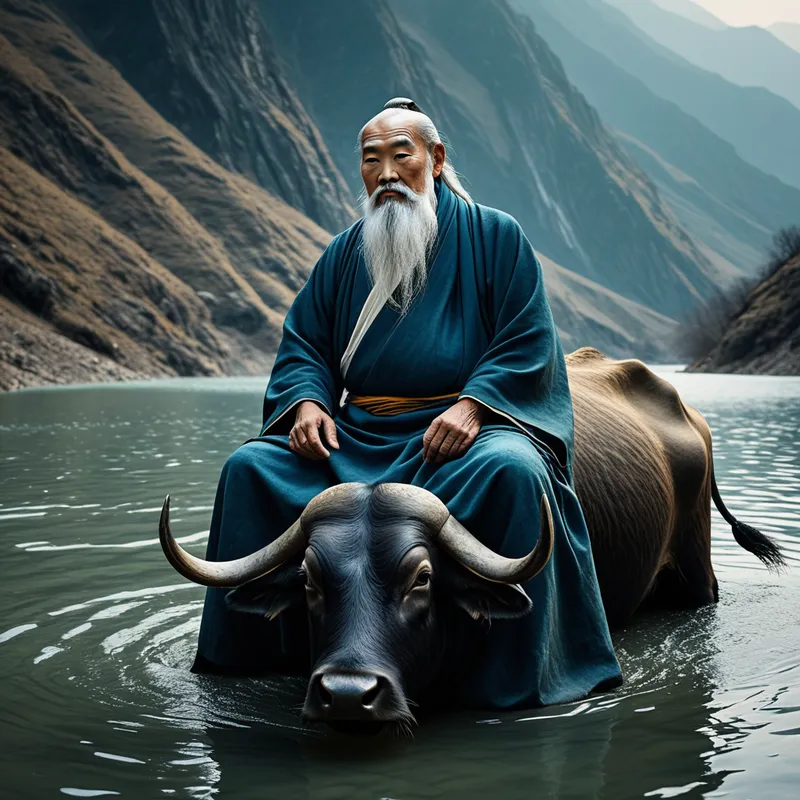
So he saddled his black water buffalo, a beast of patient, plodding earth, and turned its head toward the western passes, toward the unknown lands beyond the known world. He sought the place where the Tao might still be felt, unfiltered by the clamor of men.
At the final gate, the guardian, Yin Xi, barred his way. Not with weapons, but with recognition. "Master," Yin Xi said, his voice a blend of demand and plea, "you would leave the world with your wisdom locked in silence? If you will not stay, then leave behind a map of the path you walk."
Laozi looked at the earnest keeper of the gate, then back at the kingdom of strife and complication. He saw the conflict not as a wall, but as the very call to write the unwritable. For three days and nights, he sat in the gatehouse. The ink was not ink, but the shadow of thought; the brush did not write, but traced the echoes of the formless. He wrote of the Tao that cannot be told, of the virtue that comes from not forcing, of the strength found in yielding like water. He wrote of the mystery of the Yin and the Yang, born from the One, dancing in eternal embrace.
When the last character was set down—a simple stroke that meant both "end" and "return"—a profound silence filled the room. The scroll was not a book of answers, but a mirror for the soul. Laozi handed it to Yin Xi, mounted his buffalo, and passed through the gate. He did not look back. As he ascended into the western mists, he did not vanish, but seemed to dissolve into the landscape itself, becoming one with the rolling hills, the flowing rivers, and the vast, empty sky. The keeper of the gate was left holding not a man, but the echo of the source, and the path to find it within.
Cultural Origins & Context
The mythos of the Tao is not a single story with gods and monsters, but a philosophical and spiritual tradition crystallized around the enigmatic figure of Laozi and the text attributed to him, the Tao Te Ching (The Book of the Way and Its Virtue). Emerging during the Warring States period (5th-3rd centuries BCE) in China—a time of immense social upheaval, political fragmentation, and philosophical ferment—Taoist thought offered a radical counter-narrative.
It was a response to the prevailing Confucian focus on social order, ritual, and moral effort. Where others saw chaos to be controlled, the Taoist sages saw a natural order to be aligned with. The myth was passed down not by bards around a fire, but by hermits in mountain caves, by court scholars seeking solace, and by practitioners of Qigong and alchemy. Its societal function was therapeutic: to offer a way of being that reduced friction, restored balance, and connected the individual to the primordial rhythm of existence, providing a profound sense of peace in a world of conflict.
Symbolic Architecture
The myth’s power lies in its architecture of paradox. It uses symbols not to define, but to point beyond themselves.
- The Uncarved Block (Pu): Represents the original, undifferentiated state of the psyche—the Self before it is carved by societal expectations, trauma, and personal identity. It is wholeness prior to analysis.
The Tao that can be told is not the eternal Tao. The name that can be named is not the eternal name.
- The Water Buffalo: A symbol of earthy, patient, unstoppable nature. Laozi’s mount signifies that the journey to the Tao is not a flight from the world, but a movement through it with grounded, instinctual wisdom. It is the body and the unconscious, carrying the conscious mind (the rider) home.
- The Western Pass: The liminal space, the threshold between the conscious, structured world (the kingdom) and the unconscious, unknown territory of the deep Self. All transformation requires passing through such a gate.
- Yin Xi, the Keeper: Represents the part of the psyche that demands conscious articulation of the unconscious process. He is the ego that, rightly oriented, can become the scribe of the Self, translating numinous experience into a form that can guide the personality.
- The Act of Writing the Unwritable: This is the core alchemical act. It symbolizes the impossible but necessary task of bringing the formless content of the unconscious into the realm of form—through art, through insight, through a lived philosophy. The text that results is not the truth itself, but a finger pointing at the moon.
The Dreamer's Resonance
When this myth stirs in the modern dreamer, it often manifests as a profound somatic and psychological pull toward simplicity and authenticity. One might dream of:
- Finding a hidden, perfectly simple room in a chaotic house.
- Following an animal (like an ox or a deer) through a dense forest toward a source of light or water.
- Trying to read a book where the words flow like water or fade as soon as they are seen.
- Being asked to explain something deeply felt but impossible to put into words.
These dreams signal a process of deceleration. The psyche is overwhelmed by the complexity and efforting (Yang) of modern life and is initiating a compensatory movement toward receptivity, rest, and allowing (Yin). It is the Self prompting a "return to the source," a shedding of accumulated, burdensome identities to reconnect with the uncarved block of one's essential nature. There is often a somatic component—a feeling of deep fatigue that sleep doesn't touch, or a longing for quiet and emptiness.
Alchemical Translation
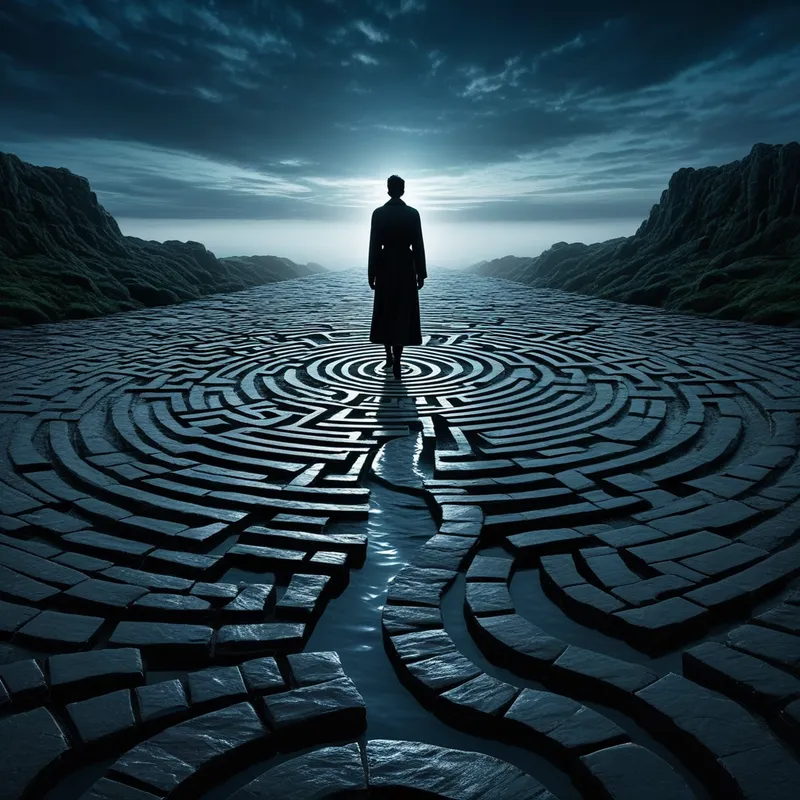
The myth of the Tao models the individuation process as a paradoxical return. It is not a heroic journey outward to conquer a dragon, but a sage's journey inward to dissolve the need for conquest.
The Recognition of Weary Complexity (Laozi in the Court): The process begins with a conscious feeling of alienation, of living a life that is all "doing" and no "being." The ego realizes its strategies for control are creating more strife. This is the call to adventure—not to add more, but to subtract.
Mounting the Instinct (The Water Buffalo): One must consciously ally with the unconscious, with the body's wisdom and the natural rhythms ignored in pursuit of goals. This means honoring fatigue, engaging in non-goal-oriented activity, and practicing profound self-acceptance.
The Threshold and the Demand (The Western Pass & Yin Xi): At the brink of this inward turn, the ego often panics. It demands a product, a map, a guarantee ("What will I become? Explain this!"). The alchemical work here is to comply, but in the myth's way: to articulate the process not as a final answer, but as poetic, paradoxical notes from the frontier. This is journaling, painting, or dialoguing with the unconscious—creating the "scroll" for one's own inner gatekeeper.
Dissolution into the Landscape (The Return): The triumph is not attainment, but integration. It is the state where one's actions begin to feel effortless (Wu Wei), where the boundary between the "I" and the "world" softens. The psyche no longer experiences itself as a rider on nature, but as an expression of nature. The conflict is resolved not by victory, but by realizing the conflict itself was born from a false separation from the seamless, flowing whole of the Tao.
Associated Symbols
Explore related symbols from the CaleaDream lexicon: