The Zen Master Myth Meaning & Symbolism
A seeker confronts a master, whose paradoxical actions shatter illusion, revealing the luminous emptiness at the heart of all being.
The Tale of The Zen Master
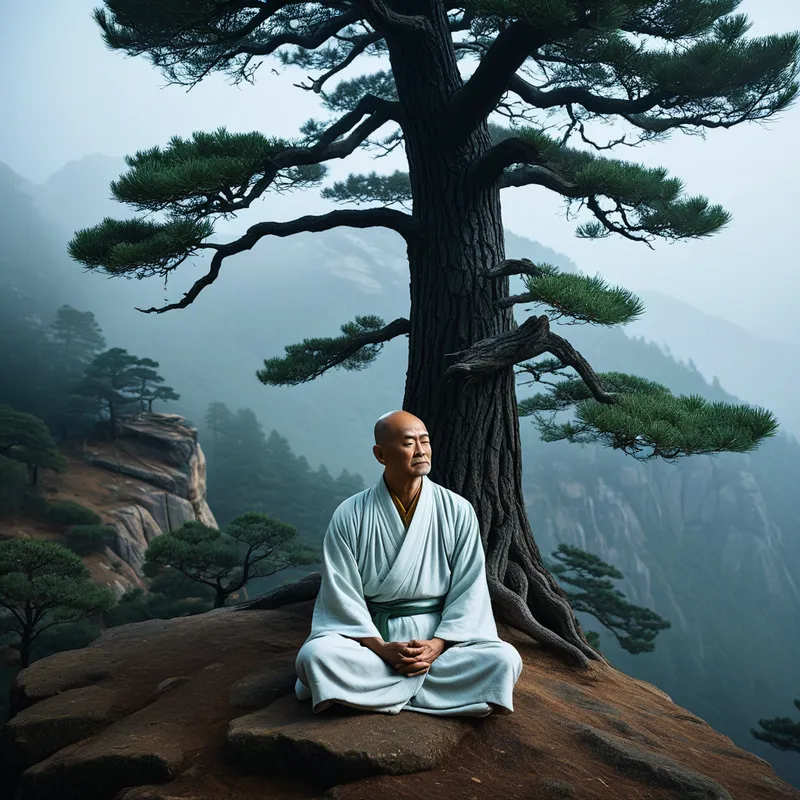
Listen. There is a mountain, older than memory, where the mist clings to the pines like a lover’s ghost. The air is thin, tasting of stone and silence. On this mountain, in a hermitage of weathered wood and paper, dwells the Master.
He is not old, yet he contains all ages. His eyes are two pools reflecting a sky without clouds. He moves through the world as a heron moves through water—deliberate, effortless, leaving barely a ripple. To him come the seekers. The scholars with minds full of scriptures, the ascetics with bodies worn thin by discipline, the restless souls who feel a thorn in the heart they cannot name.
One such seeker arrives. Let us call him Jiro. For years he has studied the sutras, mastered the postures, chanted until his voice grew hoarse. He has climbed the mountain bearing the heavy sack of his knowledge, his attainment, his burning desire to know. He bows before the Master, who is raking the gravel of the courtyard into perfect, flowing lines.
“Master,” Jiro begins, his voice tight with earnestness. “I have come to understand the ultimate truth. I have studied the doctrine of śūnyatā. I have contemplated the buddha-dhātu. Please, instruct me. What is the true nature of reality?”
The Master does not pause his raking. The shush-shush of the stones is the only sound. Jiro waits, his question hanging in the mist. Minutes pass. An hour. The Master finishes his task, leans on his rake, and looks at Jiro. Not at his face, but through him, to the mountain behind him.
“The cypress tree in the courtyard,” the Master says, his voice like dry leaves.
Jiro is stunned. This is a famous kōan. He knows the expected answer. He marshals his intellect, searches his memory. “Master!” he declares, confident. “It is a manifestation of the universal dharma!”
The Master says nothing. He turns and walks into the hermitage. Jiro is left in the courtyard, the weight of his clever answer now feeling like a stone in his gut. The lesson, it seems, has failed.
Days turn into weeks. Jiro performs chores, sits in meditation, but his mind is a furious debate hall. He rephrases his questions, constructs more elegant philosophical proofs. One evening, as he serves the Master tea, he can bear it no longer. He pours out his confusion, his frustration, his desperate need for a sign, a word, anything to grasp.
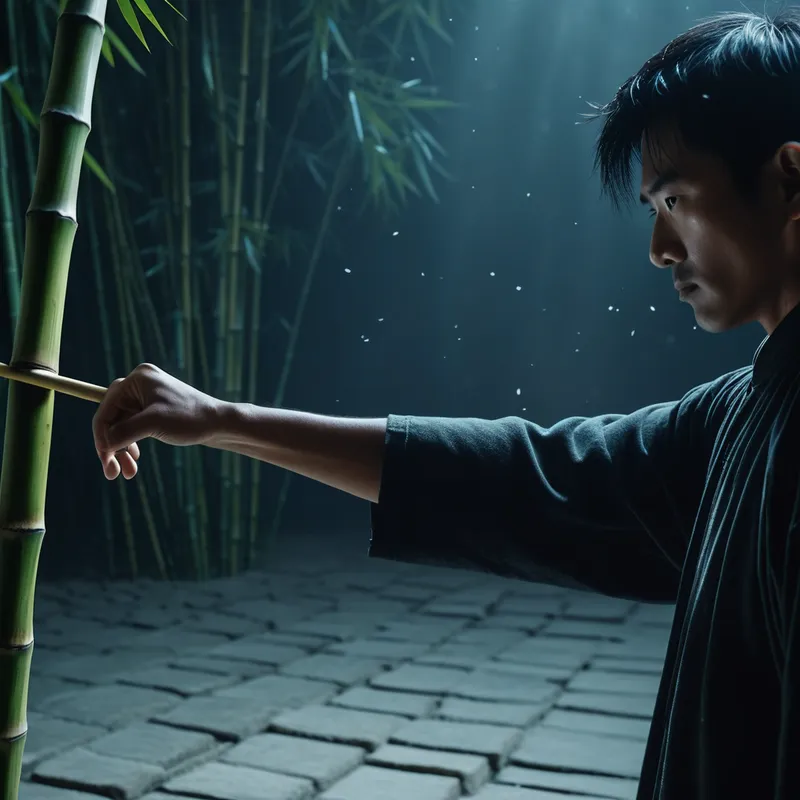
The Master accepts the tea bowl. He holds it in both hands, feeling its warmth. Then, with a motion faster than thought, he raises the bowl and brings it down sharply—not on Jiro, but on the low wooden table between them. The ceramic cracks with a sound that splits the world.
In that shattering, time stops. The sound is not just sound; it is the universe collapsing into a single, undeniable point of now. Jiro’s breath catches. All his questions, his sutras, his proofs—they evaporate like mist in sudden sun. For a fleeting, eternal instant, there is no Jiro, no Master, no broken bowl. There is only the clear, ringing silence after the crack.
And in that silence, Jiro laughs. A deep, unbidden laugh that comes from a place before words. The Master, for the first time, smiles. It is not a smile of triumph, but of recognition. The transmission has occurred. Not through words, but through the shattering of all that words could ever build.
Cultural Origins & Context
The figure of the Zen Master is not the product of a single myth, but a living archetype crystallized from centuries of Chán and Zen Buddhist tradition, originating in China around the 6th century CE. These stories, known as yǔlù or kōan collections, were not mere folklore but pedagogical and spiritual records. They were transmitted orally and then meticulously written down by monastic communities.
The tellers were the monks themselves, passing tales of the great patriarchs like Bodhidharma, or the iconic masters of the Tang dynasty "golden age." Their societal function was multifaceted: to preserve lineage, to provide inexhaustible subjects for meditation, and to model a path to enlightenment that was fiercely anti-doctrinal, immediate, and grounded in everyday life. The Master in these tales often occupies a liminal space—part teacher, part trickster, part mirror—whose primary role is to dismantle, not construct.
Symbolic Architecture
The myth is a map of the psyche’s journey from the complexity of the ego to the simplicity of being. The Seeker (Jiro) represents the conscious mind, the persona, burdened by its accumulated knowledge and desperate for a conceptual "answer" it can own. The mountain hermitage is the individuation process itself—remote, arduous, and separate from the mundane world.
The Master symbolizes the integrated Self, the Self, who operates from a center beyond duality. His actions are not arbitrary cruelty but precise, surgical strikes against the Seeker's identification with thought.
The Master does not give answers; he annihilates the questioner.
The broken tea bowl is the ultimate symbol. It represents the shattering of the vessel of the ego—the constructed self-image, the worldview, the very apparatus that seeks enlightenment. The profound silence that follows is not nothingness, but the luminous, aware śūnyatā from which all things arise. The laugh is the spontaneous recognition of this truth, the release of a tension held for a lifetime.
The Dreamer's Resonance
When this myth pattern appears in modern dreams, the dreamer is often at an intellectual or spiritual impasse. They may dream of a frustrating teacher, an unsolvable test, or a sudden, shocking event that disrupts a familiar scene. Somatic sensations often accompany these dreams: a jolt, a falling sensation, or a moment of breathless stillness.
Psychologically, this signifies a critical pressure point in the psyche where the conscious attitude has become rigid. The ego’s strategies for control and understanding have reached their limit. The dream-Master, who may appear as a silent figure, a sudden noise, or even a natural disaster, embodies the autonomous, corrective function of the unconscious. Its purpose is to initiate a collapse—not a destructive one, but a necessary de-structuring—so a more authentic awareness can emerge from the ruins of certainty.

Alchemical Translation
The alchemy here is one of via negativa—the path of negation. The modern individual’s psychic transmutation often follows the Seeker’s path: we collect identities, achievements, and therapies like sacred texts, hoping to assemble a perfected self. The Zen Master myth models a radical alternative: the nigredo, or blackening, is not a descent into despair, but the deliberate shattering of these accumulated constructs.
The Master’s enigmatic behavior is the archetypal catalyst for this alchemical death. It forces the Seeker (and by proxy, us) out of the head and into the raw, unmediated experience of the body and the senses—the sound of the rake, the warmth of the bowl, the shock of the crack.
Enlightenment is not an acquisition, but a subtraction. It is the moment when the last layer of interpretation falls away, and what remains is not a thing, but a suchness.
The resolution—the laugh—is the albedo, the whitening. It is the dawn of a consciousness that no longer seeks itself in objects or ideas, but rests in its own nature. For the modern individual, this translates to the profound shift from "I think, therefore I am" to a more embodied, present "I am, therefore it is." The struggle is not to become someone else, but to cease identifying with the someone you thought you were. The triumph is the freedom found in that empty, yet infinitely full, ground of being.
Associated Symbols
Explore related symbols from the CaleaDream lexicon: