
Aphrodite's Sea Foam Myth Meaning & Symbolism
The goddess of love and beauty is born from the foam of the severed genitals of Ouranos, cast upon the primordial sea.
The Tale of Aphrodite's Sea Foam
Listen, and I will tell you of a birth that was not a birth, of a beginning that was an ending. Before the reign of Zeus, before the sun knew its path, the world was ruled by raw, primal forces. Ouranos, the starry Sky, lay heavy upon Gaia, the fertile Earth, stifling her children in her dark womb. From that union of pressure and pain were born the Titans, monstrous and mighty, and among them, the youngest, Cronus, whose heart was a flint of ambition.
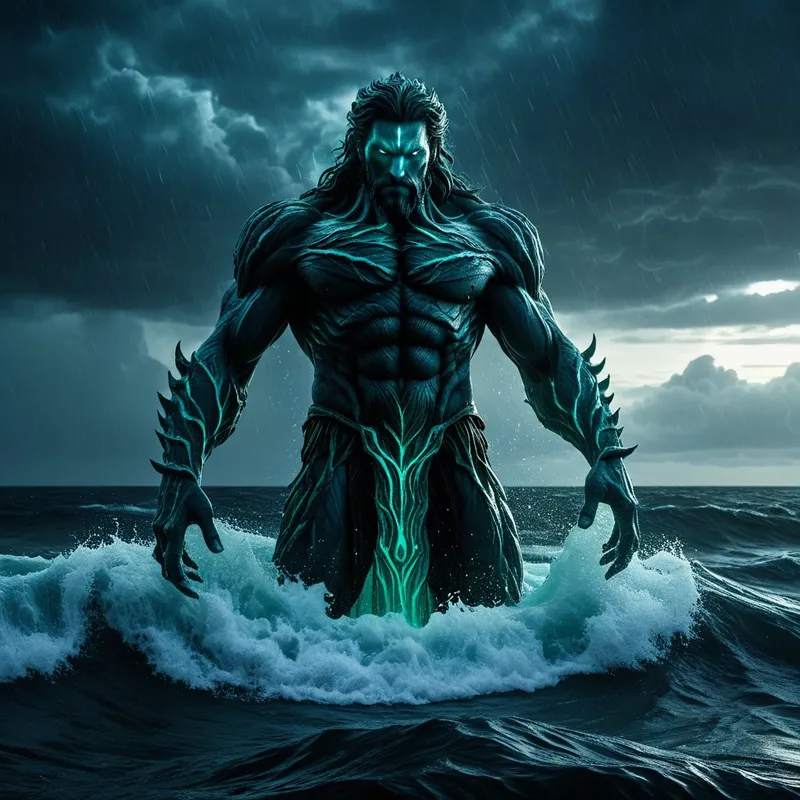
Gaia, groaning under the weight, forged a sickle of adamant and gave it to her son. "Free me," she whispered, and the whisper was a quake. When Ouranos next descended to embrace the Earth, Cronus struck. Not a battle, but a swift, terrible severing. The sky screamed, and blood, dark as ichor and rich as creation, rained upon the land. But it was not the blood that held the secret. What Cronus took, he cast away—the severed member of the Sky—hurling it far from the land, into the restless, churning expanse of the Pontus.
For a long age, it drifted. The sea, neither rejecting nor accepting, began to work upon it. The vital essence of the first god, mingling with the salt and the spray, began to ferment. A strange alchemy commenced. Around that sacred relic, the waters frothed and churned, not with violence, but with a generative frenzy. The foam—aphros in the tongue of the people—grew luminous, pearlescent, a swirling nebula upon the deep.
And from that effervescence, from that mingling of celestial seed and terrestrial brine, a form began to coalesce. It was not a struggle, but an emergence. The foam parted, and there she stood, a woman in the full flower of her beauty, born not of womb but of wound, not of love but of violence transformed. The very air softened around her. The West Wind, Zephyrus, breathed softly, carrying her ashore to the isle of Cyprus. The Horai, the Seasons, awaited her on the shell-strewn beach, cloaking her in shimmering garments. Where her feet first touched the earth, flowers sprang—anemones and roses, blooming in the footprint of divinity. They named her Aphrodite, "she who emerges from the foam," and her first breath was a sigh that promised all the longing and delight of the world.
Cultural Origins & Context
This, the most ancient of her birth stories, comes to us from the poet Hesiod in his Theogony, a foundational text composed around 700 BCE. It is a cosmogonic myth, concerned with the origins of the gods and the structure of the cosmos. Hesiod’s version is stark, primal, and deeply embedded in a pre-Olympian worldview where generation often springs from grotesque acts of separation and rebellion.
The myth served multiple societal functions. It established Aphrodite’s primordial power—she is older than the Olympian order, born from an act that predates Zeus’s reign. It connected her intrinsically to both the sea (a source of mystery, trade, and danger for the Greeks) and the sky, making her a goddess of cosmic, not merely human, attraction. Ritually, her worship, particularly in Cyprus and Cythera, involved elements of the sea and emphasized her role in fertility and the binding forces of the universe. The story was not a quaint fable but a serious theological assertion about the nature of creative power: that from severance, loss, and chaotic mingling, the principle of connection and beauty is born.
Symbolic Architecture
The myth is a masterwork of symbolic paradox. It presents creation not as a neat act of will, but as a messy, alchemical byproduct of conflict and decay.
The most profound beauty is often born not from purity, but from the sacred decay of a prior wholeness.
The castration of Ouranos represents the necessary separation that allows for differentiation and life. Sky must be severed from Earth to create the "in-between" space—the atmosphere, the realm of possibility—where life can exist. The severed genitals are the sacrificed potential of a closed, suffocating system. The sea, Pontus, represents the unconscious, the fertile, salty medium of all potential life, the great mother before the personal mother. The foam (aphros) is the liminal substance, the effervescent point where spirit (the seed of Ouranos) meets soul (the body of the sea), fermenting into a new form of consciousness.
Aphrodite, therefore, is not "love" as sentimental affection. She is the archetypal force of Eros in its broadest sense: the magnetic attraction that pulls particles together to form atoms, atoms to form worlds, and souls to form bonds. She is the principle of relatedness itself, born from the violent end of a static, oppressive relationship. Her beauty is the terrifying, compelling face of that cosmic force.

The Dreamer's Resonance
When this myth stirs in the modern psyche, it often surfaces in dreams of unexpected emergence from turbulent or "polluted" emotional waters. One might dream of finding a precious jewel in a sewer, or a beautiful child appearing in a war-torn landscape. The somatic feeling is one of profound tension followed by a sudden, graceful release—a popping into being.
Psychologically, this signals a process where a long-held, perhaps painful, complex (the "severed" part of one's history or identity) is finally surrendered to the unconscious. It is allowed to drift, to decompose in the psychic saltwater. The dreamer is in the "foam stage": a chaotic, frothy, emotionally turbulent period where old wounds are being processed at a deep, somatic level. The emergence of Aphrodite in the dream—perhaps as a luminous figure, an overwhelming feeling of compassion, or a sudden creative insight—marks the moment the psyche begins to synthesize that decomposed material into a new form of connective energy. It is the birth of the capacity to relate anew, born from the acceptance of a primal fracture.
Alchemical Translation
The individuation journey modeled here is the transmutation of trauma into eros. It is the ultimate alchemical work: taking the prima materia of a profound wound (the castration, the loss, the betrayal) and, through the long, passive work of the saline unconscious (mare nostrum), fermenting it into the philosopher's stone of relatedness.
The path to one's deepest creative power is through the sacred wound, not around it.
The first stage is Severance (Saturn): The conscious, willful act of cutting away an oppressive, internalized structure—a toxic belief, a crushing identification, the weight of a patriarchal "sky" within one's own mind. This is Cronus’s act, brutal but necessary for liberation.
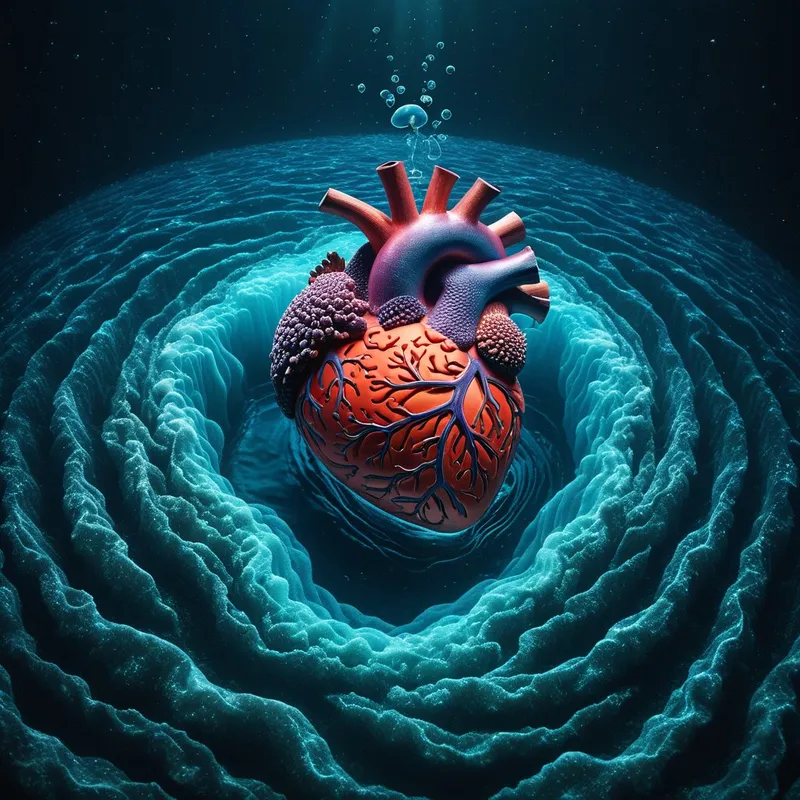
The second is Surrender (Neptune): Casting the raw, bleeding evidence of that severance into the sea of the unconscious. This is not repression, but a conscious immersion. It is allowing the wound to be salted, to drift, to be worked upon by forces beyond ego control.
The third is Fermentation (Luna): The chaotic, frothy, emotional stage. Old pain bubbles up in dreams, in moods, in somatic symptoms. This is the aphros, the foam. It feels unproductive and messy, but it is where the dissolution occurs.
The final stage is Emergence (Venus): From the fermented mixture, a new psychic function is born. Not the old wholeness restored, but a new principle: the capacity for beauty, for attraction, for creative connection that includes the reality of the wound within it. The individual no longer relates from the wound, but through the beauty forged in its aftermath. They become a vessel for Aphrodite’s sigh—the breath that says "and yet, here is love," born from the very foam of what was broken.
Associated Symbols
Explore related symbols from the CaleaDream lexicon: