Spear of Longinus Myth Meaning & Symbolism
A sacred relic of Christ's Passion, the Spear becomes a test of kingship and a vessel of divine grace in the Arthurian world.
The Tale of the Spear of Longinus
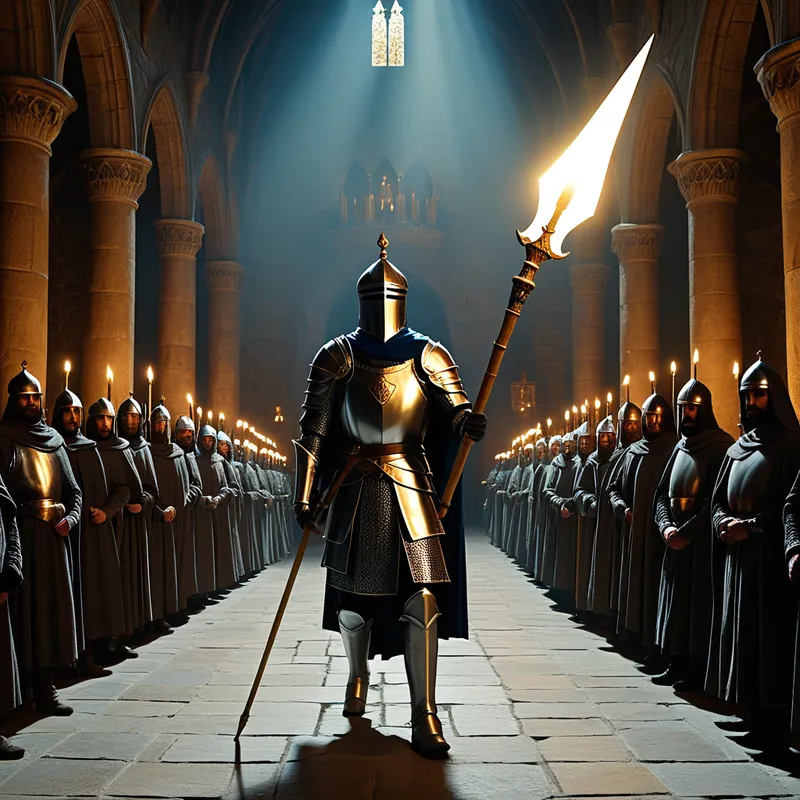
Hear now a tale not of a sword drawn from stone, but of a spear drawn from a wound. In the twilight of the world, when the mists still clung to the hollow hills of Logres, there existed a relic of such power that its mere presence could make a kingdom whole or shatter it into a thousand shards. This was the Spear of Longinus.
It was said to have been forged in the sorrow of Heaven, its iron tip forever stained by the blood and water that flowed from the side of the Fisher King. That wound was the wound of the world, and the Spear was its key. For generations, it lay hidden, a secret kept by hermits and holy men, until the time of the great quest.
That quest was for the Holy Grail. The knights of the Round Table, in their shining pride, had sworn the sacred oath. But the way to the Grail was not lit by the sun; it was a path through the interior dark, a journey into the Waste Land that mirrored the blight upon their king’s soul. Only the purest could find it.
And so it was that three knights—Galahad, the chosen one; Percival, the earnest seeker; and Bors, the survivor—came at last to the mystical castle of Corbenic. The air was thick with incense and silence. Before them, in a chamber shimmering with unearthly light, unfolded the Grail Procession.
Maidens carried candles that cast no shadow. A young man bore a sword broken and bleeding from its tip. Then came the Grail itself, veiled in a radiance that was both blinding and gentle. But behind it, carried by a knight whose face was etched with an ancient grief, came the Spear.
It moved slowly, purposefully. From its iron point, a single drop of blood welled, bright as a ruby, heavy with the memory of the divine sacrifice. It fell with a sound like a sigh into a silver cup held beneath it. In that moment, the very stones of the castle seemed to groan with release. Here was the instrument of the sacred wound, now become the vessel of its balm. The quest was fulfilled not by seizing, but by witnessing; not by conquering, but by comprehending the profound mystery of the wound that heals. The Spear, having inflicted the ultimate blow, was now the sacred sign of its redemption.
Cultural Origins & Context
The Spear’s entry into the Arthurian cycle is a late and profoundly syncretic development, a grafting of Christian Passion relics onto the older Celtic substrate of the Grail mythos. By the High Middle Ages, the era of the great prose romances like the Vulgate Cycle and Thomas Malory’s Le Morte d’Arthur, the quest for spiritual perfection had become the knightly ideal. The historical cult of relics—physical conduits to the divine—found its ultimate literary expression in these tales.
The Spear, specifically, enters through the door opened by the Grail. While early Welsh tales spoke of magical cauldrons, the continental writers, notably Robert de Boron, decisively Christianized the symbol. The Grail became the cup of the Last Supper, and its companion, the bleeding lance, was identified with the weapon of the Roman centurion. This was not mere decoration; it was theological architecture. The stories were told in courts and monasteries, serving as both entertainment and sophisticated spiritual instruction. They presented a model of chivalry that transcended battlefield glory, pointing toward an interior, sacred warfare where the ultimate enemy was one’s own spiritual blindness. The Spear, in this context, became the critical test: to behold it was to confront the paradoxical heart of the Christian faith—the saving power of sacrificial death.
Symbolic Architecture
The Spear of Longinus is not merely a weapon; it is a supreme symbol of paradoxical unity. It represents the point where opposites collide and are reconciled.
The spear is the axis mundi where violence and mercy, death and life, wound and cure become one and the same.
Psychologically, it embodies the principle of the coincidentia oppositorum—the coincidence of opposites. It is the instrument of penetration, of decisive, often painful, action that breaches boundaries. In the myth, it breached the side of Christ, releasing a flood of grace (blood and water). In the Arthurian quest, its appearance breaches the veil between the mundane and the divine, forcing a confrontation with a foundational trauma—both cosmological and personal.
The bleeding tip is its central motif. This is not a sign of ongoing violence, but of perpetual emanation. The blood is alive, a continuous offering. It symbolizes the flow of life-force, spirit, or consciousness that springs eternally from a sacred wound. The knight who can witness this, without turning away in horror or seeking to possess it, demonstrates a consciousness capable of holding profound contradiction. He sees the wound not as an end, but as a source.
Furthermore, the Spear is inextricably linked to the concept of Sovereignty. In Celtic myth, the land and the king are one; a wounded king means a wasted land. The Spear that wounded the Fisher King is also the key to his healing. Thus, it symbolizes the difficult truth that legitimate power (spiritual or psychological sovereignty) is only earned by integrating, not denying, one’s deepest wounds and vulnerabilities. The true king is he who has made peace with the spear that pierced him.
The Dreamer's Resonance
When the Spear of Longinus manifests in a modern dream, it signals a profound encounter with the archetypal Wound. This is not a trivial injury, but a core, perhaps forgotten, psychic trauma that holds the key to the dreamer’s vitality.
The dream image may vary: a sharp, focused beam of light piercing darkness; a surgical instrument; a tree branch striking the chest; or the classic spear itself. The somatic experience is crucial. Dreamers often report a feeling of pressure or piercing in the solar plexus or heart center—not necessarily painful, but intensely activating. This is the psyche pinpointing the exact location of a constriction, a sealed-over grief, or a buried memory.
The psychological process underway is one of puncturing. The defensive ego-structure, the persona that has kept the individual functional but numb, is being breached by contents from the deeper Self. This can feel invasive and frightening—the Spear is, after all, a weapon. But in the dreamscape, its purpose is medicinal. It aims to release what has been trapped: a flood of tears (the water) or a surge of passionate life-force (the blood). To dream of the Spear is to be in the initial, often painful, stages of a psychic opening that promises eventual healing and a more authentic flow of energy.

Alchemical Translation
The myth of the Spear models the alchemical stage of Mortificatio and Separatio leading to a miraculous Coagulatio. It is a map for the individuation process, where the seeker must undergo a sacred wounding to become whole.
The quest for the Grail represents the ego’s desire for spiritual wholeness (the Lapis Philosophorum). But the path is blocked by the Waste Land—a state of psychic sterility, depression, or meaninglessness. The ego, in its initial state, cannot heal this. It must first encounter the Spear, the symbol of a necessary dissolution.
Individuation demands we be pierced by the truth of our own nature, to allow the rigid structures of the persona to be broken open so the soul may flow.
In psychological terms, this is the confrontation with the shadow or with a core complex—a deeply ingrained pattern of suffering. This confrontation feels like a wounding, a humiliation, a piercing of one’s self-image. The alchemical translation of the myth instructs us not to flee this pain, but to contemplate the bleeding point. What ancient grief, what rejected passion, what unacknowledged truth is now seeking to flow out?
The sacred drop falling into the cup is the moment of transmutation. The raw, painful insight (the blood) is caught and contained by a new, receptive consciousness (the silver cup). The wound’s essence is transformed into a nourishing elixir. For the modern individual, this means moving from being a victim of one’s wounds to becoming a steward of their meaning. The integrated person is like the Grail Castle: they contain the Spear and the Cup. They hold the memory of their piercing trauma, not as a source of bitterness, but as the very wellspring of their compassion, depth, and capacity to heal both themselves and the “waste land” around them. They achieve sovereignty not through invulnerability, but through the sacred vulnerability revealed by the Spear.
Associated Symbols
Explore related symbols from the CaleaDream lexicon: