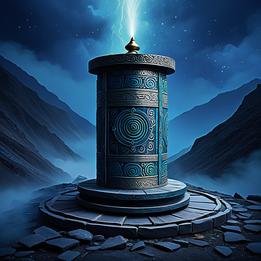
Prayer Wheel
A cylindrical device used in Tibetan Buddhism to accumulate spiritual merit and purify karma by spinning mantras inscribed within.
Prayer Wheel Dream Meaning
A cylindrical device used in Tibetan Buddhism to accumulate spiritual merit and purify karma by spinning mantras inscribed within.
Interpretive Themes
Mythological Resonance
Mani Wheel
Tibetan BuddhismSaid to contain the essence of Avalokiteshvara's compassion mantra, spinning it is believed to send blessings like wind across the world.
The Wheel of Dharma
UniversalRepresents the Buddha's teachings set in motion, turning to liberate beings from suffering, paralleling the prayer wheel's function.
Cultural Lenses
Jungian Perspective
View Context →Represents the mandala—a symbol of wholeness and the Self. Spinning motion signifies the individuation process, integrating conscious and unconscious elements through repetitive, centering ritual.
Freudian Perspective
View Context →May symbolize repressed desires for maternal comfort or oral fixation, with the spinning representing compulsive, soothing behavior linked to early developmental stages and unmet needs.
Gestalt Perspective
View Context →The dreamer projects parts of themselves onto the wheel. Its function reveals unfinished business—what prayers or intentions need 'spinning out' into awareness for completion.
Cognitive Perspective
View Context →Represents a mental schema for processing anxiety or seeking control. The repetitive motion is a cognitive ritual reducing uncertainty by imposing predictable, orderly patterns on thoughts.
Evolutionary Perspective
View Context →Taps into adaptive behaviors for social cohesion and stress reduction. Ritualized, repetitive motion may have offered survival advantages by promoting group harmony and reducing individual anxiety.
South Asian Perspective
View Context →In Tibetan Buddhism, it accumulates merit, purifies negative karma, and spreads compassion. Historically central to monastic and lay practice, now also a cultural symbol and tourist artifact.
East Asian Perspective
View Context →Influenced by Tibetan Buddhism in regions like Mongolia and parts of China. Viewed as a tool for blessing and protection, often used in rituals to harmonize with cosmic energies.
Modern Western Perspective
View Context →Often divorced from religious context, seen as a mindfulness aid, decorative object, or symbol of exotic spirituality. Represents a search for meaning through appropriated ritual forms.
Global/Universal Perspective
View Context →A cross-cultural symbol of prayer-in-motion, representing the human desire to connect with the divine through ritual action, turning intention into tangible, repetitive practice.
European Perspective
View Context →Historically viewed through colonial or missionary lenses as exotic. Now often appears in New Age or mindfulness contexts as a tool for meditation and stress relief.
North American Perspective
View Context →Common in Buddhist convert communities and mindfulness movements. Symbolizes a personal, portable practice—individual spirituality over institutional religion, often commercialized.
Middle Eastern Perspective
View Context →In Islamic contexts, might be compared to prayer beads (misbaha) or dhikr rituals. Generally viewed as a non-Islamic spiritual tool, sometimes with curiosity or theological distance.
Historical Authorities
Want a deeper analysis?
Get a personalized interpretation of your entire dream including this symbol.
Interpret My DreamThe Oracle's Prediction
Combine multiple symbolsA deepening of meditative practice or intuitive insight.
Timeframe
Lunation (~29 Days)
Intensity
Deep
Common Appearances & Contexts
| Context | Emotion | Interpretation |
|---|---|---|
| Context Spinning rapidly | Emotion Anxious | Interpretation Overwhelmed by spiritual duties. |
| Context Wheel broken | Emotion Guilty | Interpretation Interrupted spiritual practice. |
| Context Gifting a wheel | Emotion Compassionate | Interpretation Sharing spiritual wisdom. |
| Context Ancient prayer wheel | Emotion Awed | Interpretation Connecting to tradition. |
| Context Spinning effortlessly | Emotion Peaceful | Interpretation Flow state achieved. |
| Context Wheel glowing | Emotion Inspired | Interpretation Divine presence felt. |
| Context Multiple wheels | Emotion Overwhelmed | Interpretation Too many obligations. |
| Context Teaching to spin | Emotion Proud | Interpretation Mentoring spiritual growth. |
| Context Wheel stuck | Emotion Frustrated | Interpretation Spiritual blockage present. |
| Context Portable wheel | Emotion Secure | Interpretation Faith travels with you. |
| Context Giant wheel | Emotion Humbled | Interpretation Small part of whole. |
| Context Digital prayer wheel | Emotion Curious | Interpretation Modernizing ancient practice. |
Interpret Your Full Dream
Beyond this symbol, every dream carries a unique story. Share your dream for a personalized AI-powered interpretation.