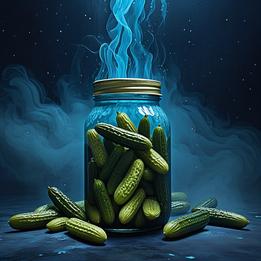
Pickled
A food preserved through fermentation, symbolizing transformation, memory, and the tension between preservation and change.
Pickled Dream Meaning
A food preserved through fermentation, symbolizing transformation, memory, and the tension between preservation and change.
Interpretive Themes
Mythological Resonance
Mimir's Well
NorseThe well of wisdom where Odin sacrificed an eye to drink, representing knowledge preserved through sacrifice and time, much like pickling preserves through transformation.
Lethe
GreekThe river of forgetfulness in the underworld, whose waters cause souls to forget their past lives—the opposite of pickling's preservation of memory.
Cultural Lenses
Jungian Perspective
View Context →Symbolizes the process of individuation—preserving aspects of the self through transformation. The pickle jar represents the unconscious containing archetypal contents awaiting integration into consciousness.
Freudian Perspective
View Context →Often represents repressed desires or memories preserved in the unconscious. The act of pickling can symbolize anal-retentive tendencies or fixation on controlling emotional experiences.
Gestalt Perspective
View Context →Represents unfinished business or experiences that have been 'preserved' rather than fully processed. The dreamer may be asked: 'What part of you feels pickled?'
Cognitive Perspective
View Context →May reflect memory consolidation processes or schemas about preservation. Could indicate cognitive patterns where experiences are categorized as 'saved' rather than actively engaged with.
Evolutionary Perspective
View Context →Taps into ancient survival mechanisms of food preservation. Symbolizes adaptive strategies for resource management, preparation for scarcity, and communal knowledge transmission.
East Asian Perspective
View Context →In cultures like Korean (kimchi) and Japanese (tsukemono), pickling represents harmony with seasons, ancestral wisdom, and health. Historically essential for winter survival, now symbolizes cultural identity.
European Perspective
View Context →Traditionally associated with peasant survival, seasonal cycles, and folk medicine. In modern context, represents artisanal revival, slow food movement, and connection to agricultural heritage.
Middle Eastern Perspective
View Context →Pickled vegetables (torshi) symbolize hospitality, abundance, and medicinal properties. Historically important for trade routes and desert survival, now represents culinary diversity and preservation of tradition.
South Asian Perspective
View Context →Achar (pickle) represents regional diversity, Ayurvedic principles, and family legacy. Often made communally, symbolizing intergenerational knowledge transfer and the balance of tastes in life.
Latin American Perspective
View Context →Encurtidos represent mestizo culture blending indigenous and Spanish traditions. Symbolizes resourcefulness, celebration of local ingredients, and the preservation of cultural memory through foodways.
Modern Western Perspective
View Context →Often signifies hipster food culture, probiotic health trends, or DIY movements. Can also represent anxiety about artificial preservation in industrial food systems versus natural processes.
Global/Universal Perspective
View Context →Cross-culturally represents humanity's struggle against decay and time. Symbolizes the universal human desire to preserve moments, memories, and resources against inevitable change and loss.
Historical Authorities
Want a deeper analysis?
Get a personalized interpretation of your entire dream including this symbol.
Interpret My DreamThe Oracle's Prediction
Combine multiple symbolsAn old friendship or connection will resurface with renewed significance.
Timeframe
Lunation (~29 Days)
Intensity
Deep
You will uncover wisdom from a past experience that applies to your current situation.
Timeframe
Immediate (Next 48h)
Intensity
Deep
Common Appearances & Contexts
| Context | Emotion | Interpretation |
|---|---|---|
| Context Eating pickled food | Emotion nostalgic | Interpretation Longing for past. |
| Context Making pickles | Emotion hopeful | Interpretation Preparing for future. |
| Context Spilled pickles | Emotion anxious | Interpretation Loss of control. |
| Context Rotten pickles | Emotion disgusted | Interpretation Failed preservation. |
| Context Gifting pickles | Emotion proud | Interpretation Sharing tradition. |
| Context Forced to pickle | Emotion resentful | Interpretation Unwanted change. |
| Context Pickling something alive | Emotion fearful | Interpretation Stifling growth. |
| Context Ancient pickled jar | Emotion awe | Interpretation Timeless knowledge. |
| Context Too many pickles | Emotion overwhelmed | Interpretation Excess of past. |
| Context Pickling in secret | Emotion guilty | Interpretation Hidden transformation. |
| Context Breaking pickle jar | Emotion liberated | Interpretation Release from past. |
| Context Pickling as ritual | Emotion reverent | Interpretation Sacred preservation. |
Interpret Your Full Dream
Beyond this symbol, every dream carries a unique story. Share your dream for a personalized AI-powered interpretation.