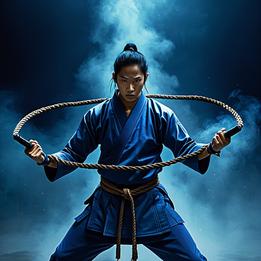
Nunchaku
A martial arts weapon consisting of two sticks connected by a chain or rope, symbolizing fluidity, discipline, and controlled power.
Nunchaku Dream Meaning
A martial arts weapon consisting of two sticks connected by a chain or rope, symbolizing fluidity, discipline, and controlled power.
Interpretive Themes
Cultural Lenses
Jungian Perspective
View Context →Archetype of the warrior integrating shadow aspects; the chain represents connection between conscious and unconscious, with dual sticks symbolizing reconciled opposites in the individuation process.
Freudian Perspective
View Context →Phallic symbol representing masculine power and aggression; the swinging motion suggests sexual energy and release, while the connection symbolizes union of masculine and feminine principles.
Gestalt Perspective
View Context →Projection of the dreamer's need for integration; the two parts represent fragmented aspects of self seeking connection through the flexible chain of awareness.
Cognitive Perspective
View Context →Mental representation of problem-solving tools; symbolizes the brain's ability to connect disparate ideas through flexible thinking patterns to achieve goals.
Evolutionary Perspective
View Context →Extension of primate tool use for defense; represents human adaptation creating compound tools from simple elements for survival advantage and social status display.
East Asian Perspective
View Context →Okinawan martial arts weapon originally from rice flails; represents peasant resistance against oppression, with circular movements embodying Taoist principles of flowing with force rather than opposing directly.
Modern Western Perspective
View Context →Pop culture icon from martial arts films; symbolizes cool competence and streetwise self-reliance, often divorced from traditional discipline and reduced to aesthetic rebellion.
Global/Universal Perspective
View Context →Universal symbol of connected duality; appears across cultures as flail weapons representing the human ability to create compound tools that extend physical capabilities through clever design.
European Perspective
View Context →Medieval agricultural flail weaponized by peasants; symbolizes class struggle and practical ingenuity transforming everyday tools into means of resistance against better-armed oppressors.
African Perspective
View Context →Similar to throwing clubs and connected weapons in various traditions; represents community defense and the wisdom of using available resources creatively for protection.
South Asian Perspective
View Context →Resonates with flexible weapons like urumi swords; symbolizes the dance-like quality of martial arts as spiritual practice, where weapon becomes extension of disciplined body.
Latin American Perspective
View Context →Connected to indigenous bolas weapons and colonial resistance; represents improvisation with limited resources and the circular rhythms fundamental to many cultural expressions.
Want a deeper analysis?
Get a personalized interpretation of your entire dream including this symbol.
Interpret My DreamCommon Appearances & Contexts
| Context | Emotion | Interpretation |
|---|---|---|
| Context Mastering technique | Emotion Confident | Interpretation Skill development achievement. |
| Context Being attacked | Emotion Fearful | Interpretation Need for self-protection. |
| Context Breaking objects | Emotion Angry | Interpretation Releasing pent-up frustration. |
| Context Teaching others | Emotion Proud | Interpretation Sharing knowledge authority. |
| Context Dropping weapon | Emotion Anxious | Interpretation Loss of control. |
| Context Fluid movements | Emotion Joyful | Interpretation Harmonious self-expression. |
| Context Weapon malfunctioning | Emotion Frustrated | Interpretation Tools failing you. |
| Context Ancient dojo | Emotion Reverent | Interpretation Connecting to tradition. |
| Context Movie scene | Emotion Excited | Interpretation Fantasy empowerment. |
| Context Child playing | Emotion Nostalgic | Interpretation Innocent imitation. |
| Context Competition match | Emotion Competitive | Interpretation Testing abilities. |
| Context Weapon confiscated | Emotion Powerless | Interpretation Disarmed vulnerability. |
Interpret Your Full Dream
Beyond this symbol, every dream carries a unique story. Share your dream for a personalized AI-powered interpretation.