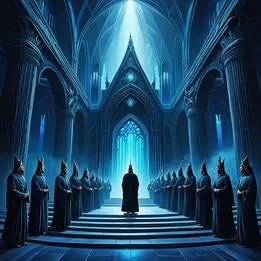
Imperial Court Dream Meaning
Represents hierarchical power structures, spiritual authority, and the intersection of divine will with human governance.
Common Appearances & Contexts
| Context | Emotion | Interpretation |
|---|---|---|
| Being judged before the court | fear | Feeling scrutinized by authority figures or internal standards. |
| Serving in the court | pride | Recognition of personal authority or responsibility. |
| Observing court proceedings | curiosity | Detached examination of power structures. |
| Challenging court authority | defiance | Rebellion against established systems or rules. |
| Receiving honors from court | validation | Seeking or receiving external approval. |
| Court in disarray | confusion | Chaos in personal or professional hierarchies. |
| Ancient imperial court | reverence | Connection to historical or ancestral wisdom. |
| Modern corporate court | pressure | Workplace hierarchy and performance anxiety. |
| Empty imperial court | loneliness | Feeling abandoned by authority or structure. |
| Court during celebration | joy | Successful integration within social systems. |
| Foreign imperial court | alienation | Feeling out of place in social structures. |
| Court under siege | panic | Threats to personal stability or authority. |
Interpretive Themes
Power Dynamics
highDreamer's relationship with power structures.
Spiritual Authority
highConnection between earthly and divine rule.
Social Order
mediumPersonal position within social systems.
Ritual and Ceremony
mediumImportance of protocol and tradition.
Judgment and Justice
lowInternal or external judgment processes.
Cultural Lenses
Jungian Perspective
View Context →Represents the Self archetype integrating various aspects of personality. The court symbolizes the psyche's governing center where conscious and unconscious elements negotiate order and authority.
Freudian Perspective
View Context →Symbolizes the superego's authority and societal constraints. The imperial aspect represents paternal authority figures and the dreamer's relationship with rules, punishment, and moral judgment.
Gestalt Perspective
View Context →Each court element represents disowned aspects of self. The emperor might symbolize repressed authority, while courtiers represent neglected social roles needing integration for wholeness.
Cognitive Perspective
View Context →Represents mental schemas about authority and social hierarchy. The dream processes waking experiences with power structures through metaphorical court imagery.
Evolutionary Perspective
View Context →Reflects ancient human adaptations for social hierarchy and group governance. The court symbolizes status negotiation, alliance formation, and survival within structured communities.
East Asian Perspective
View Context →In Chinese tradition, represents the Mandate of Heaven and cosmic order. Historically, imperial courts mediated between heaven and earth, with rituals maintaining harmony between human and divine realms.
European Perspective
View Context →Symbolizes divine right monarchy and feudal hierarchy. Historically courts balanced secular power with religious authority, representing both earthly governance and spiritual order in medieval to early modern periods.
Middle Eastern Perspective
View Context →Represents caliphal or imperial authority as both political and religious leadership. Historically courts like the Ottoman Divan integrated Islamic law with state governance, symbolizing unified spiritual-temporal authority.
South Asian Perspective
View Context →In Hindu and Buddhist traditions, represents the Chakravartin ideal of righteous universal ruler. Courts symbolized dharma in action, with the emperor maintaining cosmic and social order through righteous governance.
African Perspective
View Context →In kingdoms like Ethiopia or Great Zimbabwe, courts represented sacred kingship linking ancestors to living community. Rituals maintained balance between human, natural, and spiritual worlds through royal authority.
Modern Western Perspective
View Context →Often symbolizes bureaucratic systems, corporate hierarchies, or political institutions. Represents contemporary anxieties about power, surveillance, and individual agency within complex organizational structures.
Global/Universal Perspective
View Context →Cross-cultural symbol of centralized authority and social order. Universally represents human need for structure, governance, and the tension between individual freedom and collective organization across civilizations.
Interpret Your Full Dream
Beyond this symbol, every dream carries a unique story. Share your dream for a personalized AI-powered interpretation.