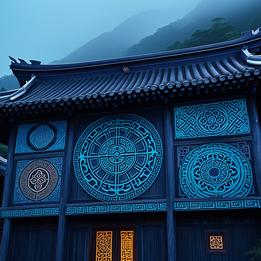
Dancheong Patterns
Traditional Korean decorative patterns on wooden buildings, using five symbolic colors to represent cosmic order, protection, and spiritual harmony.
Dancheong Patterns Dream Meaning
Traditional Korean decorative patterns on wooden buildings, using five symbolic colors to represent cosmic order, protection, and spiritual harmony.
Interpretive Themes
Mythological Resonance
Sanshin (Mountain Spirit)
KoreanThe mountain spirit's sacred realm is marked by patterns that harmonize natural and supernatural forces, much like Dancheong bridges earthly structures with celestial order.
Mandala
UniversalLike Tibetan sand mandalas, Dancheong patterns are temporary cosmic diagrams that map spiritual truths onto physical space, creating microcosms of divine order.
Cultural Lenses
Jungian Perspective
View Context →Archetype of the Self's ordered structure; mandala-like patterns representing psychic wholeness and individuation process. Colors symbolize integration of unconscious elements into conscious awareness.
Freudian Perspective
View Context →Sublimation of primal urges into culturally acceptable artistic expression; patterns may represent repressed desires for order/control or fixation on parental/authority structures (buildings as parental symbols).
Gestalt Perspective
View Context →Whole greater than parts; dreamer's perception of patterns reflects how they organize life experiences. Missing/emphasized colors indicate unfinished business or dominant life aspects needing integration.
Cognitive Perspective
View Context →Mental schema for processing cultural information; patterns represent cognitive frameworks for understanding tradition vs. modernity. Dream may indicate memory consolidation of cultural learning.
Evolutionary Perspective
View Context →Adaptive signaling of group identity and safe sacred spaces; colorful patterns evolved as costly signals of community cohesion and protection against threats, triggering innate responses to ordered environments.
East Asian Perspective
View Context →Korean Buddhist/Confucian tradition using five colors (obangsaek) representing directions/elements: blue-east-wood, white-west-metal, red-south-fire, black-north-water, yellow-center-earth. Historically protected buildings from evil, now cultural heritage symbol.
Global/Universal Perspective
View Context →Cross-cultural pattern of sacred geometry in religious architecture; like Islamic arabesques or Christian rose windows, represents human universal need to encode spiritual concepts in visual, ordered forms connecting earthly and divine.
South Asian Perspective
View Context →Parallel to mandala and rangoli patterns in Hindu/Buddhist traditions; geometric designs as cosmic maps and meditation aids. Colors have similar elemental symbolism but different cultural applications in temple art.
Modern Western Perspective
View Context →Often viewed as exotic aesthetic or mindfulness symbol; reduced to decorative pattern in wellness contexts, divorced from original spiritual meaning but appreciated for perceived calming, ordered qualities.
Middle Eastern Perspective
View Context →Resonates with Islamic aniconic tradition of geometric patterns representing infinite divine order; like arabesques, avoids figurative representation to focus on spiritual mathematics and God's perfection through repetition.
European Perspective
View Context →Comparable to Gothic cathedral rose windows or Celtic knots; sacred geometry encoding theological concepts through color and pattern. Historically served similar protective/educational functions for illiterate congregations.
African Perspective
View Context →Echoes of Adinkra symbols or Ndebele patterns; cultural coding of wisdom and identity in visual language. While materials differ, shared concept of patterns as living tradition transmitting values across generations.
Historical Authorities
Want a deeper analysis?
Get a personalized interpretation of your entire dream including this symbol.
Interpret My DreamThe Oracle's Prediction
Combine multiple symbolsA breakthrough in understanding ancient wisdom or family traditions.
Timeframe
Seasonal (~3 Months)
Intensity
Deep
Resolution of a long-standing conflict through aesthetic or ceremonial means.
Timeframe
Lunation (~29 Days)
Intensity
Deep
Common Appearances & Contexts
| Context | Emotion | Interpretation |
|---|---|---|
| Context Temple visit | Emotion Peaceful | Interpretation Seeking spiritual guidance. |
| Context Patterns fading | Emotion Anxious | Interpretation Fear of lost tradition. |
| Context Creating Dancheong | Emotion Fulfilled | Interpretation Building personal harmony. |
| Context Vivid colors | Emotion Joyful | Interpretation Emotional vibrancy awakening. |
| Context Damaged patterns | Emotion Sad | Interpretation Protection feels breached. |
| Context Modern building | Emotion Confused | Interpretation Tradition-meets-modernity conflict. |
| Context Teaching patterns | Emotion Proud | Interpretation Passing on wisdom. |
| Context Overwhelming patterns | Emotion Overwhelmed | Interpretation Too much structure. |
| Context Patterns moving | Emotion Awestruck | Interpretation Dynamic spiritual forces. |
| Context Forgotten temple | Emotion Nostalgic | Interpretation Longing for past. |
| Context Bright Dancheong | Emotion Inspired | Interpretation Creative energy surge. |
| Context Monochrome patterns | Emotion Empty | Interpretation Lack of balance. |
Interpret Your Full Dream
Beyond this symbol, every dream carries a unique story. Share your dream for a personalized AI-powered interpretation.