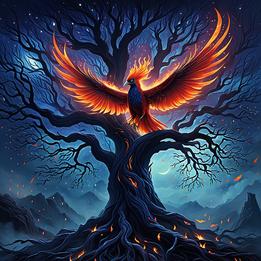
Vermilion Bird
A mythical firebird in East Asian cosmology representing the south, summer, and transformative power. It symbolizes passion, renewal, and celestial protection.
Vermilion Bird Dream Meaning
A mythical firebird in East Asian cosmology representing the south, summer, and transformative power. It symbolizes passion, renewal, and celestial protection.
Interpretive Themes
Transformation & Rebirth
highAssociated with phoenix-like resurrection myths.
Cosmic Order
highOne of the Four Symbols in Chinese constellations.
Passionate Energy
mediumLinked to fire element and summer season.
Spiritual Protection
mediumOften depicted as a benevolent celestial being.
Wisdom
lowBird symbolism combined with fiery illumination.
Mythological Resonance
Zhuque (Vermilion Bird of the South)
ChineseOne of the Four Symbols, guardian of the southern quadrant, associated with summer, fire, and the element of transformation in Chinese cosmology.
Phoenix
GlobalA mythical bird that cyclically regenerates or is reborn from its own ashes, symbolizing immortality, renewal, and resurrection across cultures.
Cultural Lenses
East Asian Perspective
View Context →In Chinese cosmology, the Vermilion Bird (Zhuque) is one of the Four Symbols, governing the south and summer. Historically associated with fire element, it appears in rituals, architecture, and astrology as a protective celestial guardian symbolizing transformation.
Jungian Perspective
View Context →Represents the archetype of transformation and the fiery aspect of the Self. Symbolizes the process of individuation through passionate engagement with the unconscious, often appearing during periods of significant psychological rebirth.
Freudian Perspective
View Context →May symbolize sublimated sexual energy (libido) transformed into creative or spiritual pursuits. The fiery aspect could represent repressed passions seeking expression through symbolic, culturally acceptable forms.
Gestalt Perspective
View Context →Represents the 'hot' or passionate aspects of the self needing integration. The bird's flight might symbolize avoidance of grounded issues, while its fire suggests intense emotions requiring acknowledgment and expression.
Cognitive Perspective
View Context →A conceptual blend of 'bird' (freedom, perspective) and 'fire' (energy, transformation) schemas. Dream appearances may reflect the mind processing change, passion, or elevated states through culturally available symbolic frameworks.
Evolutionary Perspective
View Context →Taps into primal associations: fire as survival tool and social center, birds as omens or messengers. The combination may trigger ancient neural pathways related to transformation, warning systems, or group cohesion around significant events.
Global/Universal Perspective
View Context →As a phoenix-like creature, represents nearly universal themes of rebirth through fire. Appears in various mythologies as a symbol of cyclical renewal, connecting to human experiences of destruction leading to new creation.
South Asian Perspective
View Context →Resonates with Garuda and fire deities like Agni. In Hindu and Buddhist contexts, fiery birds often represent spiritual ascent, the burning away of karma, or divine messengers carrying transformative wisdom.
Modern Western Perspective
View Context →Appears in fantasy literature, video games, and tattoo culture as a symbol of passion, rebirth, or magical power. Often divorced from original cosmological context, representing personal transformation or intense creative energy.
Middle Eastern Perspective
View Context →Echoes the Simurgh and Phoenix myths. In Persian tradition, represents purification through fire, spiritual completion, and the soul's journey. Appears in Sufi poetry as a symbol of divine love's transformative power.
European Perspective
View Context →Parallels the Phoenix in Greek and Roman mythology. Medieval bestiaries described firebirds as miraculous creatures symbolizing resurrection, often Christianized as representing Christ's resurrection or the purified soul.
African Perspective
View Context →Resonates with thunderbird myths and fire deities across cultures. In some traditions, represents the transformative power of the sun, ancestral spirits manifesting as birds, or shamanic journeys involving elemental transformation.
Historical Authorities
Want a deeper analysis?
Get a personalized interpretation of your entire dream including this symbol.
Interpret My DreamThe Oracle's Prediction
Combine multiple symbolsA period of intense personal transformation and renewal is imminent.
Timeframe
Seasonal (~3 Months)
Intensity
Deep
A surge of creative energy or a passionate new project will emerge.
Timeframe
Lunation (~29 Days)
Intensity
Deep
Common Appearances & Contexts
| Context | Emotion | Interpretation |
|---|---|---|
| Context Soaring above mountains | Emotion exhilaration | Interpretation Indicates rising above challenges with grace. |
| Context Perched on a temple roof | Emotion awe | Interpretation Suggests spiritual awakening or divine connection. |
| Context Engulfed in flames | Emotion fear | Interpretation May represent fear of necessary transformation. |
| Context Leading a flock | Emotion pride | Interpretation Symbolizes leadership or guiding others spiritually. |
| Context Singing at dawn | Emotion hope | Interpretation Signals new beginnings or creative inspiration. |
| Context Fighting a serpent | Emotion determination | Interpretation Represents overcoming obstacles or inner conflicts. |
| Context Nest in a burning tree | Emotion anxiety | Interpretation Could indicate precarious creative or life situations. |
| Context Feather falling into hand | Emotion wonder | Interpretation Suggests receiving spiritual gifts or insights. |
| Context Guarding a sacred object | Emotion reverence | Interpretation Points to protecting core values or truths. |
| Context Molting old feathers | Emotion relief | Interpretation Symbolizes shedding past burdens or identities. |
| Context Reflected in water | Emotion contemplation | Interpretation May represent self-reflection on fiery aspects. |
| Context Carrying a message | Emotion urgency | Interpretation Indicates important communication or revelation. |
Interpret Your Full Dream
Beyond this symbol, every dream carries a unique story. Share your dream for a personalized AI-powered interpretation.