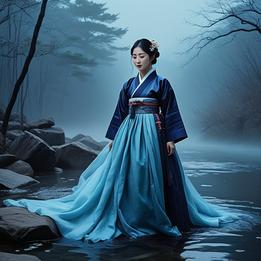
Hanbok Dress
A traditional Korean garment symbolizing cultural identity, ancestral connection, and ceremonial transition between life stages.
Hanbok Dress Dream Meaning
A traditional Korean garment symbolizing cultural identity, ancestral connection, and ceremonial transition between life stages.
Interpretive Themes
Mythological Resonance
Dangun
KoreanThe mythical founder of Gojoseon, whose lineage and sacred ceremonies established Korean cultural identity, much like the Hanbok embodies formal tradition.
Hestia
GreekGoddess of the hearth and home, representing the sacred domestic order, ritual purity, and familial continuity mirrored in the Hanbok's ceremonial role.
Cultural Lenses
Jungian Perspective
View Context →Archetype of the Self's cultural persona; integration of collective unconscious heritage with individual identity through symbolic garment representing wholeness and ancestral wisdom.
Freudian Perspective
View Context →Symbol of repressed cultural superego; garment representing societal expectations and familial pressures, possibly relating to childhood rituals or parental authority conflicts.
Gestalt Perspective
View Context →Projection of self-concept onto cultural garment; the hanbok as empty vessel filled with dreamer's current relationship to tradition, belonging, and personal history.
Cognitive Perspective
View Context →Mental schema for cultural identity processing; the brain organizing concepts of heritage, social roles, and memory through familiar symbolic clothing imagery during sleep consolidation.
Evolutionary Perspective
View Context →Adaptive signaling of group membership and social status; traditional dress as evolved mechanism for displaying cultural fitness, cooperation signals, and in-group identification for survival advantage.
East Asian Perspective
View Context →Korean traditional dress embodying Confucian values of harmony, filial piety, and social hierarchy; historically color-coded by status, now worn for celebrations connecting modern Koreans to Joseon dynasty heritage.
Global/Universal Perspective
View Context →Universal symbol of cultural preservation and identity negotiation; traditional garments worldwide represent the tension between heritage maintenance and modern adaptation in globalized societies.
Modern Western Perspective
View Context →Exoticized symbol of otherness or fashionable ethnic aesthetic; often divorced from cultural context, representing Western fascination with or appropriation of Asian traditions in global fashion.
European Perspective
View Context →Parallel to national costumes like dirndl or kilt; symbol of folk revival movements where traditional dress represents resistance to homogenization and celebration of regional identity.
African Perspective
View Context →Resonates with traditional textiles like kente or dashiki; garments carrying ancestral stories, social status, and spiritual protection, with similar contemporary revival for cultural affirmation.
Latin American Perspective
View Context →Echoes of indigenous traje or pollera; traditional dress as living resistance to colonization, maintaining pre-Columbian cosmologies while adapting to modern mestizo identities.
Middle Eastern Perspective
View Context →Parallel to thobe or abaya; modest ceremonial garments encoding social values, religious observance, and tribal affiliations while negotiating modern identity politics.
Historical Authorities
Want a deeper analysis?
Get a personalized interpretation of your entire dream including this symbol.
Interpret My DreamThe Oracle's Prediction
Combine multiple symbolsA deepening connection with family or cultural community.
Timeframe
Seasonal (~3 Months)
Intensity
Deep
Common Appearances & Contexts
| Context | Emotion | Interpretation |
|---|---|---|
| Context Wearing at wedding | Emotion Joy | Interpretation Commitment to tradition. |
| Context Seeing ancestor wear | Emotion Awe | Interpretation Lineage continuity. |
| Context Tearing fabric | Emotion Grief | Interpretation Cultural loss fear. |
| Context Choosing colors | Emotion Contemplation | Interpretation Identity expression. |
| Context Receiving as gift | Emotion Gratitude | Interpretation Heritage acceptance. |
| Context Washing hanbok | Emotion Reverence | Interpretation Ritual purification. |
| Context Modern adaptation | Emotion Curiosity | Interpretation Tradition evolution. |
| Context Passing down | Emotion Responsibility | Interpretation Legacy duty. |
| Context Wearing incorrectly | Emotion Shame | Interpretation Disconnection anxiety. |
| Context Dancing in hanbok | Emotion Liberation | Interpretation Cultural celebration. |
| Context Storage in chest | Emotion Nostalgia | Interpretation Memory preservation. |
| Context Designing new hanbok | Emotion Creativity | Interpretation Identity innovation. |
Interpret Your Full Dream
Beyond this symbol, every dream carries a unique story. Share your dream for a personalized AI-powered interpretation.