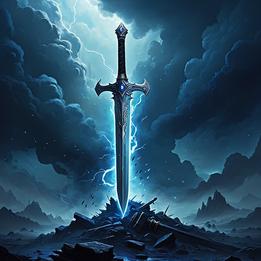
Battle Sword
A spiritual weapon representing inner conflict, moral choices, and the struggle between opposing forces within the psyche or external world.
Battle Sword Dream Meaning
A spiritual weapon representing inner conflict, moral choices, and the struggle between opposing forces within the psyche or external world.
Interpretive Themes
Mythological Resonance
Excalibur
ArthurianThe sword in the stone, drawn by Arthur to prove his divine right to rule and unite Britain.
Gram
NorseSigurd's sword, reforged from fragments to slay the dragon Fafnir and claim treasure.
Cultural Lenses
Global/Universal Perspective
View Context →Universal symbol of power, justice, and protection across cultures. Historically used in rituals and ceremonies, now represents personal strength and moral authority in modern contexts.
Jungian Perspective
View Context →Archetype of the hero's weapon representing the conscious ego cutting through unconscious material. Symbolizes differentiation, decision-making, and the masculine principle of Logos in psychological development.
Freudian Perspective
View Context →Phallic symbol representing masculine power, aggression, and sexual energy. May indicate repressed desires, castration anxiety, or unresolved Oedipal conflicts manifesting as weapons in dreams.
Gestalt Perspective
View Context →Projection of the dreamer's cutting edge - the ability to make distinctions, set boundaries, or separate aspects of experience. Represents how one divides their world into parts.
Cognitive Perspective
View Context →Mental schema for conflict resolution and problem-solving. Represents cognitive tools for cutting through confusion, making decisions, or defending against psychological threats in waking life.
Evolutionary Perspective
View Context →Ancient survival tool representing threat response, dominance hierarchies, and territorial defense. Modern manifestation of primal instincts for protection, status competition, and resource acquisition.
East Asian Perspective
View Context →In Japanese tradition, the katana represents the samurai's soul and Bushido code. Chinese dao swords symbolize martial virtue and cosmic balance between yin and yang principles in both historical and modern contexts.
European Perspective
View Context →Excalibur and similar legendary swords represent divine right, kingship, and chivalric ideals. Historically used in coronation ceremonies, now symbolizes heritage, honor, and cultural identity in contemporary Europe.
Middle Eastern Perspective
View Context →Zulfiqar (Ali's sword) represents divine justice and spiritual authority in Islam. Scimitars symbolize protection and nomadic warrior traditions, maintaining cultural significance in modern religious and national contexts.
South Asian Perspective
View Context →Khanda represents divine knowledge cutting through ignorance in Sikhism. Historical use in rituals and warfare, now symbolizes spiritual discipline and community defense in contemporary religious practice.
African Perspective
View Context →Ceremonial swords like the flywhisk-sword represent royal authority and ancestral connection. Used in rituals and leadership ceremonies, maintaining cultural significance in traditional and modern governance contexts.
Modern Western Perspective
View Context →Fantasy genre symbol representing personal empowerment and moral clarity. Video games and films use swords as metaphors for self-discovery, with contemporary focus on individual agency rather than historical warfare.
Historical Authorities
Want a deeper analysis?
Get a personalized interpretation of your entire dream including this symbol.
Interpret My DreamThe Oracle's Prediction
Combine multiple symbolsA decisive confrontation or opportunity for leadership will arise.
Timeframe
Seasonal (~3 Months)
Intensity
Deep
A profound inner conflict will lead to personal transformation.
Timeframe
Lunation (~29 Days)
Intensity
Deep
Common Appearances & Contexts
| Context | Emotion | Interpretation |
|---|---|---|
| Context Wielding sword | Emotion empowered | Interpretation Taking control actively. |
| Context Broken sword | Emotion defeated | Interpretation Loss of personal power. |
| Context Receiving sword | Emotion honored | Interpretation Accepting responsibility willingly. |
| Context Dropping sword | Emotion relieved | Interpretation Choosing peace over conflict. |
| Context Sharpening sword | Emotion prepared | Interpretation Readying for challenges ahead. |
| Context Bloody sword | Emotion guilty | Interpretation Consequences of actions. |
| Context Shining sword | Emotion hopeful | Interpretation Clarity in purpose. |
| Context Heavy sword | Emotion burdened | Interpretation Responsibility feels overwhelming. |
| Context Sword in scabbard | Emotion restrained | Interpretation Power held in check. |
| Context Sword fighting | Emotion aggressive | Interpretation Active confrontation ongoing. |
| Context Giving sword | Emotion generous | Interpretation Sharing power willingly. |
| Context Rusty sword | Emotion neglected | Interpretation Unused potential evident. |
Interpret Your Full Dream
Beyond this symbol, every dream carries a unique story. Share your dream for a personalized AI-powered interpretation.