Yurlunggur the Copper Python
A powerful serpent deity from Aboriginal Australian mythology, Yurlunggur embodies creation, water, and ancestral wisdom in Dreamtime stories.
The Tale of Yurlunggur the Copper Python
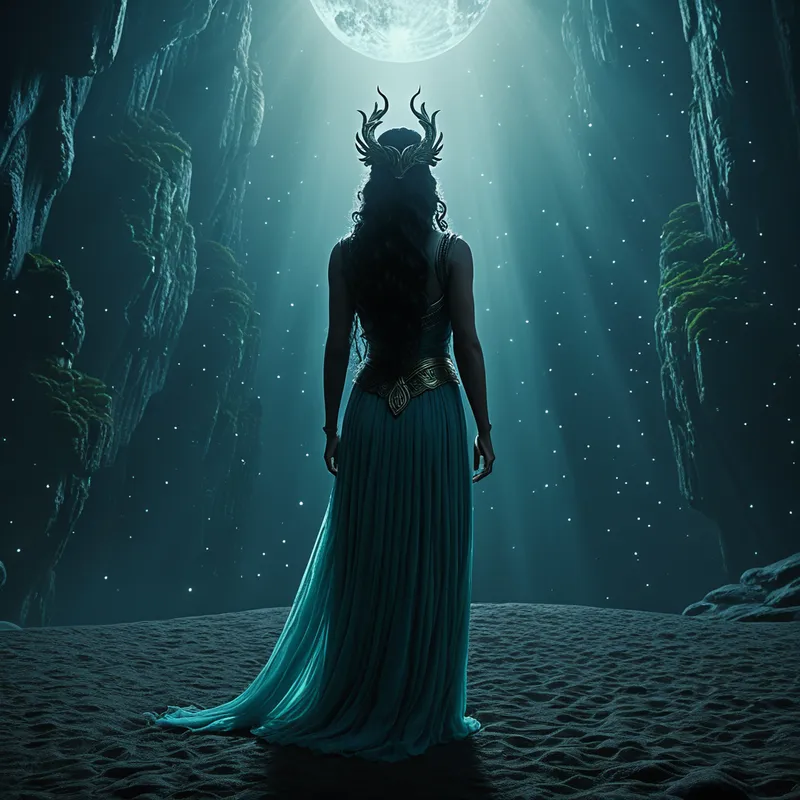
In the [Dreamtime](/myths/dreamtime “Myth from Aboriginal culture.”/), before the rivers had found their beds and the hills their shapes, there was a great stillness. From within this stillness, in the deep, unformed places, [Yurlunggur](/myths/yurlunggur “Myth from Aboriginal Australian culture.”/) the Copper [Python](/myths/python “Myth from Greek culture.”/) stirred. He was not born but simply was, a colossal serpent whose scales held the dull, potent gleam of raw copper, a metal not of the forge but of [the earth](/myths/the-earth “Myth from Hindu culture.”/)’s dreaming heart.
His first movement was a coil, a circle drawn upon [the void](/myths/the-void “Myth from Buddhist culture.”/). Where his body pressed, the earth sank, forming the first waterholes and [sacred wells](/myths/sacred-wells “Myth from Celtic culture.”/). His breath was not fire but mist, a cool exhalation that became the morning fog clinging to gullies, the promise of rain in dry air. He traveled across the nascent land, his immense weight carving valleys, his sinuous passage defining the curves of riverbeds yet to flow. He was the land’s first sculptor, but his work was silent, a pressing of form from potential.
The tale deepens with the people, the Dhuwa moiety of the Yolngu. Yurlunggur was their foundational ancestor, their Dreaming. In one pivotal story, he comes upon two sisters of the Wawilak clan. A complex drama unfolds—a transgression, the spilling of blood into his sacred waterhole. This act stirs Yurlunggur from his deep, generative sleep. He rises, a towering column of scaled muscle that blots out the sun, his head touching the storm clouds. With this rising, the waters swell, a [great flood](/myths/great-flood “Myth from Mesopotamian culture.”/) following his ascent, swallowing the land in a churning, purifying deluge.
The sisters and the community are engulfed. This is not merely punishment, but a profound, terrifying transformation. Yurlunggur swallows them, taking them into the dark, wet mystery of his being. Within him, the boundaries between self and other, ancestor and descendant, dissolve. After a time of cosmic digestion, he returns them to [the world](/myths/the-world “Myth from Tarot culture.”/), not as they were, but as part of the eternal landscape—their spirits in the rocks, their voices in the waterfall, their essence in the rituals that would forever after be performed. Yurlunggur then descends, his body forming the bedrock, his spirit remaining in the [water](/myths/water “Myth from Chinese culture.”/) and the shining, copper-colored stones. He becomes the land itself, a memory in stone and a presence in water, the eternal cycle of emergence, consumption, and return made manifest.
Cultural Origins & Context
Yurlunggur’s stories belong primarily to the Yolngu people of north-eastern Arnhem Land. He is a central Dreaming figure for the Dhuwa moiety, one of the two fundamental kinship divisions that structure Yolngu society and cosmology. This is not a “myth” in the sense of a forgotten tale, but a living, enacted truth. The knowledge of Yurlunggur is sacred, held and transmitted through intricate song cycles, dances, body paintings, and rituals that are the property of specific clans.
The myth is a charter for law, ecology, and identity. It defines the sacred geography of the land—that waterhole is Yurlunggur’s resting place; that canyon is the path of his travel. It legislates social order, explaining moiety relationships and the grave consequences of breaking taboos, symbolized by the Wawilak sisters’ actions. Most vitally, it connects people to place and past in an unbroken chain. An individual does not simply live on the land; they are an incarnation of the ancestral essence that Yurlunggur, and other beings, deposited there during [the Dreamtime](/myths/the-dreamtime “Myth from Aboriginal Australian culture.”/). To know Yurlunggur is to know one’s own origin and one’s sacred responsibilities.
Symbolic Architecture
Yurlunggur is a being of profound [paradox](/symbols/paradox “Symbol: A contradictory yet true concept that challenges logic and perception, often representing unresolved tensions or profound truths.”/), his [symbolism](/symbols/symbolism “Symbol: The use of symbols to represent ideas or qualities, often conveying deeper meanings beyond literal interpretation. In dreams, it’s the language of the unconscious.”/) woven from complementary tensions. He is the unity of opposites, a psychic [structure](/symbols/structure “Symbol: Structure in dreams often symbolizes stability, organization, and the framework of one’s life, reflecting how one perceives their environment and personal life.”/) of immense [depth](/symbols/depth “Symbol: Represents profound layers of consciousness, hidden truths, or the unknown aspects of existence, often symbolizing introspection and existential exploration.”/).
He is the coiled potential of the unconscious and the active, shaping force of creation. His swallowing is not an end, but a return to the source for rebirth.
His [copper](/symbols/copper “Symbol: Copper symbolizes conductivity and connection, representing the ability to channel energy, ideas, and emotions between people or concepts.”/) hue is key. It is the color of [earth](/symbols/earth “Symbol: The symbol of Earth often represents grounding, stability, and the physical realm, embodying a connection to nature and the innate support it provides.”/), of [life](/symbols/life “Symbol: The symbol of ‘Life’ represents a journey of growth, interconnectedness, and existential meaning, encompassing both the joys and challenges that define human experience.”/)-giving [blood](/symbols/blood “Symbol: Blood often symbolizes life force, vitality, and deep emotional connections, but it can also evoke themes of sacrifice, trauma, and mortality.”/), and of the sacred ochre used in [ceremony](/symbols/ceremony “Symbol: Ceremonies in dreams often symbolize transitions, rituals of passage, or significant life events.”/). It speaks of a [metal](/symbols/metal “Symbol: Metal in dreams often signifies strength, transformation, and the qualities of resilience or coldness.”/) that is durable yet malleable, conductive yet prone to a verdigris that hints at age and transformation. He is not the flashy gold of kings, but the foundational [copper](/symbols/copper “Symbol: Copper symbolizes conductivity and connection, representing the ability to channel energy, ideas, and emotions between people or concepts.”/) of the [earth](/symbols/earth “Symbol: The symbol of Earth often represents grounding, stability, and the physical realm, embodying a connection to nature and the innate support it provides.”/)’s own circuitry.
The serpentine form is [eternity](/symbols/eternity “Symbol: The infinite, timeless state beyond human life and measurement, often representing the ultimate or divine.”/) in [motion](/symbols/motion “Symbol: Represents change, progress, or the flow of life energy. Often signifies transition, personal growth, or the passage of time.”/), the [ouroboros](/symbols/ouroboros “Symbol: An ancient symbol depicting a serpent or dragon eating its own tail, representing cyclicality, eternity, self-sufficiency, and the unity of opposites.”/) of Aboriginal cosmology. He embodies the [water](/symbols/water “Symbol: Water symbolizes the subconscious mind, emotions, and the flow of life, representing both cleansing and creation.”/) cycle—the hidden [aquifer](/symbols/aquifer “Symbol: An underground layer of water-bearing rock or sediment, symbolizing hidden resources, emotional reserves, and life-sustaining potential beneath the surface.”/), the rising flood, the life-giving rain, the returning stream. His act of swallowing and later releasing encapsulates the core Dreamtime principle: ancestors do not vanish; they change state, becoming the tangible, immanent world. The conflict initiated by the sisters is not a simple morality play, but a necessary catalyst that forces the ancestral being to enact his full [nature](/symbols/nature “Symbol: Nature symbolizes growth, connectivity, and the primal forces of existence.”/)—as judge, as flood, as [womb](/symbols/womb “Symbol: A symbol of origin, potential, and profound transformation, representing the beginning of life’s journey and the unconscious source of creation.”/), and as tomb—completing the cycle from [stasis](/symbols/stasis “Symbol: A state of inactivity, equilibrium, or suspension where no change or progress occurs, often representing psychological or existential paralysis.”/), through chaotic transformation, to a new, sacred order.
The Dreamer’s Resonance
To encounter Yurlunggur in the psychic landscape is to confront the foundational powers of [the self](/myths/the-self “Myth from Jungian culture.”/). He represents the deep, instinctual ground of being from which our conscious identity emerges. His rising is the sudden, overwhelming upsurge of what has been repressed or ignored—the emotional flood that washes away the fragile structures of [the ego](/myths/the-ego “Myth from Jungian culture.”/), forcing a confrontation with primal truths.
Psychologically, his swallowing is a symbol of integration. The aspects of the self (the “sisters”) that have caused disruption through unconscious action are not destroyed, but are taken back into the wholeness of the [psyche](/myths/psyche “Myth from Greek culture.”/). This is a terrifying, regressive experience, a feeling of being consumed by one’s own depths. Yet, it is a necessary dissolution. The rebirth that follows is not a return to the old self, but the emergence of a personality now informed by, and in relationship with, those powerful ancestral layers. Yurlunggur challenges the modern notion of the autonomous individual, proposing instead a self that is a temporary, conscious expression of an eternal, ancestral pattern.
Alchemical Translation
In the alchemy of the soul, Yurlunggur is the [prima materia](/myths/prima-materia “Myth from Alchemical culture.”/), the chaotic, foundational substance from which [the great work](/myths/the-great-work “Myth from Alchemical culture.”/) begins. His copper is the base metal, the unrefined soul, heavy with potential and connected to the terrestrial realm.
The flood is the solutio, the overwhelming dissolution where all fixed forms are dissolved in the waters of the unconscious. This is not death, but the necessary return to a fluid state.
The process within Yurlunggur’s belly is the [nigredo](/myths/nigredo “Myth from Alchemical culture.”/), the dark night where identity is lost and all seems black. Yet, this is where the transformation occurs. The regurgitation or return of the ancestors as landscape is the [albedo](/myths/albedo “Myth from Alchemical culture.”/) and [rubedo](/myths/rubedo “Myth from Alchemical culture.”/)—the whitening and reddening—where the spirit is purified and reborn, now fixed in a new, enduring, and sacred form. The serpent becomes the stable, coiled stone; the chaotic flood becomes the ordered, life-sustaining waterhole. The alchemical goal is not to escape the copper, but to understand it as the sacred ground of being, to achieve the coincidentia oppositorum—the coincidence of opposites—that Yurlunggur himself embodies: creator and destroyer, judge and womb, the moving serpent and the eternal land.
Associated Symbols
Explore related symbols from the CaleaDream lexicon:
- Serpent — The eternal cycle of life, [death](/myths/death “Myth from Tarot culture.”/), and rebirth; primal wisdom and the foundational energy that shapes worlds from the formless void.
- Water — The primordial substance of life and the unconscious mind; a force of purification, memory, and transformative flood that dissolves old forms to make way for the new.
- Copper — The foundational, conductive metal of the earth’s soul; symbolizing ancestral blood, sacred ochre, and the durable yet malleable substance of enduring tradition.
- Dream — The timeless dimension of creation where [ancestral beings](/myths/ancestral-beings “Myth from Aboriginal Australian culture.”/) move and act, forming the enduring template for all reality and identity.
- Origin — The point of [emanation](/myths/emanation “Myth from Neoplatonic/Gnostic culture.”/) where being emerges from stillness; the sacred source to which all things ultimately return and from which they are perpetually renewed.
- Cave — [The womb](/myths/the-womb “Myth from Various culture.”/) of the earth and the unconscious; a place of initiation, hidden knowledge, and the dark, fertile containment where profound transformations begin.
- Rain — The generative blessing from [the sky](/myths/the-sky “Myth from Persian culture.”/), intimately connected to the serpent’s power; the promise of renewal, fertility, and the cyclical fulfillment of creative potential.
- Circle — The shape of eternity, the coiled serpent, the sacred waterhole, and the unbroken cycle of the Dreaming that contains all time—past, present, and future.
- Ritual — The enacted memory and recreation of the ancestral event; the human technology for bridging time and participating directly in the ongoing power of the Dreaming.
- Rebirth — The core promise following dissolution; not a return to a previous state, but an emergence into a new, sanctified form, integrated with ancestral truth.
- Stone — The eternal, fixed testament of the ancestral journey; the dream made permanent, holding the memory and law of the creative past within the present landscape.
- Flood — The catastrophic yet cleansing force of transformation; the overwhelming emotional or spiritual deluge that erases boundaries and forces a confrontation with primal reality.