Wu Gang Myth Meaning & Symbolism
An immortal's eternal punishment: to chop a self-healing cassia tree on the moon, a profound myth of endless striving and the nature of time.
The Tale of Wu Gang
Listen, and hear the tale of the man who sought the heavens and found an eternity of labor.
In the time when emperors were gods and immortals walked the misty peaks, there lived a man named Wu Gang. He was a scholar of the earthly arts, yet his heart burned not for knowledge, but for the ultimate prize: immortality itself. He envied the carefree xian who danced among the clouds, unbound by time or sorrow. His desire was a furnace, consuming all patience, all humility.
He abandoned his studies, his home, and climbed the sacred mountains where the air thins and the world falls away. He sought the Jade Emperor in his celestial court, not with a supplicant’s bow, but with a demand. “Grant me the elixir!” he cried to the silent, star-dusted halls. “I am worthy of your gift! I will not be denied!”
The heavens, vast and ancient, do not suffer such hubris lightly. The Jade Emperor, from his throne of jade and starlight, perceived the raging fire in Wu Gang’s soul—a fire of ambition, not wisdom; of grasping, not grace. As punishment for his arrogance and his refusal to walk the long, patient path of cultivation, a unique sentence was pronounced.
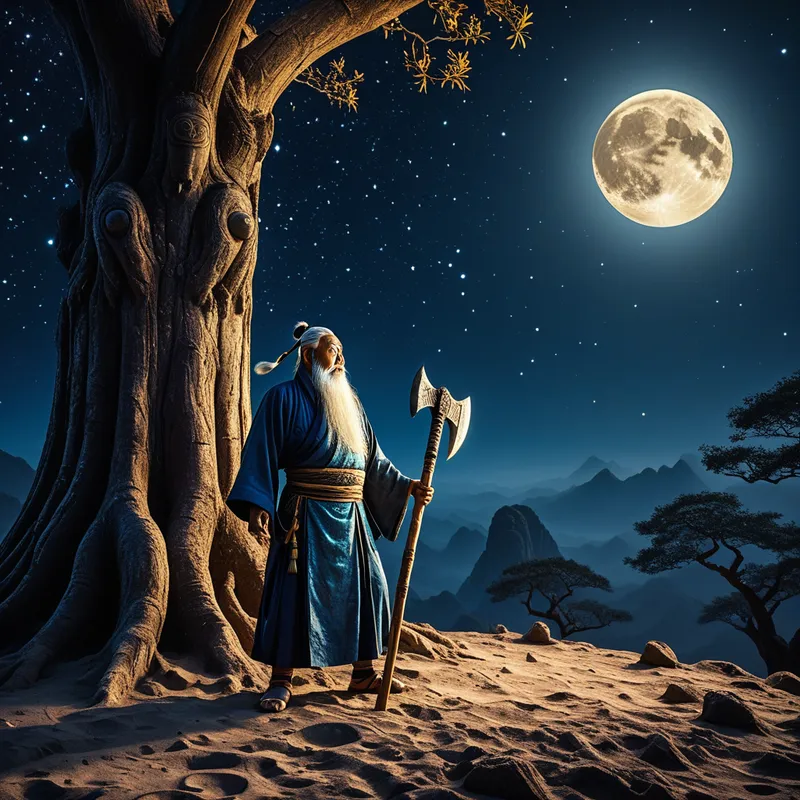
Wu Gang was banished not to a hell of fire, but to a cold paradise. He was sent to the Moon Palace, that silent, silver orb that watches over the night. His task was simple: cut down the enormous cassia tree that grew there, a tree whose wood was fragrant and luminous. The Emperor promised, “When the tree falls, you shall attain immortality and your punishment will end.”
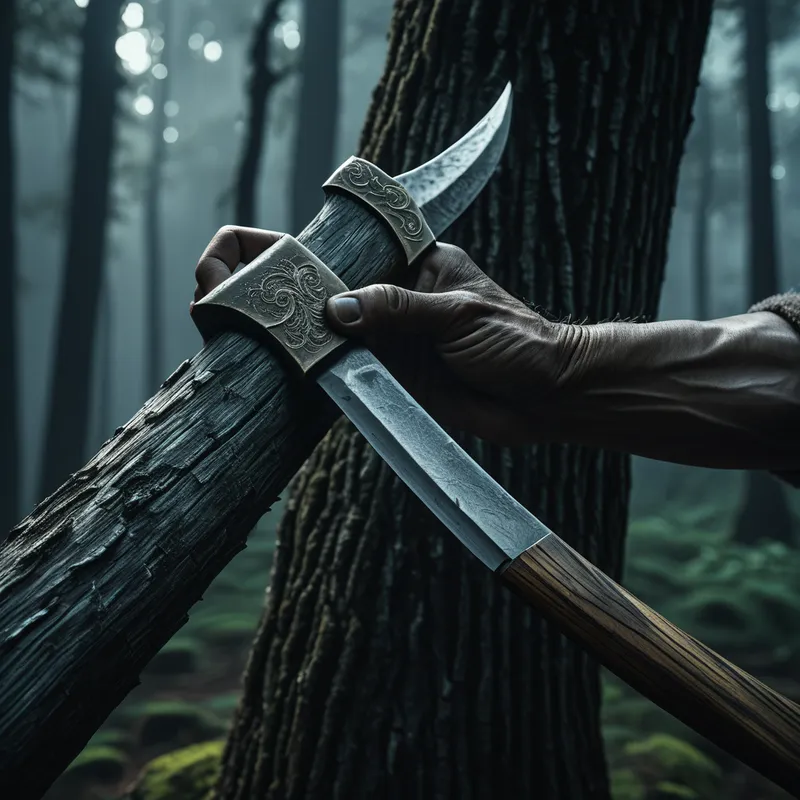
Wu Gang, his resolve hardened, seized the great axe provided. With a mighty roar, he swung. The blade bit deep into the shimmering bark, and a chunk of wood fell away. A surge of triumph flooded him. But as he raised his axe for a second blow, a soft, silver light began to pulse from the wound. Before his disbelieving eyes, the gash in the tree sealed itself, the bark weaving back together as if the blow had never landed. The tree stood whole, untouched.
A cold dread, deeper than any mortal fear, settled in his bones. He swung again. And again. Each strike was strong, true, and futile. The tree healed instantly, eternally. The thock of the axe, the shower of luminous splinters, the silent, seamless healing—this became the rhythm of his existence. He is there still, on that desolate, beautiful moon, a figure of endless effort under the constant, watchful gaze of the Earth. He sought to conquer eternity, and instead became its servant, trapped in a single, perfect moment of almost-victory that never arrives.
Cultural Origins & Context
The myth of Wu Gang is a folk narrative, its origins woven into the rich tapestry of Chinese mid-autumn lore. It is not a canonical scripture from a major philosophical text, but a story that grew from the soil of popular imagination, often told alongside the more famous tale of Chang'e. It served as a companion piece to her story of lonely beauty, providing a masculine counterpoint of endless labor on the same celestial body.
Passed down orally, especially during the Mid-Autumn Festival when families gather to admire the full moon, the tale functioned as a profound moral and philosophical lesson. It was a narrative tool used by elders and storytellers to illustrate the dangers of impatience, the folly of demanding shortcuts from the cosmic order (Dao), and the nature of true immortality versus a cursed, static existence. It grounded celestial mythology in a very human psychological reality: the torment of futile effort.
Symbolic Architecture
The myth is a masterful symbolic construct. Wu Gang is not a villain, but an aspect of the human psyche—the part that believes sheer force of will can conquer natural law and spiritual process. The moon is not just a setting, but the symbol of the unconscious, the reflective, cold, and cyclical realm of the soul. The cassia tree itself is the ultimate symbol.
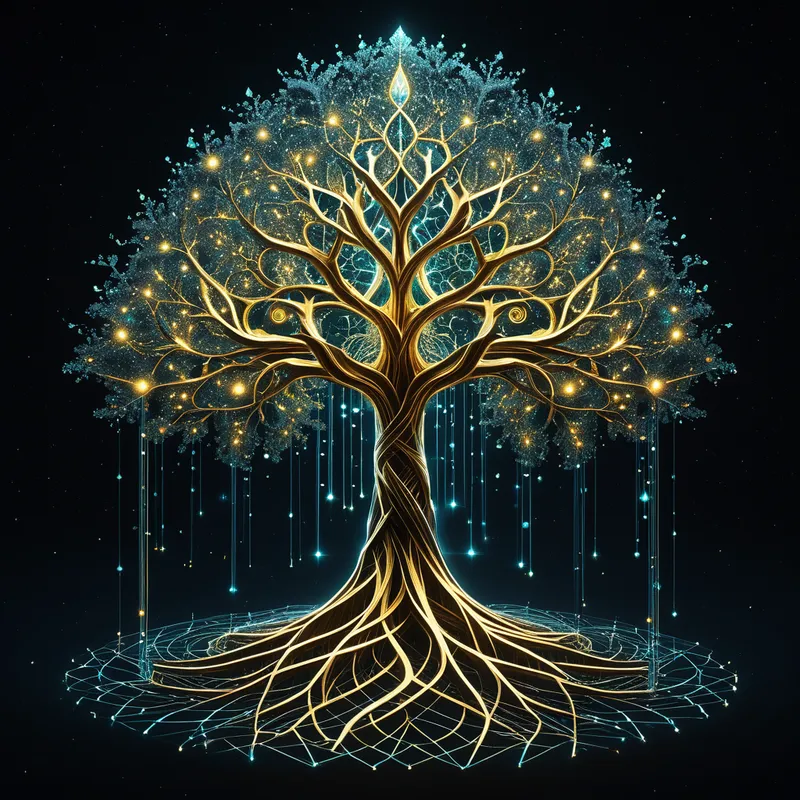
The tree is the Self, the totality of the psyche. To "cut it down" with the crude axe of egoic will is to attempt a violent integration, a conquest of one's own nature. But the Self does not yield to force; it regenerates, persists, and heals according to its own timeless rhythm.
The axe represents directed, conscious effort—willpower, ambition, the tool of the ego. The instant healing represents the autonomous, self-regulating nature of the psyche, which cannot be fundamentally altered by superficial or aggressive action. The entire tableau is a perfect image of neurosis: a compulsive, repetitive behavior (chopping) engaged in to solve a problem (attaining immortality/wholeness), which only perpetuates the problem itself.
The Dreamer's Resonance
When this myth stirs in the modern dreamer, it often manifests not as a man on the moon, but as the sensation of the Wu Gang pattern. It is the dream of being late for an exam in a classroom whose layout constantly changes. It is the dream of running on a treadmill that speeds up, or of trying to climb a sand dune that slips away with every step. Somatically, the dreamer may wake with tense shoulders, a clenched jaw, or a feeling of profound exhaustion unrelated to physical sleep.
Psychologically, this signals a state where the conscious mind (Wu Gang) is engaged in a futile, repetitive struggle against an aspect of the unconscious (the tree/the moon). This could be a deeply ingrained habit, a core wound that one tries to "fix" through sheer effort, or a life goal pursued with such rigid obsession that the process becomes a self-defeating loop. The dream is the psyche's dramatic rendering of burnout, of effort devoid of integration, warning that the current mode of operation is as endless as it is fruitless.

Alchemical Translation
The path of individuation, of becoming whole, is not one of conquest, but of relationship. Wu Gang’s alchemical failure is his refusal to relate to the tree. He sees it only as an obstacle to be removed, not as a living entity with which he shares a destiny.
The transmutation begins when the axe falls silent. The first step is not to chop better, but to stop chopping. To sit. To observe the tree’s luminous healing. To feel the cool lunar air. This is the shift from doing to being, from willpower to witnessing.
In this pause, the psychic energy bound in the compulsive loop is released. The immortal punishment becomes the immortal practice. Perhaps the tree is not meant to be felled, but to be tended. The work transforms from "cutting down the Self" to "engaging with the process of the Self." The endless task, seen through the eyes of the ego, is a curse. Seen through the eyes of the soul, it becomes a meditation—the eternal, necessary work of consciousness engaging with the mysteries of its own existence. The goal is no longer the fallen tree (a static achievement), but the quality of attention in each swing, the awareness of the healing that follows, and the eventual, humble question: "What if I am not here to conquer this, but to learn from it?" In that question lies the true elixir.
Associated Symbols
Explore related symbols from the CaleaDream lexicon: