The Dream of Eternity: A Somatic Call from the Infinite Self
The Somatic Echo
It begins not as a thought, but as a gravity. A weight in the marrow of your bones that feels less like heaviness and more like density—as if your very cells are remembering a slower, more fundamental rhythm. The breath catches, not in panic, but in a suspension, as if the lungs have forgotten the need for the next cycle. There is a profound stillness, a silence so deep it has texture. This is the body’s first, wordless recognition of the theme of eternity. It is not the mind’s concept of endless time; it is the visceral, pre-verbal experience of timelessness. The nervous system registers it as a paradox: a terrifying dissolution of all known boundaries, coupled with an eerie, magnetic pull toward a center you did not know you possessed. The skin feels both infinite and a prison. This is the somatic echo of the psyche brushing against its own eternal architecture.
The Dreamer's Log
The dreamer stands in a library whose obsidian shelves recede into a starry void. On a stone pedestal lies a single, open book. As they try to read, the text shifts—not in language, but in substance, becoming a map of their own neural pathways, then a galaxy, then a single, pulsing vein of light. They understand, without words, that this book contains every thought they have ever had and ever will have, and that reading it to its end would take forever. They wake with the taste of ozone and a profound, quiet grief.
Alchemical Interpretation: The dream presents the totality of the personal psyche as an infinite text, forcing a confrontation with the unbearable weight and liberation of one’s own complete narrative.

The False Lead
A dream of eternity is not a forecast of boredom or a warning of endless repetition. It is not the mind’s fear of a tedious afterlife or a simple metaphor for a monotonous life. To mistake it for such is to confuse the ocean for a puddle. The terror it evokes is not about too much time, but about the collapse of time as a meaningful container for identity. The grief is not for a long life, but for the fragile, time-bound story of “you” that must be relinquished at the threshold of the infinite. This dream is a structural event, not a situational one. It speaks to the foundation of being, not the decoration of circumstance.
Psychological Architecture
To dream of eternity is to be drafted into the deepest strata of Shadow work. Here, the Shadow is not a collection of repressed desires or shamed traits, but the entirety of the personal unconscious experienced as an object—a vast, cold, impersonal fact. The ego, that diligent manager of a life measured in days and achievements, stands before the abyss of its own origin and dissolution. This is the Individuation process in its most radical form: the imperative to differentiate a conscious “I” not from mother or father, but from the Pleroma itself, from the undifferentiated ground of being. The psyche’s internal family system is thrown into chaos; every inner child, every critic, every protector is rendered silent, their dramas meaningless against the backdrop of the timeless. The work here is to build a relationship with this infinity, to find the point of contact where the finite soul touches the eternal without being annihilated by it. It is the alchemy of building a vessel strong enough to hold the ocean.
Mythic Resonance
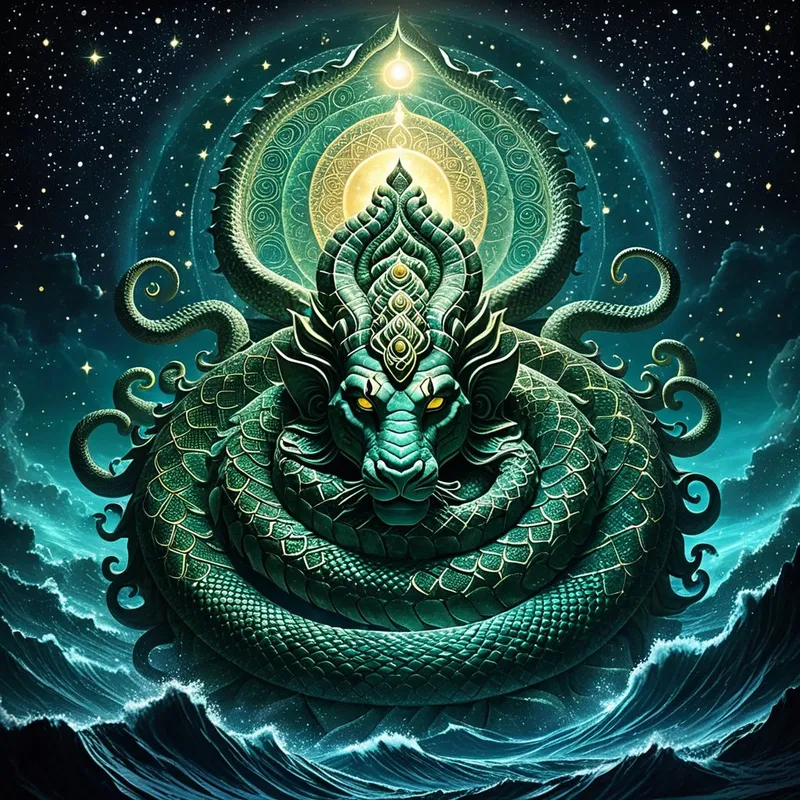
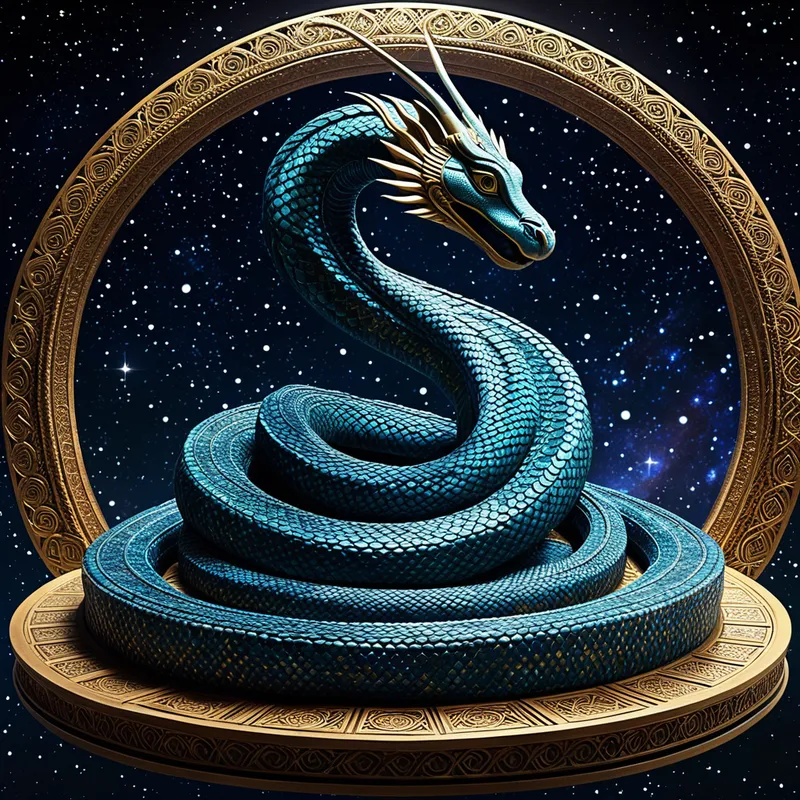
We see this architecture in the myth of Tithonus, to whom the gods granted eternal life but forgot to grant eternal youth. He ages endlessly, trapped in a decaying body, his eternity a curse of duration without essence. This is the nightmare of the unintegrated eternal—time without transformation, existence without being. Contrast this with the Ouroboros, the serpent devouring its own tail. This is not a linear eternity, but a cyclical, completed one. It represents the self-sufficient, self-renewing system, the psyche that has integrated its beginning and its end into a timeless now. The dream of eternity asks us: are we Tithonus, clinging to a life-form that cannot withstand the infinite, or are we moving toward the Ouroboros, becoming the contained, self-sustaining circle?
Symbolic Nodes
- Endless Hallways, Staircases, or Corridors: The labyrinth of the psyche with no exit, demanding a surrender of the goal-oriented mind.
- Vast, Empty Landscapes (Deserts, Oceans, Starfields): The unformed potential of the Self, both liberating and terrifying in its lack of landmarks.
- Immobile or Petrified Figures (Including Oneself): The ego’s fear of being fixed forever in one state, the antithesis of alchemical transformation.
- A Single, Repeating Moment or Scene: Time experienced as a depth rather than a length, a single point containing infinite dimensions.
- Ancient, Unchanging Objects (Stones, Tomes, Mountains): Symbols of the enduring, impersonal substrate beneath personal history.
Archetypal Resonance
The energy of the eternal dream is most purely channeled through The Sage Archetype. The Sage seeks not action or possession, but fundamental truth and understanding. Its core question is “What is real?”—a question that, when pursued to its end, inevitably dissolves temporal illusions. The somatic echo of eternity—that still, dense gravity—is the Sage’s deep listening, the withdrawal from the sensory world to apprehend the pattern that connects all things. The alchemical potential here is the Sage’s gift: to use the confrontation with the infinite not to paralyze, but to distill wisdom. The Shadow Sage, dogmatic and judgmental, would use this encounter to pronounce a final, frozen truth about the dreamer’s life. The integrated Sage allows the vastness to relativize all petty truths, creating a perspective so wide it becomes a form of liberation.
The Alchemical Process
The transmutation here is of terror into awe, and grief into humility. The raw materia is the ego’s shock at its own insignificance within the infinite. The alchemical vessel is the dreamer’s conscious attention, courageously held upon this unbearable image. The heat and pressure are applied by sustaining that gaze, by refusing to look away from the void or to hastily fill it with comforting, time-bound meanings. This is the nigredo, the blackening, where all personal identity dissolves into the dark night of the eternal. The transformation occurs when, within that blackness, a new perception is born: not “I am nothing,” but “I am of this.” The personal self is not erased; it is re-contextualized as a unique, fleeting expression of the timeless whole. The gold produced is a profound, unshakable sovereignty—not control over life, but a serene participation in it, grounded in the knowledge of one’s eternal substrate.

The Integration Protocol
Question 1: Where in your waking life do you feel the "gravity" of eternity—not as an idea, but as a somatic pressure or stillness? Is it in silence, in vast spaces, or in the eyes of someone very old or very young?
Question 2: If your life were a single, eternal moment—not a line, but a point containing everything—what would be at the very center of that point? What quality, sensation, or truth persists when the story is stripped away?
Question 3: What personal story, identity, or grievance are you most afraid to release into the infinite? What part of you believes it must endure forever to be valid?
Action 1 (The Timeless Breath): For five minutes, breathe with the intention that each inhalation draws from eternity and each exhalation returns to it. Do not try to visualize "forever." Simply feel the breath as an event occurring within an unbounded field. Note the subtle shift in the quality of the pause between breaths.
Action 2 (The Eternal Artifact): Create a simple, physical object—a small clay shape, a wrapped bundle of found items, a single line of ink on a page. As you make it, imbue it with this intention: "This is an artifact from the eternal. It holds no story, only presence." Place it where you will see it, not as a decoration, but as an anchor to the timeless state.
Action 3 (The Narrative Dissolution): Write a detailed account of a core memory or defining life story. Then, on a new page, rewrite it from the perspective of a mountain, a river, or a star that witnessed it. Finally, rewrite it a third time as if it were a single, fleeting pattern in the flow of an infinite substance. Burn or bury the pages as a ritual of release.
Final Validation
To encounter eternity in a dream is to be asked to bear the unbearable, to look directly at the sun of the Self. It is a brutal and sacred privilege. The disorientation, the grief, the sheer weight of it are not signs of failure, but proof of contact. You have touched the outer wall of your own being. The integration is not about solving eternity, but about letting its reality solve you—dissolving the cramped quarters of a time-bound identity to make space for a consciousness that can, finally, begin to inhabit its true home. The sovereignty you seek is not won through battle here, but through a profound and yielding surrender to the infinite that you already, and always, are.