Well of Segais Myth Meaning & Symbolism
A sacred well of wisdom, guarded by hazel trees and a fierce goddess, whose waters grant poetic inspiration to those who dare the journey.
The Tale of the Well of Segais
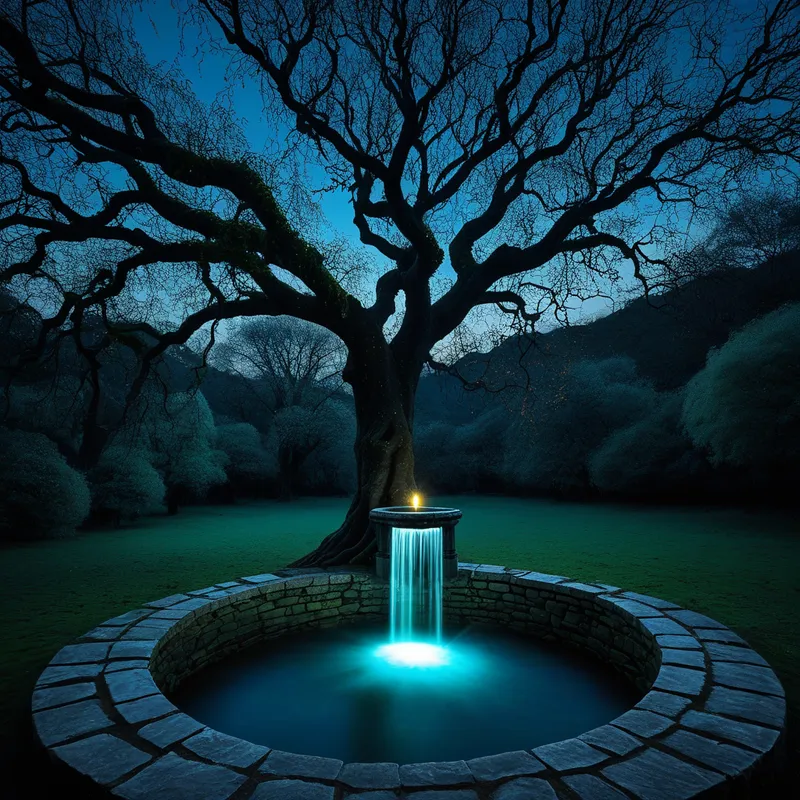
Listen now, and let the firelight carve shadows of the old world upon the walls of your mind. In the mist-shrouded heart of the Sídhe, where time flows like honey and memory is a living thing, there lies a place of profound silence. This is the Well of Segais.
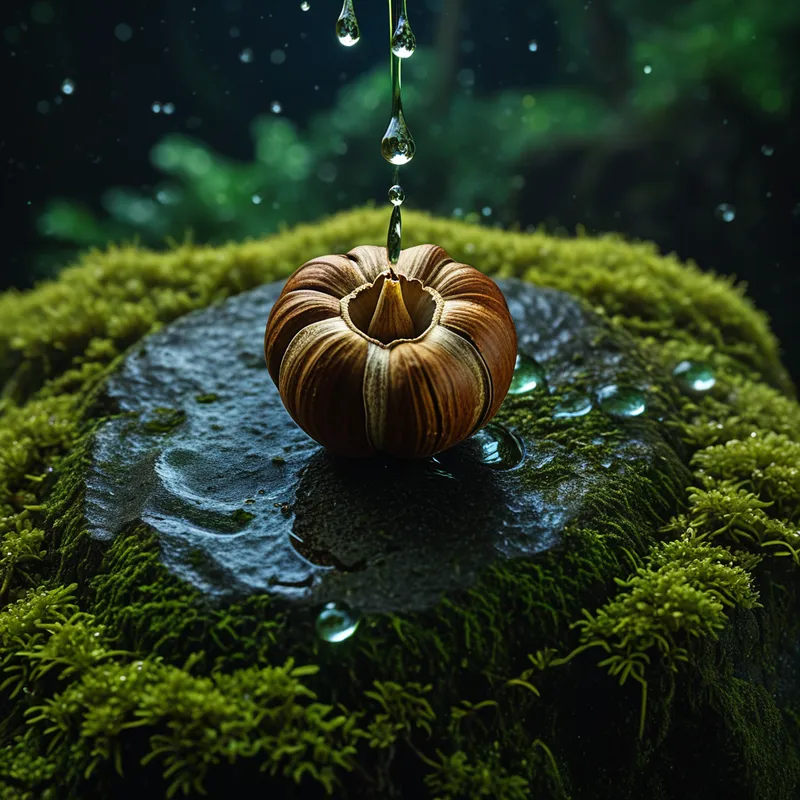
It is not a place for mortal feet. The earth around it is dark and rich, and from its stone lip, water of such clarity and potency bubbles forth that it is less a liquid and more a condensed form of wisdom itself. Guarding this source are nine hazel trees of perfect beauty. They are the Filidh of the plant world. In autumn, they do not drop simple nuts. They let fall purple hazelnuts, each one imbued with imbas, the all-encompassing knowledge that sparks true poetry and prophecy. The nuts fall into the water with a soft plink, and the salmon that dwell in the well’s depths swim to consume them. With each nut eaten, bright spots of wisdom appear on their silver sides.
This well is under the fierce and jealous guardianship of Boann. She is its sovereign, and the law is absolute: none may approach its waters, none may taste its wisdom, without her sacred consent. To do so is to invite a cataclysm.
Yet, the heart yearns for what is forbidden. The great god the Dagda desired this wisdom. Perhaps he sought it for the good of his people, the Tuatha Dé Danann; perhaps a god’s curiosity is a force as unstoppable as a tide. He came to the well in secrecy, when the light was low and the guardian’s attention was turned. He saw the luminous water, heard the soft fall of the nuts, watched the spotted salmon glide.
He reached. He took. The moment his hand, or perhaps a vessel, breached the sacred surface, the stillness shattered. The well did not merely overflow; it erupted. A torrent of water and wisdom burst from its confines, a roaring, churning flood of impossible knowledge breaking its banks. It carved a path through the land with furious purpose, becoming the mighty Boyne. Boann, rushing to the source of the tumult, was caught in the furious current and swept along its course, her body becoming one with the river that now bore her name. The well was emptied, its secret spilled across the earth for all to see, yet forever diluted in its flowing, mortal form.
Cultural Origins & Context
This myth is preserved primarily within the medieval Irish textual tradition, most notably in the Dindsenchas (the "Lore of Places"), which poetically explains the origins of Ireland’s place names. It is a myth deeply rooted in the landscape itself—a story told to explain why the River Boyne exists and why it holds such cultural significance. The river was associated with sovereignty, wisdom, and the aos sí.
The tellers were the Filidh, the poet-seers who underwent rigorous training to access states of inspired knowledge, or imbas. For them, the myth was not mere folklore; it was a map of their own vocation. The well represented the source of all poetic inspiration, a dangerous and divine fount that could overwhelm the unprepared. The story served as a warning about the sacred responsibility of the poet and the transformative, often destructive, power of true wisdom when it moves from the hidden, structured realm of the divine into the chaotic, flowing world of manifestation.
Symbolic Architecture
At its core, the Well of Segais is an image of the unconscious psyche in its primordial, undifferentiated state. It is the prima materia of the soul—pure, potent, and self-contained.
The well is the unconscious mind; the nine hazel trees are the structures of consciousness that filter raw archetypal energy into digestible forms of insight.
The hazelnuts symbolize these crystallized insights—nuggets of profound truth (imbas) that fall from the cognitive structures (the trees) into the emotional and intuitive waters below. The salmon, a creature famed in Celtic lore for its wisdom, represents the deep, instinctual self that integrates this knowledge, marked by it forever. Boann, the guardian goddess, is the psychic censor or the protective persona that maintains the boundary between the conscious ego and the overwhelming depths of the unconscious. Her role is not evil but necessary; she maintains the integrity of the self.
The Dagda’s transgression is the heroic, or perhaps foolish, act of the ego seeking direct access to this core wisdom. It is the desire for enlightenment, for genius, for a truth so complete it shatters one’s previous reality. The catastrophic flood is the inevitable result: a psychic breakdown, a creative explosion, a spiritual awakening that forever alters the landscape of the self. The once-contained, private wisdom becomes a public, flowing identity—the River Boyne, which is both a blessing (fertile land, navigable waters) and a reminder of the lost, concentrated source.

The Dreamer's Resonance
When this myth stirs in the modern dreamer, it often manifests as dreams of forbidden sources: a secret room in one’s house containing a radiant pool, a locked garden with a magical fountain, or a computer file or book one is not supposed to open. The somatic feeling is one of intense magnetic pull mixed with dread. There is a sense that accessing this "thing" will change everything, possibly destroy a current life structure.
Psychologically, this dream pattern signals a critical pressure point in the individuation process. The dreamer is on the cusp of a major insight or a necessary disintegration of an old self-image. The guardian (Boann) in the dream may appear as a strict authority figure, a parent, a boss, or even one’s own critical inner voice warning of danger. To dream of drinking from such a source and causing a flood indicates the psyche is undergoing a necessary, if traumatic, release of repressed knowledge or emotion—a creative or spiritual breakthrough that feels both destructive and liberating.

Alchemical Translation
The myth of Segais is a perfect allegory for the alchemical solve et coagula—dissolve and coagulate. The well is the sealed vas hermeticum where the great work begins. The ego (the Dagda), driven by a holy curiosity, performs the forbidden act that breaks the seal.
The flood is the nigredo, the blackening—the chaotic, overwhelming dissolution of all former certainties. The old structures of the psyche are washed away in a torrent of raw, undigested truth.
This is not the end, but the essential beginning. Boann’s transformation is key. She does not die; she becomes the river. The rigid guardian of the secret is transmuted into the flowing vehicle for that same secret. This is the albedo, the whitening, where the dissolved elements begin to find a new, dynamic form. The concentrated, static wisdom of the well becomes the flowing, life-giving wisdom of the river.
For the modern individual, this models the journey from possessing a rigid, hidden truth (a talent kept dormant, a trauma buried, a spiritual belief held in secret fear) to embodying a flowing, expressed truth. It is the process where one’s genius, once a terrifying and guarded potential, breaks its banks and becomes one’s life’s work, one’s identity in the world. The cost is the loss of the old, safe container. The reward is the birth of a new landscape, fertile and wide, where what was once a forbidden secret now nourishes every step of the journey. The salmon, now swimming in a great river instead of a deep well, remains spotted with wisdom—a reminder that the source, though transformed, is always within.
Associated Symbols
Explore related symbols from the CaleaDream lexicon: