
Dagda Myth Meaning & Symbolism
The tale of the Good God, whose cauldron never empties, whose club gives and takes life, and whose harp commands the seasons of the heart.
The Tale of Dagda
Listen now, by the fire’s glow, to the story of the Good God. In the time of the Tuatha Dé Danann, when the world was raw and magic bled from the hills, there walked a father. He was not a slender, distant king of the sky, but a vast, earthy presence. His name was the Dagda.
He carried the weight of the tribe in his broad shoulders and in the great swell of his belly. In his hands, he bore the tools of his nature: a club so massive it took eight men to lift, yet he wielded it with one. One end could slay nine men with a single blow; the other could restore them to life with a touch. On his back, he carried the Coire Ansic, the Undry Cauldron, from which no company ever went away unsatisfied. And from his belt hung the Uaithne, the oak harp whose music commanded the very order of the world—the laughter of spring, the sorrow of autumn, the sleep of winter, the passion of summer.
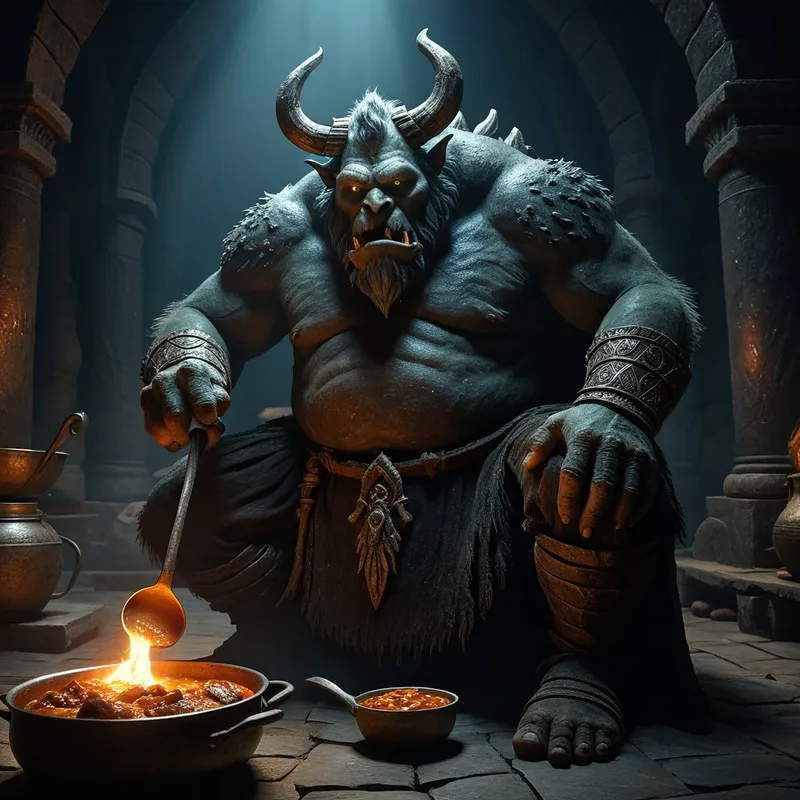
Yet a shadow fell upon the land. The monstrous Fomorians, led by the cruel Bres, had claimed the kingship and laid a heavy tribute upon the Tuatha Dé. As the great war of Mag Tuired drew near, the Dagda was sent as an emissary to the Fomorian camp to delay them. They mocked his simple tunic, which barely covered his mighty frame, and sought to humiliate him. They challenged him to a test of gluttony, digging a pit as deep as a man is tall and filling it with eighty gallons of milk, meal, fat, and goats, sheep, and pigs—a vile, congealed stew.
The Dagda took up the ladle, a spoon so large its bowl could hold a man and a woman. And he ate. He ate until he scraped the bottom of the pit, his vast belly swelling like a cauldron itself. Then, heavy with the grotesque meal, he lumbered to his bed with a Fomorian maiden, fulfilling another part of the demand placed upon him. In his seeming clumsiness and appetite, he played the fool, but he was buying precious time for his people.
When the battle horns finally sounded at Mag Tuired, the Dagda was no longer the bloated buffoon. He was the All-Father, the protector. He fought with terrible might, his great club hewing down the Fomorian ranks. But the battle was fierce, and the tide turned against the Tuatha Dé. In that moment of despair, the Dagda called for his harp. It had been stolen away, hidden in the feasting hall of the enemy. He found it there, silent on the wall. He sang to it, and it leaped into his hands. He played three strains.
The first was Goltraí, the strain of weeping. Every Fomorian warrior dropped their weapon and wept until their cheeks were wet with salt. The second was Geantraí, the strain of smile. They laughed until their strength left them, collapsing in helpless mirth. The third was Suantraí, the strain of slumber. A deep, enchanted sleep fell upon the host. And while they slept, the Tuatha Dé Danann drove them forever from the land. The Dagda, with his harp, had not won by force alone, but by mastering the very rhythms of the soul.
Cultural Origins & Context
The figure of the Dagda emerges from the rich, pre-Christian oral traditions of Ireland, preserved by the filid, the poet-seers who were the keepers of history, law, and sacred story. These narratives were later compiled by Christian monks in manuscripts like the Lebor na hUidre and the Lebor Laignech. The Dagda is a central pillar of the Mythological Cycle, specifically the saga of the Cath Maige Tuired.
He is not a distant Olympian but a god deeply embedded in the concerns of a tribal, pastoral society. His attributes—the cauldron of plenty, the club of life and death, the harp of order—are not abstract symbols but reflections of essential survival: food, security, and the social/seasonal harmony necessary for community prosperity. He is the "Good God" (Eochaid Ollathair), a title denoting not moral perfection but effective, beneficent function. He is the tribal father, responsible for the fertility of the land and the protection of the people, a divine chieftain whose power is measured by his capacity to provide and preserve.
Symbolic Architecture
The Dagda is the archetype of integrated, sovereign power. He embodies a wholeness that modern consciousness often splits apart. His club represents the dual nature of authority: the capacity for decisive, even destructive action (the death-dealing end) and the profound responsibility of restoration and healing (the life-giving end). True power holds both.
The cauldron is the womb of the world, the promise that reality itself is founded on abundance, not scarcity. To approach the Dagda is to trust that there is enough.
His infamous feast at the Fomorian camp is a masterclass in the strategy of the deep self. He willingly enters into a state of apparent degradation, consuming the "shadow" substance of the enemy (the vile stew). This is not a failure of will but a profound act of containment. He takes in the chaos, the gluttony, the oppression, and metabolizes it within his own vast being. He does not reject the dark task but transforms it through acceptance, turning humiliation into a tactical victory. His harp, Uaithne, symbolizes the ordering principle of consciousness—the music that calls raw emotion (weeping, laughter, sleep) into a harmonious sequence, creating the rhythm within which life and culture can flourish.
The Dreamer's Resonance
When the pattern of the Dagda stirs in the modern psyche, it often manifests in dreams of overwhelming burdens or seemingly crude solutions. You may dream of being forced to eat a repulsive yet mandatory meal, signifying a psychological "geis" or obligation you must digest—a toxic job, a draining relationship, a personal flaw you can no longer avoid. The somatic feeling is one of bloated, sluggish heaviness.
Alternatively, you might dream of a simple, humble object—a bowl, a stick, a crude instrument—that holds miraculous, life-affirming power. This is the call of the integrated Self beneath the persona. The dream ego may feel foolish or oversized, like the Dagda in his short tunic, yet this very "ungainliness" is a sign of authentic power breaking through civilized pretensions. The psyche is preparing you to pick up your own "club"—to make a decision that feels brutal but is necessary for life, or to apply a healing touch where you thought only force was needed.

Alchemical Translation
The Dagda’s journey is a map for the alchemical process of individuation—becoming the integrated, sovereign ruler of one’s own inner kingdom. The first stage is the nigredo, the blackening. This is the Fomorian feast: the conscious ego willingly descends into and consumes its own shadow material—the repressed appetites, the shame, the accepted burdens. One must become "bloated" with self-knowledge, however unappealing.
The transmutation begins not by rejecting the base matter, but by containing it within the vessel of a broader consciousness—the Dagda’s great belly, which is also his cauldron.
The second stage is the reclaiming of one’s innate music. The stolen harp is the soul’s unique ordering principle, lost to the complexes and pressures of life (the inner Fomorians). The modern seeker must enter the "feasting hall" of their own psyche—where trauma or conditioning holds sway—and call their power back by name. Playing the three strains is the act of integrating emotion: allowing deep grief (Goltraí), then authentic joy (Geantraí), and finally finding restorative peace (Suantraí). This sequenced mastery of inner states is what finally banishes the chaotic, oppressive forces.
The result is not a sterile perfection, but a grounded, abundant sovereignty. The individuated Self, like the Dagda, is a caregiver to its own realm—nourishing with the cauldron, protecting and healing with the club, and bringing the disparate seasons of the soul into a harmonious, life-sustaining song.
Associated Symbols
Explore related symbols from the CaleaDream lexicon: