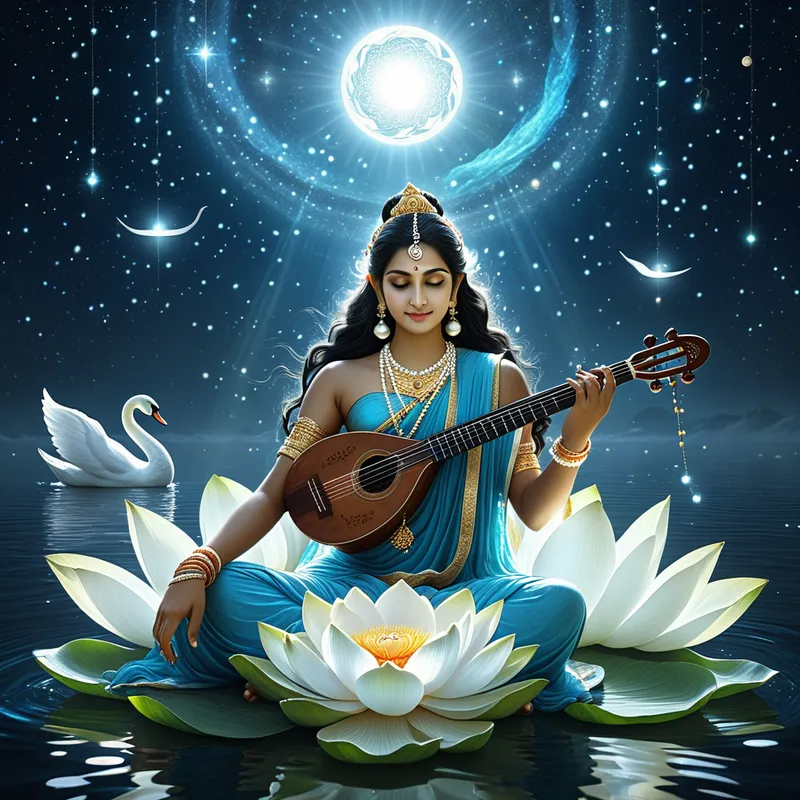
Vina of Saraswati Myth Meaning & Symbolism
The myth of the divine Vina, crafted from the cosmos and gifted to Saraswati, embodies the sacred resonance that harmonizes knowledge, art, and the soul's deepest truth.
The Tale of Vina of Saraswati
In the time before time, when the universe was a single, silent note held in the breath of the Absolute, there was a longing. It was the longing of consciousness to know itself, not as a silent witness, but as a song. From this longing, the first triad of manifest divinity arose: Brahma, the progenitor of form; Vishnu, the sustainer of life; and Shiva, the lord of dissolution and rhythm.
Yet, the worlds Brahma spun from his thoughts were beautiful but mute. The laws Vishnu upheld were just but silent. A profound stillness lay over creation, a stillness not of peace, but of potential unexpressed. The cosmos was a magnificent library with no one to read its texts, a vast canvas with no hand to paint its stories. The gods themselves felt a hollow echo in their splendor.
Then, from the gathered essence of all that is pure, clear, and flowing—from the clarity of a mountain stream, the wisdom of an ancient text, the grace of a white swan gliding—she manifested. Saraswati. She was not born; she emerged, fully formed, as the embodiment of Shabda-Brahman, the Absolute as Sound. Dressed in radiant white, seated upon a lotus, she held the scriptures, but her hands were empty of the instrument to give them voice. Her very presence was a melody waiting for its instrument, a wisdom yearning for its song.
Seeing the silent yearning in his creation and in the goddess who was its voice, Brahma was moved. He turned to Vishnu, the great preserver. "Brother," he said, his voice like the rustle of cosmic pages, "we have given the world form and order. She has given it meaning and knowledge. But where is the bridge between the two? Where is the vessel that carries meaning into the heart?"
Vishnu, resting on the coils of the serpent Ananta Shesha in the milky ocean, understood. With a smile, he reached into the fabric of reality itself. From the substance of the earth, he drew the firmness for the body. From the flexibility of water, he shaped the graceful, curving neck. From the heat of fire, he tempered the strings. From the movement of air, he granted the capacity for vibration. And from the space of ether, he hollowed the resonating chamber.
Together, the creator and the preserver fashioned the first Vina. It was not merely an instrument; it was a microcosm, a map of existence. Its two gourds represented the sun and the moon, the dualities of existence. Its twenty-four frets symbolized the rhythms of time. Its seven strings were the seven levels of consciousness, from the earthly to the divine.
They presented it to Saraswati. As her fingers, which had turned the pages of eternal knowledge, first touched the strings, the universe shuddered. Not in destruction, but in recognition. The first note sounded—a pure Om that rippled through the silent realms. It was the sound of consciousness awakening to its own beauty. With that touch, knowledge became music, wisdom became melody, and law became rhythm. The silent library of creation was filled with a symphony of meaning. The Vina had found its player, and the player had found her voice. The cosmos was no longer mute; it was a conversation, a hymn, a story being sung into eternity.

Cultural Origins & Context
The myth of Saraswati and her Vina is woven deeply into the Vedic and post-Vedic tapestry of Hindu thought. While Saraswati originates as a mighty river goddess in the Rig Veda, her evolution into the goddess of Vak (speech) and eventually all knowledge and arts is central to this narrative. The Vina itself, as a specific instrument, finds detailed mention in later texts like the Natya Shastra.
This story was not confined to a single scripture but was carried through the oral tradition of storytellers, temple priests, and especially the gurus of music. In the gurukula, the student's first lesson often began with the invocation of Saraswati and the reverence for the Vina as her divine form. The myth served a critical societal function: it sacralized the pursuit of knowledge and art. It taught that true learning (vidya) was not mere intellectual accumulation but a devotional act, a tuning of the individual soul (jivatma) to the cosmic resonance (nada). The musician, the scholar, the artist—all were seen as engaging in a sacred ritual, channeling the harmony Saraswati embodies.
Symbolic Architecture
The Vina of Saraswati is a profound symbol of integrated consciousness. It represents the necessary instrument that translates pure, abstract potential into manifested, harmonious expression.
The unplayed Vina is latent wisdom; the strummed Vina is wisdom enacted. The silence between notes is as sacred as the notes themselves, holding the potential of all sound.
Its physical structure is a symbolic map. The two resonating gourds symbolize the dualistic world we navigate—sun and moon, male and female, matter and spirit, intellect and emotion. The single neck that connects them is the path of consciousness, the individual's focused awareness that bridges these opposites. The strings, typically seven, represent the seven levels of existence or consciousness, from the gross physical to the subtlest spiritual, all of which must be in tune for perfect harmony. Saraswati herself, as the player, is the unifying principle, the divine intelligence that knows exactly where to press (apply discipline) and where to pluck (release creativity) to produce a melody that is both true and beautiful.
Psychologically, the myth speaks to the integration of the psyche. The "silent creation" is the state of a person with vast inner resources—ideas, feelings, memories—that remain disconnected and unexpressed, leading to a sense of sterility or emptiness. Brahma and Vishnu represent the archetypal forces of our own capacity to shape (ego) and sustain (the Self) our identity. The crafting of the Vina is the conscious, often arduous, process of building a structure—a practice, a discipline, a medium—through which our inner chaos can be organized. Saraswati's touch is the moment of inspiration, where discipline and creativity marry, and the soul's unique note joins the cosmic symphony.
The Dreamer's Resonance
When this myth pattern stirs in the modern unconscious, it often manifests in dreams of searching for a lost instrument, hearing a beautiful but distant melody one cannot locate, or finding a strange, intricate object that feels profoundly meaningful but whose function is unknown. Somatic sensations might include a tightness in the throat (unexpressed voice) or a humming vibration in the chest.
Such dreams signal a psychological process of seeking one's authentic medium of expression. The dreamer may be intellectually full—saturated with information, theories, or unprocessed experiences—but artistically or emotionally mute. The dream Vina is the psyche's symbol for the missing "technology of the soul," the personal method or practice needed to translate inner complexity into coherent outer form. It is a call from the Self to move beyond accumulation to creation, to find the unique frequency at which one's knowledge, talent, and life experience can resonate as a gift to the world.

Alchemical Translation
The alchemical process modeled here is the transmutation of information into wisdom, and further, into beauty—the creation of the Philosopher's Stone not as gold, but as a harmonious life.
The initial state is nigredo, the silent, dark, undifferentiated mass of potential (the mute creation). The collaborative work of Brahma and Vishnu is the albedo, the laborious whitening or purification: gathering one's raw materials (experiences, skills), applying discipline (fire), and structuring them with care (water and earth) into a viable vessel—a career path, an artistic practice, a philosophical outlook. This is the building of the vas, the sacred vessel.
The final act is not creation by the ego, but surrender to the inspiration that comes from the deeper Self. The instrument must be given to the goddess within.
Saraswati's arrival and her act of playing represent the rubedo, the reddening, the culmination. This is the moment of inspired flow, where the ego's labor is taken up by a greater force. For the individual, it is the experience of "individuation in action": one's unique composition of traits and experiences becomes a coherent, resonant whole. The music that results is not for personal glory but is an offering that brings harmony to one's immediate environment and, symbolically, to the cosmos. The struggle is the crafting of the instrument; the triumph is the willingness to become a clear channel for the music that wishes to be played through you. The Vina teaches that true creation is always a collaboration between human effort and divine grace.
Associated Symbols
Explore related symbols from the CaleaDream lexicon: