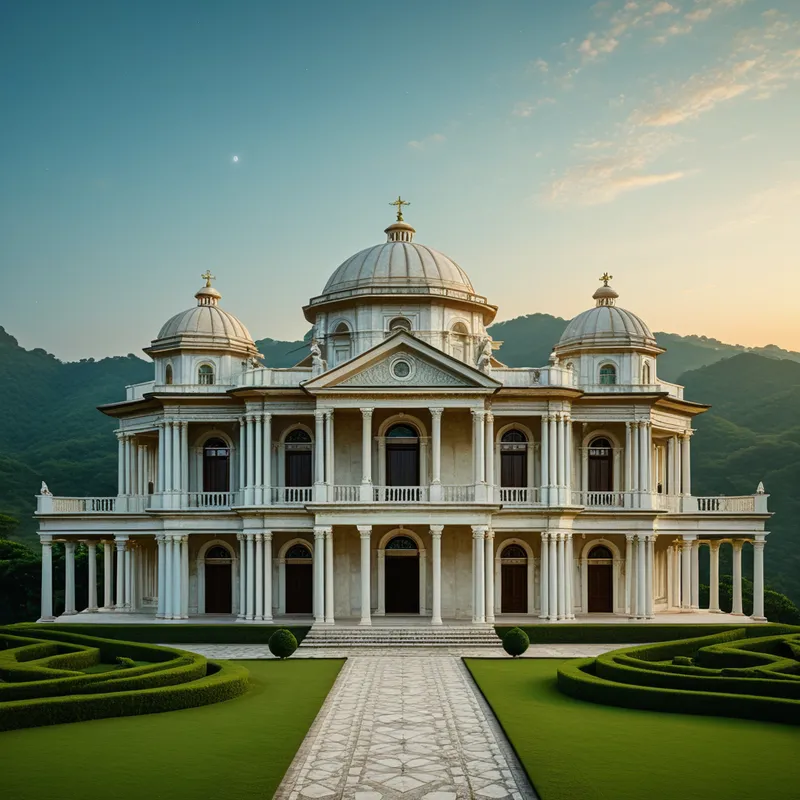
Villa Rotonda Myth Meaning & Symbolism
A myth of a divine architect who, guided by celestial harmony, built a perfect villa to bridge the human world with the cosmic order of the heavens.
The Tale of Villa Rotonda
Listen, and hear the tale not of a king or a warrior, but of an architect. In an age when the world was shaking off a long slumber, there lived a man named Andrea. He was not born of royal blood, but of line and measure. His mind was a crucible where the whispers of ancient sages met the restless spirit of a new dawn.
Andrea walked the earth with his eyes turned upward, not in prayer, but in a fierce, silent conversation with the sky. He saw in the sweep of a hill, the curve of a river, and the arch of a branch not chaos, but a hidden grammar—a divine syntax waiting to be spoken in stone. The conflict was within him: a tormenting vision of perfect harmony, a form so lucid and complete it hovered just behind his eyelids, yet the world of clay and compromise, of patrons and budgets, refused to hold its shape.
Then came the vision. It was not in a dream, but in the stark clarity of a spring noon. Standing on a low hill, he watched the sun trace its path. He saw the four winds gather, not to clash, but to dance a quadrille around the summit. He felt the hill itself, this gentle rise from the Venetian plain, as the navel of a quieter world. Here, the conflict resolved. The celestial order would not be painted on a ceiling; it would be lived in.
He took up his compass, a tool as sacred as any relic. The conflict became action. The rising action was the birth of the villa from the hill. He commanded the digging of foundations that squared perfectly with the four pillars of the world: North, South, East, West. From this square, he raised a circle—a majestic dome, not to enclose a god, but to model the very vault of heaven. On each face of the square, he opened a portico, a mouth offering a different song of the landscape: the slow river to the north, the cypress road to the south, the rising sun to the east, the setting sun to the west.
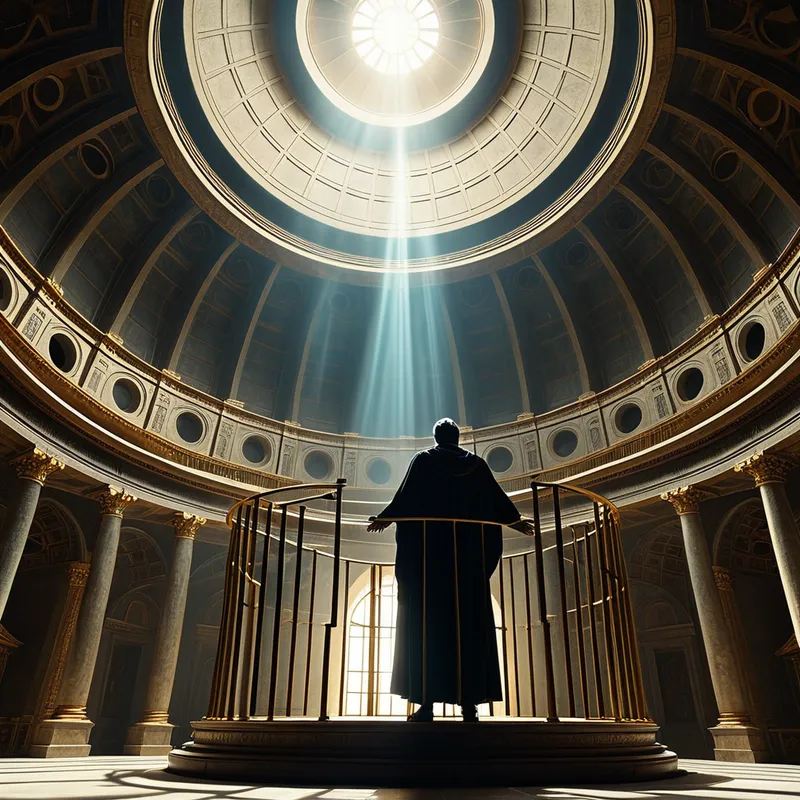
The air grew thick with the scent of cut stone and damp plaster. The sound was not of battle, but of chisels finding rhythm and masons chanting as they laid each block. The central hall, beneath the oculus, became a sundial and a moondial, a chamber where time itself was measured in light and shadow. Statues of gods and muses took their places not as idols, but as notes in a spatial symphony.
The resolution was not a battle won, but a silence achieved. When the last scaffold fell, Andrea stood in the center. The morning light entered from the east portico, traveled across the patterned floor, and at the precise zenith, a beam from the oculus pierced the heart of the building, illuminating the geometric center of the world he had made. The villa did not conquer the hill; it revealed the hill’s true purpose. It was not a shelter from nature, but a lens through which nature—earth, sky, light, wind—was understood, welcomed, and given perfect form. The architect had built a hymn, and the world sang back in harmony.
Cultural Origins & Context
This is the myth of Villa Rotonda, born not from an oral folk tradition, but from the deliberate, revolutionary ethos of the Renaissance. Its tellers were humanist scholars, artists, and the architects themselves—men like Leon Battista Alberti, who wrote the scripture for this new faith in his De re aedificatoria, and of course, Andrea Palladio, whose designs became its gospel.
The myth was passed down through meticulously illustrated treatises and traveling draftsmen. Its societal function was profound: it was a manifesto. In a society emerging from a medieval worldview that often saw the earthly realm as a mere shadow or a vale of tears, the Villa Rotonda myth proposed a radical alternative. It asserted that through reason, geometry, and a deep study of classical antiquity, humanity could actively participate in the cosmic order. The villa was a microcosm, a small, perfect world that mirrored the macrocosm of the universe. It served to legitimize and inspire a new class of creative intellectuals—the architect as philosopher-priest—and to provide a tangible ideal for the enlightened patron: a life of balanced contemplation, civic virtue, and harmonious existence with the natural world.
Symbolic Architecture
At its core, the myth of Villa Rotonda is a blueprint for the psyche seeking its own center and order. The villa itself is the Self made manifest in architecture.
The Square represents the earthly, the material, the fourfold structure of reality (the four elements, seasons, directions, functions of consciousness). It is the defined, the stable, the human domain. The Circle and its Dome symbolize the celestial, the eternal, the spirit, and the encompassing unity. The synthesis of square and circle is the squaring of the circle, the alchemical conjunctio oppositorum—the marriage of heaven and earth, matter and spirit, within the human soul.
The true temple is not where one goes to find the divine, but where one builds a dwelling so perfectly ordered that the divine cannot help but reside within it.
The four identical porticos facing the cardinal directions signify the psyche’s capacity for balanced perception. It is the ability to meet every aspect of life—every "wind" of fortune, challenge, inspiration, and decline—with the same composed, welcoming intelligence. There is no "front" or "back"; the Self is oriented to all possibilities equally. The central oculus, or eye, opening the dome to the sky, represents the consciousness illuminated from above—the point where transcendent awareness pours into the structured human vessel.
The Dreamer's Resonance
When this myth stirs in the modern unconscious, it often manifests in dreams of searching for or building a perfect, serene space. One might dream of a house with too many rooms finally revealing a central, round hall of stunning calm. Or of trying to align objects in a room to catch a specific beam of light.
Somatically, this can correlate with a felt sense of disorientation or "scatter" seeking consolidation. Psychologically, these dreams signal a process of centering. The dream-ego is undertaking the labor of the mythic architect: surveying the landscape of their life (the hill), confronting the chaos of conflicting demands and identities (the unformed vision), and striving to impose an inner order. The dream is the psyche’s blueprint phase. The anxiety in such dreams is the fear that the parts will not cohere, that the center will not hold. The profound relief, when it comes, is the somatic experience of psychic alignment—a deep, calming breath felt in the very core of the body, as if one has finally come home to a house the soul itself designed.
Alchemical Translation
The individuation process modeled by Villa Rotonda is one of geometrization of the soul. It is not a fiery, dramatic battle with dragons, but a meticulous, patient work of precision and alignment.
The prima materia, the raw stuff, is the undifferentiated self—the hill with potential, the vague yearning for harmony. The first stage (nigredo) is the architect’s torment, the confusion of the unmanifest ideal. The separatio is the act of choosing the site and the plan, defining the square of one’s earthly commitments and boundaries. The coniunctio is the raising of the dome—the moment when one’s spiritual aspiration (the circle) is successfully integrated with one’s lived reality (the square), creating a sacred interior space.
Individuation is the architecture of the soul: a lifelong project of building a dwelling so authentic that every room faces a true direction, and the light at the center is your own.
The final stage, the rubedo or reddening, is the perpetual sunrise and sunset streaming through the porticos. It is the lived experience of the integrated Self. The individual becomes a vessel through which the cycles of life—joy and grief, activity and rest, engagement and solitude—flow without causing collapse, because they are all held within a stable, beautiful, and conscious structure. The modern seeker, in their own "Renaissance," is tasked not with finding a pre-built temple, but with becoming the architect, the mason, and the dweller of their own Villa Rotonda. The goal is to build a psyche that is, in itself, a bridge between the human and the cosmic—a place of perfect, resonant stillness at the center of the turning world.
Associated Symbols
Explore related symbols from the CaleaDream lexicon: