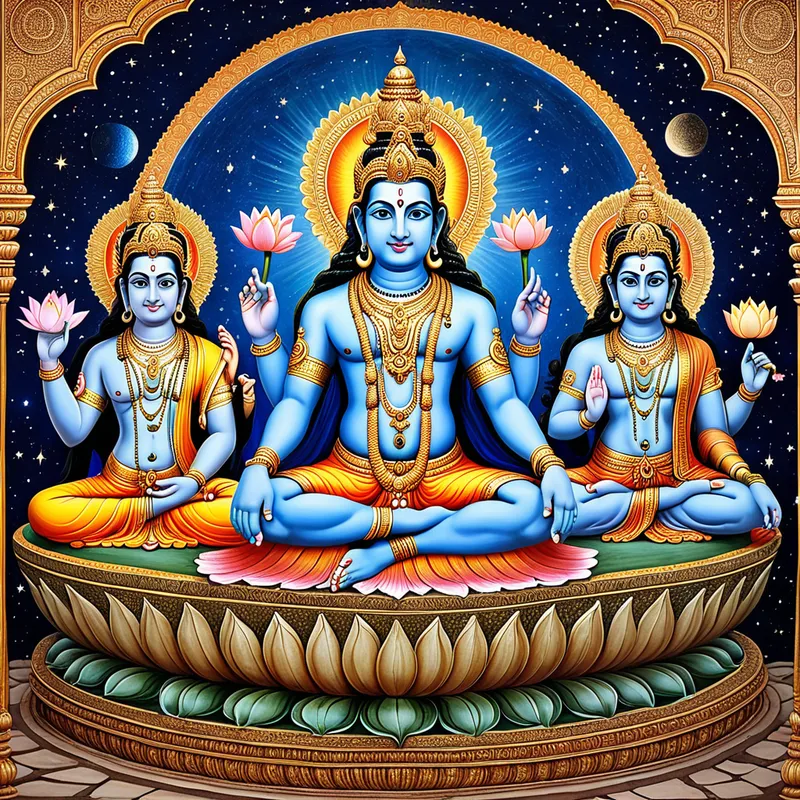
Trimurti Myth Meaning & Symbolism
The eternal cosmic rhythm of creation, preservation, and dissolution personified as the divine triad of Brahma, Vishnu, and Shiva.
The Tale of Trimurti
In the beginning, before time had a name, there was only the boundless, silent ocean of potential. No sun, no moon, no stars to cast a shadow. Only the deep, dark, infinite waters, cradling within their depths the unmanifest seed of all that ever was and ever could be. This was the Pralaya, the great dissolution, a sleep so profound it was indistinguishable from death.
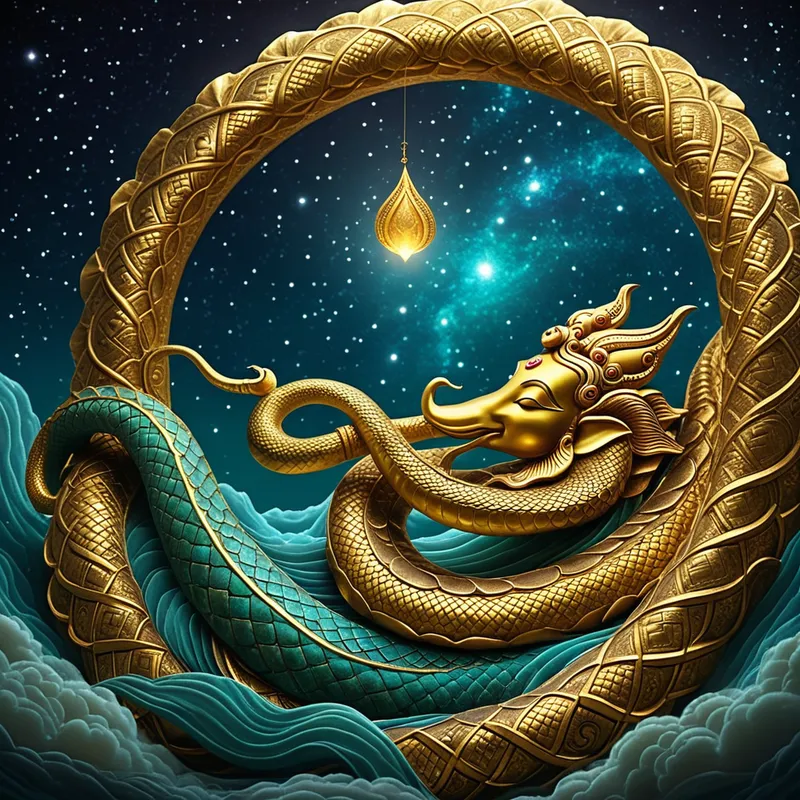
Upon this dark ocean, the great serpent Ananta Shesha floated, its thousand hoods forming a celestial canopy. And upon its coils, as if in a dream within a dream, lay Vishnu. He was the deep blue of twilight sky, clad in golden silk, in the posture of divine repose. The universe was his dream.
From the stillness of his meditation, a sound began—a vibration so subtle it was felt more than heard. It was the primordial Om. As it resonated through the void, a change stirred in the dreamer. From the navel of Vishnu, a stem of light emerged, piercing the dark waters. It grew, reaching upward into the nothingness, and from its apex blossomed a lotus of a thousand radiant petals. The light was not of sun or fire, but the pure light of consciousness itself.
Within that luminous chalice sat Brahma. With four faces, he gazed upon the four directions, seeing all possibilities at once. In his four hands, he held the tools of manifestation: the scriptures of knowledge, the rosary of time, the water pot of life, and the lotus from which he was born. His breath was the wind. His thoughts became the laws. From the petals of his lotus-throne, he began to weave the tapestry of existence—the shimmering realms of the gods, the solid earth, the rushing rivers, the teeming life in countless forms. He sang the world into being, note by note, a symphony of names and forms.
But a symphony requires rhythm, and a tapestry, tension. As Brahma’s creation flourished, it began to solidify, to grow heavy with habit, clogged with old forms, weary with the weight of its own existence. The vibrant dance threatened to become a stagnant statue. It was then that the third presence made itself known, not from a lotus, but from the very fabric of the unfolding dream.
He was Shiva, the great ascetic. Smeared with the ash of burnt universes, his hair a wild torrent from which the sacred river Ganga descended, he danced. This was the Tandava, the dance of furious bliss. With one hand he beat the drum of time’s relentless march, with another he held the flame of ultimate dissolution. Where his feet stamped, old worlds crumbled to dust. Where his hands gestured, space itself tore and reformed. He was the storm that clears the air, the forest fire that makes way for new growth, the moment of breakdown that precedes breakthrough. He did not destroy out of malice, but out of necessity—to make space for Brahma’s next breath of creation, to return form back to the formless potential from which it came.
And through it all, Vishnu slept and dreamed, his sleep the foundation, his dream the ever-turning wheel. Brahma built. Shiva broke. And Vishnu, in the space between his in-breath and out-breath, sustained. This was not a sequence, but a simultaneous, eternal act. The creator, the preserver, the destroyer—three faces of one boundless reality, locked in an endless, sacred cycle upon the dark waters of the unmanifest.
Cultural Origins & Context
The concept of the Trimurti crystallized in the early centuries of the Common Era, finding its most prominent expression in the Puranas. These were not dry theological tracts, but living, breathing compendiums of myth, genealogy, and cosmology, recited by storytellers and priests to village and court audiences alike. The Trimurti provided a powerful philosophical and narrative framework to unify the vast, sometimes seemingly contradictory, pantheon of Vedic and post-Vedic deities into a coherent cosmic model.
It served a profound societal function: to explain the nature of reality itself. In a culture deeply attuned to cycles—the daily cycle of sun and moon, the seasonal cycles of planting and harvest, the human cycles of birth and death—the Trimurti offered a grand, divine mirror. It taught that creation, stability, and dissolution were not chaotic or arbitrary, but intrinsic, sacred phases of one continuous process. This understanding fostered a worldview that could accommodate both immense joy and profound loss, seeing both as part of a divine rhythm far greater than the individual. The myth was passed down not just through scripture, but through temple sculpture, dance, poetry, and daily ritual, embedding the rhythm of the triad into the very heartbeat of cultural life.
Symbolic Architecture
The Trimurti is not merely a story about gods; it is a symbolic map of the fundamental processes that constitute reality, both cosmic and psychological.
The true self is not the created form, nor the preserving pattern, nor the dissolving force, but the silent, dreaming space in which all three arise.
Brahma represents the archetypal impulse of Emanation. He is the psyche’s capacity for ideation, for bringing thought into form. He is every new idea, every project begun, every relationship sparked, every identity constructed. He is the voice that says, “Let there be.” Psychologically, he is associated with the Rajas guna, the quality of activity and passion.
Vishnu symbolizes the principle of Sustenance and Integration. He is the force that maintains, protects, and gives coherence to what has been created. He is the daily routine, the committed relationship, the upheld value, the nurtured talent. He embodies compassion, order, and the preservation of meaning. He operates through the Sattva guna, the quality of balance and luminosity.
Shiva embodies the necessary power of Deconstruction and Transformation. He is the crisis that shatters a stagnant life, the grief that dissolves an old self, the critical thought that breaks a dogmatic belief, the voluntary letting go that makes new growth possible. He is not evil, but the terrifying and liberating force of truth that burns away illusion. He is connected to the Tamas guna, the quality of dissolution and potential.
Together, they form a complete psychic ecosystem. Without Shiva’s dissolution, Brahma’s creations become prisons and Vishnu’s preservation becomes rigidity. Without Vishnu’s sustenance, Brahma’s creations are stillborn and Shiva’s destruction is merely chaos. Without Brahma’s creation, there is nothing to sustain or transform.
The Dreamer's Resonance
When the pattern of the Trimurti stirs in the modern unconscious, it often signals a profound reordering of the dreamer’s psychic structure.
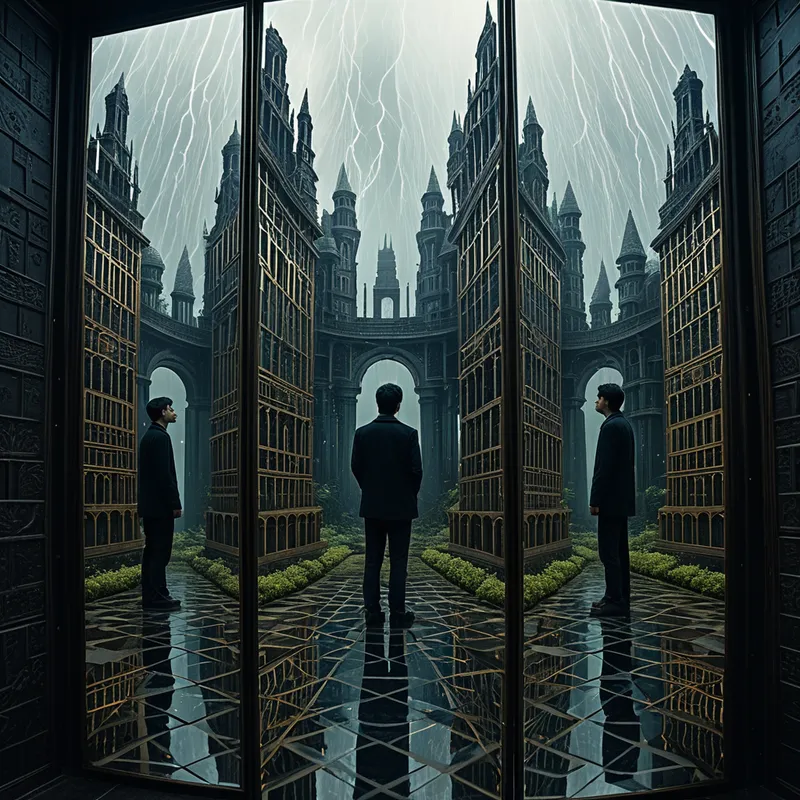
Dreaming of elaborate but collapsing buildings (Brahma’s failing creation) may point to an over-investment in an outdated identity or life project that has become hollow. The psyche is preparing a “Shiva-event.” Dreaming of a calm, blue figure resolving chaos or holding things together (Vishnu) can emerge during periods of overwhelming stress, representing the self’s innate capacity for integrative, compassionate holding. It is the dream-ego accessing the sustainer.
Most powerfully, dreams of voluntary destruction, controlled fires, or dancing figures that break forms into light signal an active, often frightening, but ultimately positive process of psychic death and rebirth. This is Shiva at work in the personal psyche. The somatic experience can be one of acute anxiety (the tremors of dissolution) followed by a strange, deep calm (the return to the Vishnu-like ground). To dream of all three figures, or a single figure with three faces, indicates the dreamer is at a pivotal crossroads, consciously or unconsciously navigating the full cycle of ending, the fertile void, and new beginning simultaneously.
Alchemical Translation
The individuation journey—the process of becoming an integrated, authentic Self—is not a linear path of accumulation, but a cyclical process mirrored precisely by the Trimurti. It is the alchemy of the soul.
The modern individual often begins identified solely with Brahma-Energy: building a career, a persona, a set of accomplishments. This is necessary. But life, in its wisdom, inevitably introduces Shiva-Energy. This is the job loss, the failed relationship, the midlife crisis, the depression—the force that dismantles the carefully constructed edifice. The psychological task here is not to frantically rebuild (re-engage Brahma) or desperately cling (call on Vishnu), but to first surrender to the dissolution. This is the dark night, the Pralaya of the soul.
To become whole, one must first consent to be unmade.
In that surrendered space, if one can endure the silence and the dark waters, the Vishnu-Energy of the deep Self begins to operate. This is not an action, but a presence. It is the compassionate, non-judgmental awareness that holds the pain, the confusion, the emptiness. It is the dreamer who witnesses the dream of breakdown. From this grounded, sustained space of acceptance, a new, more authentic Brahma-Energy can emerge—not from egoic will, but from the Self. This is the new creativity, the genuine calling, the life rebuilt on truer foundations.
Thus, the alchemical work is to internalize the entire triad. To be able to create (Brahma) with passion, to preserve (Vishnu) with compassion and integrity, and to destroy (Shiva) with courage when necessary—letting go of outdated versions of oneself with the same fierce grace as the cosmic dancer. The ultimate goal is to identify not with any one face of the triad, but with the silent, dreaming consciousness—the Vishnu-like ground of being—from which all three phases arise and into which they return, in an endless, sacred dance of becoming.
Associated Symbols
Explore related symbols from the CaleaDream lexicon: