Pralaya Myth Meaning & Symbolism
The great dissolution where the cosmos is withdrawn into the divine dreamer, a necessary end that makes all new beginnings possible.
The Tale of Pralaya
Listen. The great breath is being drawn in.
For eons beyond counting, the universe has danced its furious, beautiful dance. Stars have been born in nebular wombs, planets have spun their tales of life and strife, and gods and demons have played their eternal game upon the stage of Maya. But now, the rhythm slows. The music of the spheres grows faint, a distant echo in an expanding silence.
It begins at the edges of things, in the spaces between thoughts. Time itself, Kala, grows heavy and weary. The fires of suns cool to embers, then to ash. Oceans evaporate into mist, and the mist dissipates into nothingness. Mountains, those patient giants, sigh and settle back into the flat, waiting earth. All forms soften, their edges blurring. The vibrant tapestry of creation—the shrieking of peacocks, the rustle of leaves in the wind, the whispered prayers of sages—fades into a uniform, deep hum.
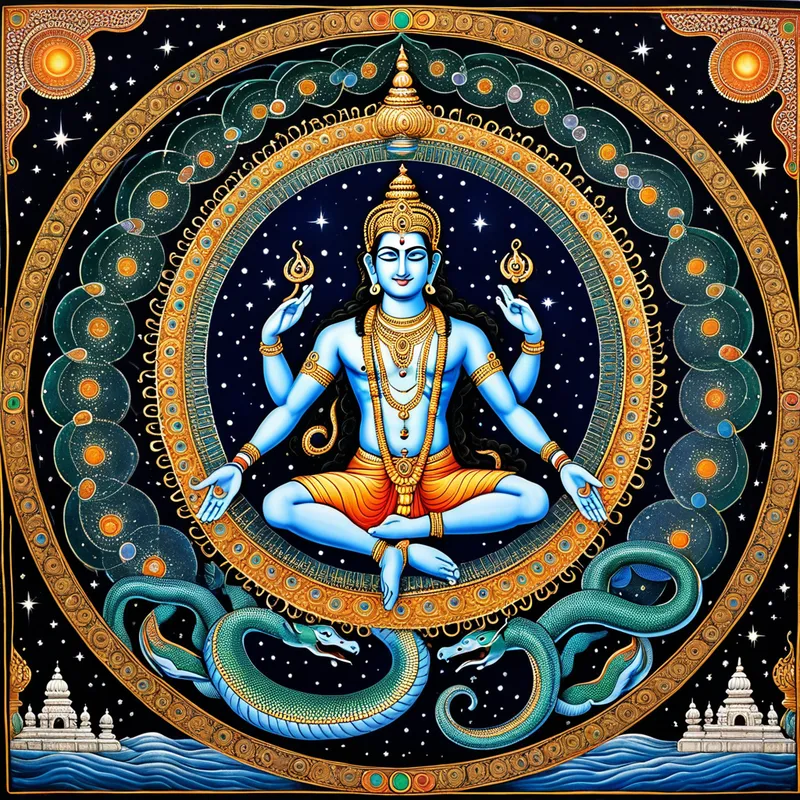
This is the work of Vishnu. Not as the active sustainer, but as the divine dreamer. His great eyes, which have witnessed the rise and fall of countless ages, grow heavy. On the dark, infinite waters of causality, Shesha coils himself into a perfect bed. Upon this living throne of eternity, Vishnu reclines. He is Ananta-Sayana, the one who sleeps on the endless.
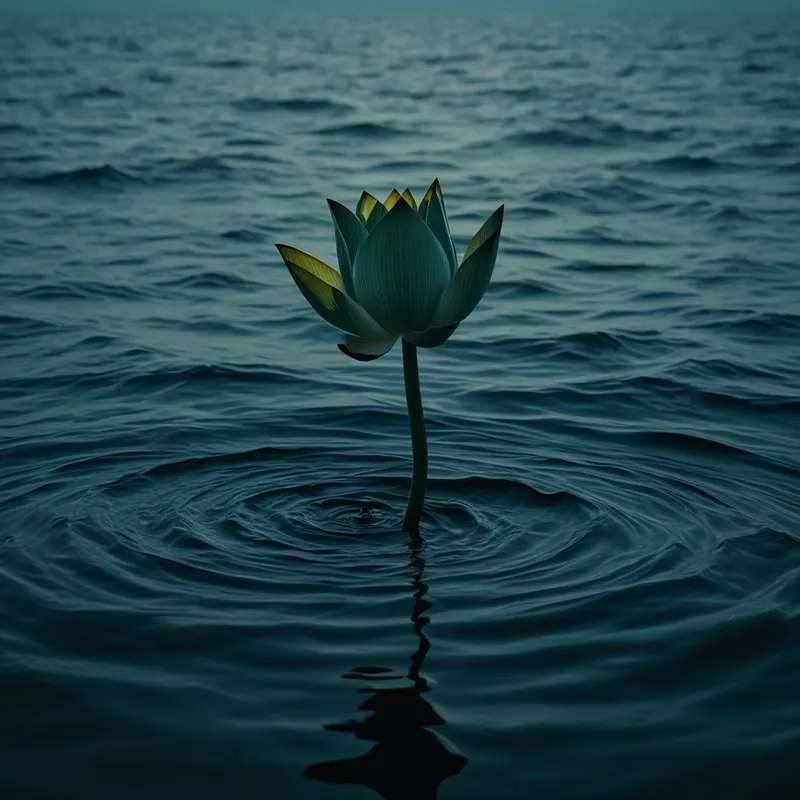
As his consciousness turns inward, the universe follows. The great Maya, his creative power, is withdrawn. It is not destruction, but a profound ingestion. Worlds are not shattered; they are unmade, their essence drawn back like threads into the spool of his being. The Brahma who resides in the lotus born from Vishnu’s navel completes his day of a hundred years, and his form too dissolves. The Shiva performs his final, silent Tandava, not to shake the heavens, but to gather the last vibrations of existence into the stillness of his drum.
All returns to the source. All distinctions melt: light into dark, sound into silence, matter into potential. The cosmos becomes a single, faint idea in the mind of the sleeper. There is only the dark, placid ocean, the Karana Samudra, and upon it, the serene form of the Preserver, dreaming the memory of what was and the possibility of what will be. This is the Night of Brahma. This is Pralaya. A profound, cosmic exhalation held in pause. In that silence, pregnant with all futures, rests the promise. For when the breath is released again, the lotus will bloom, and the dream will begin anew.
Cultural Origins & Context
The concept of Pralaya is not a singular story from one text, but a foundational rhythm woven into the fabric of Hindu cosmology, expressed in the Puranas, the great epics like the Mahabharata, and philosophical treatises. It was passed down by sages (Rishis) who contemplated the nature of time not as linear, but as cyclical—an endless procession of days and nights of the gods. This myth served a crucial societal and psychological function: it provided a cosmic scale for human life.
In a culture that deeply understood impermanence (Anitya), the story of Pralaya was the ultimate reassurance. It framed death, decay, and even societal collapse not as meaningless horrors, but as part of a divine, orderly process. Just as the universe itself undergoes dissolution and renewal, so too do kingdoms, lives, and personal epochs. This perspective fostered a philosophical detachment (Vairagya) and a profound resilience, encouraging individuals to seek what is eternal (Atman) amidst the transient waves of creation and destruction.
Symbolic Architecture
At its heart, Pralaya is the archetype of necessary dissolution. It is the cosmic equivalent of the deep, dreamless sleep that follows a long and exhausting day. Its symbolism dismantles our terror of the void, reframing it as a womb.
The end is not an enemy, but the silent guardian of all potential. Nothing new can be built on a foundation cluttered with the ruins of the old.
The central figure, Ananta-Sayana, symbolizes consciousness in a state of pure, undifferentiated potential. The serpent Shesha, whose name means "remainder," represents what persists—eternity itself, the ground of being. The dark waters are the unmanifest, the causal reality from which all forms arise. Pralaya, therefore, is not annihilation, but the return of the manifested (Nama-Rupa) to the unmanifest source. Psychologically, it represents the complete withdrawal of psychic energy from the outer world and the persona, back into the unconscious, where all contents are broken down to their essential elements.
The Dreamer's Resonance
When the pattern of Pralaya stirs in the modern psyche, it often manifests in dreams of profound endings and eerie, liminal spaces. One might dream of their childhood home dissolving into fog, of a familiar cityscape being silently submerged by a dark, calm sea, or of watching the stars go out one by one. These are not nightmares of violence, but of immense, quiet finality.
Somatically, this can correlate with periods of deep exhaustion, burnout, or depression—where the psychic energy to maintain one's "world" (career, identity, relationships) simply evaporates. The dreamer is undergoing an involuntary but necessary psychic dissolution. The ego, which constructs and maintains our personal cosmos, is being compelled to let go. The feeling is one of cosmic loneliness, but also of a strange, profound peace. The dream is the soul's way of initiating a Pralaya of its own, forcing a confrontation with the void so that a more authentic self might eventually emerge from it.
Alchemical Translation
The alchemical journey of individuation mirrors the cosmic cycle. We must have our own Pralaya. This is the dreaded nigredo phase, the dark night of the soul, where all that we thought we were—our achievements, our self-concepts, our cherished narratives—is dissolved. We are invited to recline upon our own Shesha, the enduring thread of our deepest being, and let the constructed world melt away.
To become whole, one must first consent to become nothing. The ego's death is the Self's gestation.
This process is an alchemical translation of the myth: the "dark waters" are the unconscious, teeming with disintegrated complexes and un-lived potentials. The "sleep of Vishnu" is the ego's surrender, a voluntary passivity that allows a greater intelligence (the Self) to reorganize the psyche from its core. We do not "do" this work; we endure it. We allow the old psychic structures to be withdrawn into the inner source. The promise of the myth is that this is not a terminus, but a phase. After the dissolution comes the renewal, the blooming of the new lotus from the navel of a refreshed consciousness. The individual emerges not simply rebuilt, but remade—having touched the formless source, they can now engage with form from a place of grounded eternity, no longer terrified by the inevitable endings that make all true beginnings possible.
Associated Symbols
Explore related symbols from the CaleaDream lexicon: